Photo by Abe Beame
Open Kitchen: A Conversation With the Chefs Behind BiBi Bakery and Sumac & Smoke
How two Iranian pop-ups make their businesses work
Open Kitchen is a monthly interview column covering the joys and frustrations of Brooklyn restaurant operation in all its many forms.
In Brooklyn, summer dining means al fresco. It means sandwiches on the beach or at the park for an outdoor movie. It means hot-dogs. It definitely means ramen. And it is our official, unofficial pop-up season. Pop-ups are obviously a year-round enterprise, but the warm weather and languid pace of the season allows for the spontaneity the genre title romantically suggests: that at any given moment, perhaps after camp pickup with an aimless evening ahead of you, in the corner of some park, in the backyard of some bar, on a remote street corner near a shuttle stop, a folding table with ceviche, or a gas canister-fed griddle lined with smash burgers, or a fragrant, wafting barrel smoker piled high with jerk chicken, can suddenly present itself, and a humble cook with a side hustle or a casual with a dream can provide a spontaneous dinner option, on offer for cash only, to take away in a clamshell heavy with promise.
In an era of this city defined by wealth inequality and a living expense that is blowing past a living wage, when opening even a casual eatery will run you several hundred thousand dollars just to get the door open, the pop-up harkens back to a simpler time for the hospitality industry in New York. The days of befriending a contractor who will work for sweat equity, and figuring the rest out, are gone. In their place, the pop-up has become a kind of proof of concept for shrewd chefs looking to attract an audience and investors. In some cases, thanks to the infrastructure provided by the burgeoning city food hall industry, semi-permanent weekly open-air food festivals like Smorgasburg, the development of the food truck economy, and businesses being more agreeable to unusual splits of space and revenue to outsource their food programs, they have become proper full-time businesses themselves.
But my favorite variety of pop-up has always been catching a true amateur in the establishing phase of their concept. It’s like finding a great first novel or debut film made on a shoestring budget among friends over the course of years: less an exercise in ambition with some grand design behind it than a compulsion, something a true artist simply has to get out into the world. Maybe it’s a taste of home they can’t find here, some obscure midwestern delicacy whose gospel must be spread, maybe it’s an ingenious or hairbrained foodstuff a mad scientist has invented in a moment of stoned inspiration, or maybe it’s just the conviction that a simply prepared and expertly cooked branzino is really fucking good. These weekend warrior artisans are the summer spice that keeps life, and eating in this already impossibly diverse metropolis, exciting and unpredictable.
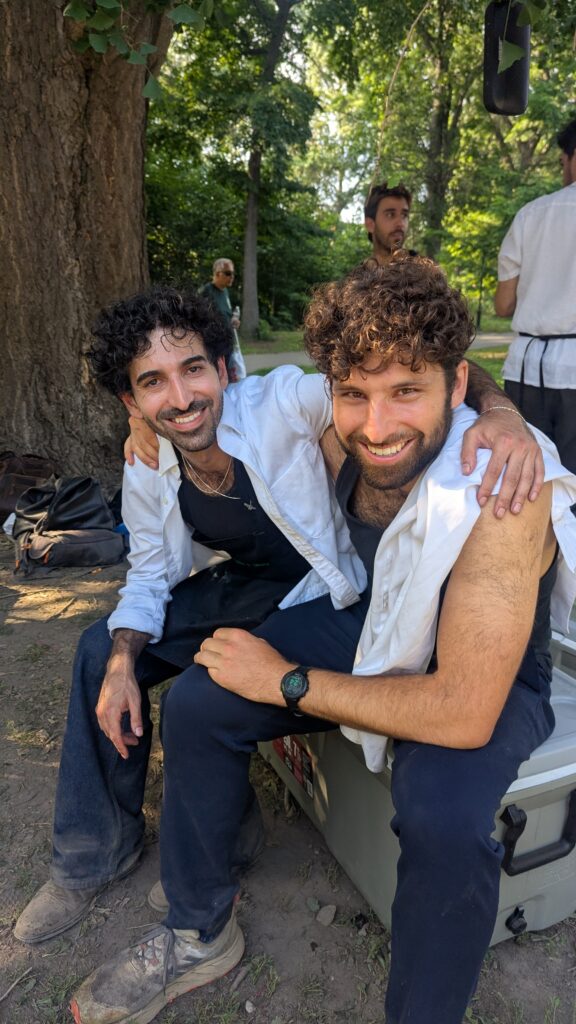
Arman Irani (left) and Joe Aste of Sumac & Smoke. Photo by Abe Beame
Case in point are two Iranian pop-ups I stumbled upon a few weeks ago: BiBi Bakery and Sumac & Smoke. They are the brainchildren and passion projects of Lena Derisavifard, a former Global Health Care Coordinator from Texas, and two old friends from Southern California, Joe Aste, a prep cook at the Williamsburg wine bar Rude Mouth, and his partner, Arman Irani, a computer science PhD who works full time in AI safety for media bias and misinformation. Derisavifard moved to New York and remade herself as a pastry chef, and now she is the founder of BiBi Bakery, her full-time concern, which specializes in inventive, Iranian-inflected pastries. Aste and Inrani started Sumac & Smoke, a pop-up dedicated to simply grilled meat.
Sumac & Smoke specializes in a cuisine I’ve heard commonly referred to by Arabs over many years around the DMV area, particularly the Iranian enclave in Northern Virginia, as “Persian Kebab.” With all the diverse Middle Eastern cuisines and styles of restaurants around New York, it’s always been somewhat bewildering to me there isn’t much of it here, even as a wave of wonderful, high-end Iranian restaurants has arrived in Brooklyn. Whenever my wife and I are in DMV, we seek out Persian Kebab, so when Sumac & Smoke began popping up on our timelines independently, we knew we had to check out their next event, which ended up being on July 26, on the far side of Prospect Park.
As is always the case, we didn’t get out of the house early enough that Sunday, and didn’t realize the pop-up was free, which meant there was a mile-long line snaking through a field in the park near the Bartel-Pritchard Square entrance, and my wife and I took turns waiting on line as our kids fucked around reading comics and getting on each other’s nerves on the grass. Their wait was aided by BiBi Bakery’s unbelievable chipwich varieties, also free: a baklava cookie made from the edges of chef Lena’s baklava trays, sandwiching brown-butter ice cream with chunks of baklava in it, and saffron and vanilla ice cream rolled in rose petal between discs of wafer.
There wasn’t much to do in line but watch, so I did, as an army of young men, mostly shirtless under their matching black aprons, manned the grills on a 90 degree afternoon, fanning coals that had to be replenished every 20 to 30 minutes, grilled swords spearing molded hunks of lamb-blend koobideh and corn cobs that would both be brushed with saffron butter, setting plates with thin sheets of lavash, sprinkling crimson sumac on the final product before handing over the plates. From the time I arrived until I left several hours later, a party was gathered off to the side of the grill and food service area. Middle Eastern pop blared on a Bluetooth speaker, and a multigenerational crowd of men, women and children—in halter tops, in cut-off denim shorts, in head wraps, sporting keffiyas, tattooed with henna, waving Iranian flags—danced in a large circle, the crowd celebrating each needle drop, chanting along to the hooks in Arabic or Farsi, the women waving their hands in the air, mirroring the flames curling and hissing as butter and lamb fat fell off the kebabs and filled this corner of the park with their scent. With the current horrors facing the Arab world, the loving embrace of community was hard not to be touched by.
As the afternoon wore on and I inched closer to the grill, a woman doing a sporadic headcount eventually warned me I was just outside of where the food supplies would likely last, but I decided I had waited this long, and it smelled so good, I would hold out till the bitter end for some fucking kebab. What began happening was the lucky people being served requested smaller portions so the people behind them could get some koobideh. I was not only served, but so were many of the people behind me. A woman eating her kebab near the grill as mine was being plated nodded approvingly and remarked, “Arab hospitality.”
As I sat in the grass passing the impossibly moist and flavorful kebab around in a circle with my wife and children, Sumac & Smoke finally ran out of product, and the hot and tired chefs skipped over to the crowd of revelers, who greeted them with wild cheers as they dove into the center and danced arm in arm in a circle.
It was the kind of afternoon that reminds you why it’s so important to occasionally shake your routine of cooking, delivery, and the safety of the go-to neighborhood restaurants you can rely on to make your kids happy, and chase the elusive magic of a great summer pop-up in Brooklyn.
(This interview has been edited and condensed to make me sound like less of an asshole.)
How did the Prospect Park event come about? Was there sponsorship? How do you pay yourselves for something like that?
Arman: We started Sumac & Smoke in October of last year, very low-key in a park with lots of friends coming out, and that was something we wanted to get back to doing: something accessible for everyone, something where the food is free and people can just come out and enjoy the park and the weather and everyone around them. So we basically put most, if not all of the money that we had made from previous paid events and a few catering gigs we’ve done towards the ingredients, and everything went into this event. It was just a big park hang.
Joe: We did a free event back in April, this past spring in McCarren Park, so that felt like a full-circle moment for us being able to again do something for free, bring people together around the Persian New Year and the spring equinox. When we put that event together, I think, in the back of our minds, there was always a thought that this would be a lot of fun to do again, as long as it continues to be financially feasible. We wanted to put money back into the community and bring people together, so that was the thought process.
What are your backgrounds, both culturally and with Persian cuisine?
Joe: I’m a quarter Iranian on my mom’s side. My dad is a mix of Italian and Irish and French but really loves Iranian food and culture and has immersed himself. My mom’s father immigrated from Iran to Canada and then to Michigan, then retired in San Diego. So that was the other culture I was able to interact with and be in touch with and experience, eating my grandfather’s kebabs growing up. He would barbecue often, mostly koobideh, which is lamb, and joojeh, which is saffron chicken. We would go to his place in La Jolla usually once a week. Those were early informative experiences for me, and I definitely learned a lot from just watching him and watching some of his techniques and then getting to try it for myself.
Arman: My parents both immigrated. During the revolution, my mom first went to London and then the United States, and my dad grew up in India, but he’s Iranian by descent, then he went to university in the States.
Growing up, it was a lot of driving up to Orange County to visit my grandparents when they would make stew after stew every weekend. There was a lot of home cooking. I really didn’t have fancy Iranian food growing up. It wasn’t until I moved to New York and Joe and I started hanging out almost every day and we would go up to his rooftop and grill up chicken kebab and koobideh that I realized, like, damn, this can be really good.
Lena: I’m Iranian American. My parents both came here from Iran; I was born and raised in Texas and moved to New York about 10 years ago. I started BiBi Bakery in 2022 as essentially a way to honor the resilient Iranian women who raised me. It’s really a love letter to them; they’re the ones that taught me about Iranian food and flavors. And I wanted to start a business to challenge single story narratives about Iran and the Middle East, and share the really strong elements of Iranian hospitality with people around Brooklyn.
I really didn’t have fancy Iranian food growing up. It wasn’t until I moved to New York and Joe and I started hanging out almost every day and we would go up to his rooftop and grill up chicken kebab and koobideh that I realized, like, damn, this can be really good. —Arman Irani
I just want to make the distinction that I use “Iranian” specifically, instead of Persian, when I talk about my business. Persian is the majority, but personally, I like to use Iranian to be more inclusive of the vast diversity that is in the country, so I just want to put that little asterisk up there.
Could you walk me through some of the technical elements of your cuisines? What is R&D and experimentation like for Sumac & Smoke, as well as BiBi? For the Sumac guys, I thought that final brush of butter was really interesting and something I’d never seen before. Is that traditional?
Joe: We’ve learned so much since we started. A lot of information we gathered was from the internet, from Instagram and YouTube. Our “For You” page, whatever you want to call it, is full of videos of chefs in Iran making kebabs, because we just watched so many trying to figure out, what are these guys doing? What are the differences? What are the cuts of lamb they’re using? What’s the onion-to-meat ratio? Are they putting saffron on it? Putting eggs in the blend? Are they just using salt and pepper, because some people season really simply? A big moment was Arman realizing we’d been searching for koobideh recipes only in English. What if we search on YouTube in Farsi so we could find YouTubers from Iran making these videos?
And the thing that we’ve learned is everyone does it a little bit differently. Everyone has their own little trick or niche thing that they figured out that works for them, and for now, this is ours. We’re still open to learning and adapting. The butter being brushed on the kebabs was not something I had growing up but something that we saw consistently in these videos, and we tried it and, and we loved it, especially with saffron butter, as a way to reintroduce the fragrant flavor of saffron right before you actually take a bite.
Arman: It’s been exciting for me, a way to bond a bit with my family. I have some cousins who recently immigrated from Iran; they speak very little English, and when I went back home last, they had heard that I started this pop-up, and they got super excited. They’re like, “We’re going to teach you how to make it just how we had it in Iran.” They were just really excited to pass on those recipes and ingredients. So it’s been a lot of research, and then trying to make it our own as well, because we’ve taken bits and pieces from so many different places, so it’s almost our own creation at this point. Kebab seems so simple, but it’s surprisingly nuanced, I would say.
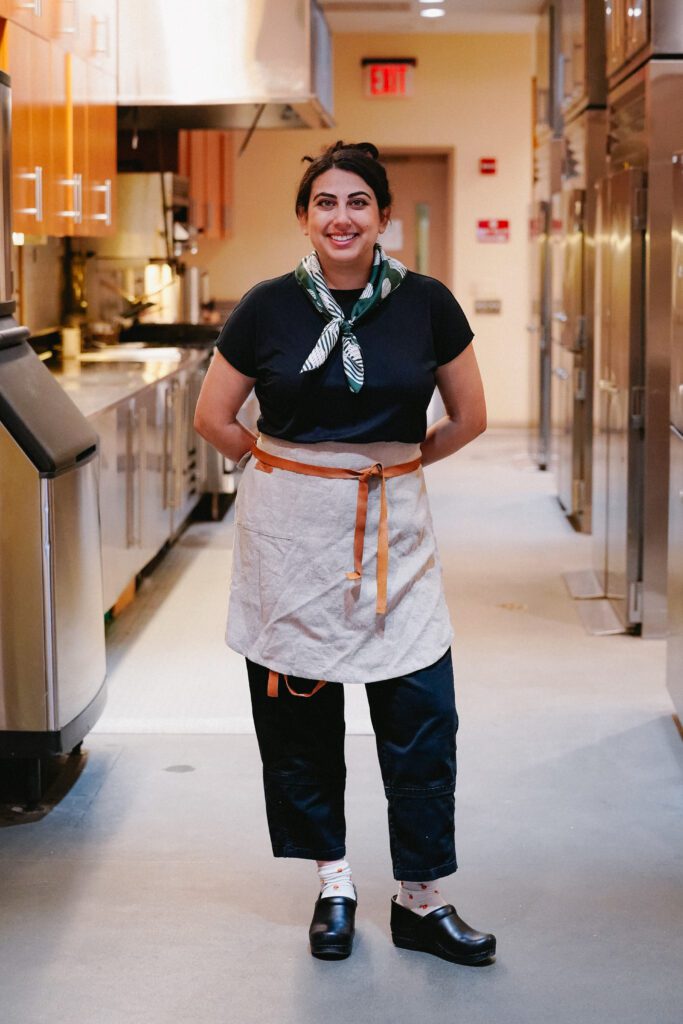
Lena Derisavifard of BiBi Bakery. Photo by Sima Jafari
Lena: I have been trying to build something that is authentic to my Iranian American experience. When I think about the food that I want to eat, it’s at the intersection of my American upbringing—everyone I grew up around had cookies, cakes, loafs—put to the flavors that really are nostalgic to me, like barberries, saffron, cardamom. So, essentially, I want to make the desserts of my dreams. Some of the items are more traditional, like our baklava, but a lot of our items are at that intersection. I am so grateful I live in New York, because there’s inspiration all around you. That is so helpful whenever I’m dreaming up something. I’m constantly finding new things and thinking, “X would really go well with this other profile.”
We’re belatedly getting an Iranian restaurant scene in New York, but many of these places are more formal and high-end. Sumac & Smoke seems to be addressing one of the more bizarre gaps in our casual offerings by serving “Persian Kebab,” which is a genre that is plentiful in enclaves in areas like Southern California and Northern Virginia, but is lacking here. Do you have any explanation for why New York has a plentiful supply of seemingly every kind of restaurant but not that?
Joe: I wish we had a clear answer, but we haven’t been able to figure it out. It’s a bit strange. I haven’t been to the DMV, but I’ve seen videos and some of the restaurants. I’ve explored Google Maps and just felt jealous. I went to Montreal recently and it felt like the options were so much greater than we have in New York, and I thought if I was living there, I don’t think I ever would have actually started Sumac & Smoke. I would have just been happy with what is available to us.
I love some of the Persian food here in New York. I don’t know why there isn’t more “in-between options”—something more casual or a little bit less formal. I think that was an issue we didn’t realize New York had, that we were filling a gap when we started, but it really quickly crystallized that, wait a minute, there’s all these great Persian places, but some of them you need a reservation weeks in advance, and it’s a little less affordable. I think a big part of what we wanted to create when we started was the energy of Persian picnics and gatherings that we went to growing up as kids.
Arman: I didn’t even really know that there were Iranians in New York City until around the time we started doing pop-ups, and they came out the woodwork and showed appreciation for what we were doing, and I think that’s why it has started to take off a little bit. I think the last two years or so, especially, there’s been a lot more community events celebrating the culture and community.
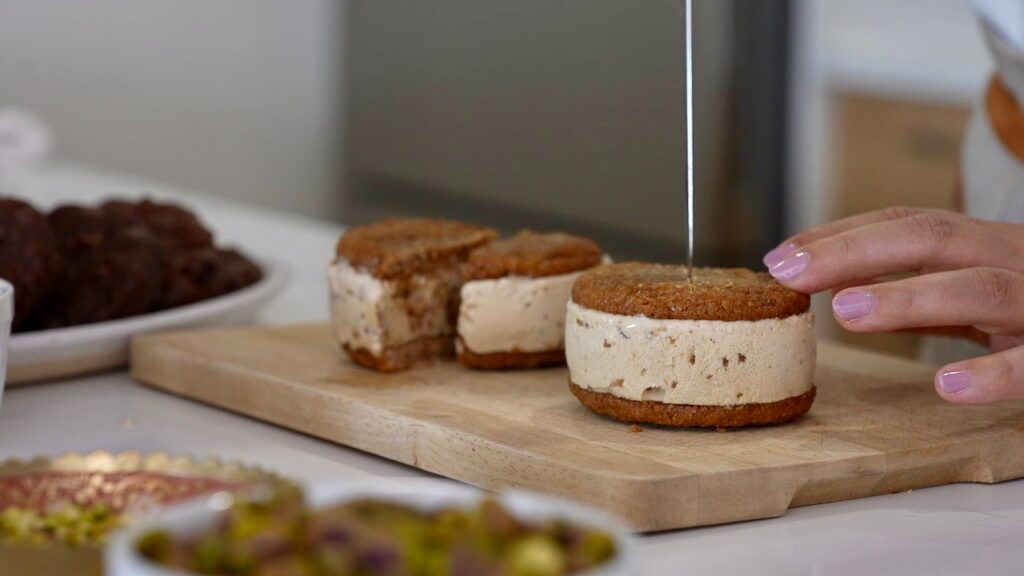
BiBi Bakery ice cream sandwich. Photo by Nilu Amin
Lena: I can only make assumptions here, but I think in the DMV area, or LA, or Toronto, there’s larger Iranian populations, so I think there is more diversity in the types of Iranian cuisines you can access. It’s not just sit-downs like Eyval or Sofreh or Masquerade, because there’s just more obvious demand for everything from sit-down to grab-and-go to grocery stores if you have a larger diaspora. That’s a one to one where it’s like, we’ve got a lot of Iranians, so we’re going to have a lot of different types of restaurants, from sit-down to grab-and-go to grocery stores. We don’t even have an Iranian grocery store I’m aware of in city limits. So we are always going to Arab stores like Sahadis.
Over the last few years, since I’ve started BiBi, we’ve done a number of community events, because part of what I’ve wanted to do is also build the community that I didn’t have growing up in Texas. And I think a lot of younger New York City transplants have been coming out of the woodwork because they also feel a similar desire to be around people within the Iranian community.
Let’s talk about that community. With everything that’s happening in the world at the moment, what have these events and their ability to bring together the Iranian diaspora in New York meant to you?
Lena: I think that it is important to be able to have spaces to be seen and for people to come in and experience joy. It felt very cathartic. I haven’t really done a lot of events in the last year because I’ve been really struggling with whether or not it’s appropriate. But it’s been really wonderful to be able to be around my community, and a lot of the feedback has been thankful for creating a space. It’s just really nice to be around people within your communities where you don’t have to explain what you’re feeling and there’s a shared understanding of your experience.
I think that it is important to be able to have spaces to be seen and for people to come in and experience joy. —Lena Derisavifard
Arman: At the event in Prospect Park, I remember being at the grill and hearing people asking for less so the people behind them could still get a plate. That idea isn’t restricted to Persian culture, but there’s this idea called tarof, which is a culture of graciousness and politeness and offering, and it’s been ingrained in us, this whole big thing of people being selfless. And that’s something that’s been really evident at all our events. And I think it’s because we’re bringing people together, and bringing our community together. It’s something I realized through this experience is really meaningful to me. It’s been really magical.
What are your ultimate ambitions for your businesses?
Lena: For the last three years, our biggest events have been in Smorgasburg. We started out with some online orders and some markets here and there, then we got into one of the urban space holiday markets, and then Smorgasburg. Slowly, as we’ve gained momentum, we’ve increased our online sales. We do catering, we ship our baklava nationally, and now we’re actually looking to open our first storefront. So, for the past year, we’ve been working on that next chapter.
Joe: We approached our first event with the question in mind of how it made us feel. Do we actually want to do it again? And that’s been a defining question for us as we’ve continued to put events together: Does this still feel good? Does this still, especially, amid some of the conflict in the Middle East and in Iran, feel appropriate? So we’ve continued to ask ourselves questions of that nature, but there’s never been a set goal in mind, like, we want to open a brick-and-mortar by X date or time. There is an idea or vision of maybe having a small market or grocery store where we’d be able to continue doing pop-ups but also sell goods that you maybe wouldn’t be able to find elsewhere, specifically Iranian goods. But nothing is concrete at the moment. We keep taking it one day at a time, and conversations like this help us clarify why we do what we do and give us the chance to let people know how much we care about the community.
There is an idea or vision of maybe having a small market or grocery store where we’d be able to continue doing pop-ups but also sell goods that you maybe wouldn’t be able to find elsewhere. —Joe Aste
We end every interview by asking the chefs what the last great dine-in or takeout meal they had in Brooklyn was.
Joe: I want to shout out Eyval in Bushwick. I went there recently with my partner, and she had emailed them asking if we could get a reservation. She knew they were booked up, so she name-dropped that I happen to be involved in Sumac & Smoke, and they got back to her with a table for two. I didn’t think too much of [it],, but we went there and their chef Ali sent out a bunch of extra plates for us, and that was a special, celebratory moment for us, to get a little recognition from someone we really respect whose food I really enjoy. Whenever my family is in town and they want Persian, that’s what I recommend.
And then I’ll shout out A&A Bake Doubles. It’s my favorite Trinidadian restaurant, and I’ll put my life on the line for them. If they are getting robbed, I’d fight for them. That place has fed me for such affordable prices for so long, and their food is so good. I love A&A.
Arman: I have to echo what Joe said about Eyval. Great food and great atmosphere.
There’s a place I went on a whim, after your birthday, Joe. We started the day in Prospect Park, then we walked over. It’s called Ix—Guatemalan place. Oh my God, it was amazing. It was so good. The ambiance as well. There was a reggae band playing; kids were dancing and interacting with the musicians. Great vibe because it was Joe’s birthday and we had friends all around. Definitely a highlight for me and I need to get back there because their food was so good.
This makes so much sense because you’re a stew guy.
Arman: Exactly!
Lena: I mean, I had a great kebab from Sumac & Smoke a couple of weeks ago.
But one of my recent new favorites is Huda. We’re in New York, and I want to try every place, but Huda is a place that I cannot wait to continuously go back to, because every single time I go, the service is great. The people are so wonderful. The food is incredible. Great vibe.
I just feel so grateful that they’re open and it has such a nice balance of—it can be a special night out, or you can just sit at the bar as a solo diner and have a lovely night. It nails relaxed, comfortable, and casual, but elevated.