Courtesy of Pacha New York
Pacha Cuts Ties with Brooklyn Mirage, Unveils Final Stage Design After Liquor License Win
Club execs turned on the charm and outlined their safety commitments to ensure the booze could flow freely this season
Pacha New York cleared a crucial hurdle ahead of its June 13th opening on Thursday, unanimously securing a temporary liquor license from the State Liquor Authority and dissolving any remaining associations with Brooklyn Mirage.
What began as a tense hearing—with Pacha representatives grilled and residents testifying against the club—gradually softened into something closer to camaraderie.
Initially combative, Pacha’s lawyer Max Bookman was repeatedly reprimanded during a meeting that at times felt like a public scolding. One neighborhood resident testified that Pacha’s sound checks have already been notably loud. SLA Chair Lily M. Fan started the meeting by sharing countless letters opposing the club and noted that Community Board 1 had already voted to deny their application.
As uncertainty mounted, the Pacha team called in Andrew Axelrod of Axar Capital Management—owner of the former Mirage site at 140 Stewart Avenue in East Williamsburg, now home to Pacha—on short notice. He arrived late, in jeans, prompting an on-the-record apology from Pacha’s attorney for his informal appearance. Still, the Ibiza-born nightclub was unanimously granted a conditional temporary liquor license.
The approval allows Pacha to legally serve alcohol while its full application is processed. The company also agreed to surrender Avant Gardner’s existing license, formally severing ties with the previous tenant.
Pacha ultimately won approval in no small part due to Kabir Mulchandani, CEO and founder of Pacha’s parent company FIVE Holdings, whose years of boardroom cool were evident in a measured tone and steady posture as he addressed concerns, promising accountability, and methodically winning over members of the SLA board.
It didn’t hurt that Mulchandani also pledged $27 million toward safety and community initiatives over the next 10 years, as well as $3 million dedicated to Brooklyn-based community projects.
The mood in the room noticeably lightened as the hearing went on. Fan reminisced with Mulchandani about possibly crossing paths at Limelight in the ’90s, while Commissioner John Maya bonded with the Dubai-based businessman over their shared ties to Syracuse University—Mulchandani’s son attends the school, while Maya graduated from its College of Law in 1992.
“My son, which is why I ended up looking at this venue, was in Syracuse,” Mulchiadini said. “I came here to drop him off at college, and I ended up buying a club.”
“Well, you know, parents are thoughtful,” Fan said, smiling.
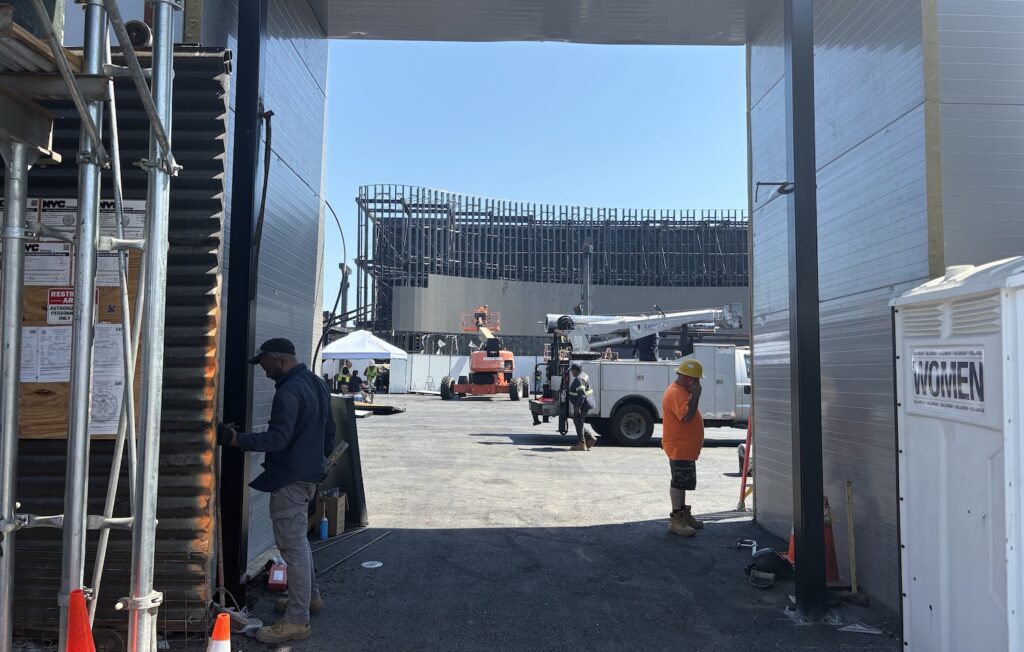
Pacha New York settling into 140 Stewart Avenue (Photo by Scott Enman)
The conditions
The temporary liquor license comes with strict conditions, and Mulchandani acknowledged that if those aren’t met, their license could be revoked. The venue must hold a public walkthrough on June 8 with all three surrounding community boards, along with residents who previously testified against the club. Pacha must submit proof of their temporary Certificate of Occupancy from the Department of Buildings, as well as all required Fire Department safety certifications.
Pacha is prohibited from holding 24-hour parties, street block parties, or using third-party promoters, and it must also carry out street cleaning and spraying within a three-block radius after events. To manage capacity, the venue may not cross-sell indoor and outdoor events. Outdoor parties are capped at roughly 5,300 people, while indoor ones are limited to around 2,500. Pacha was explicitly told that they may not oversell tickets—like Mirage did—or rely on projected “no-show rates” to exceed occupancy limits.
In addition, the venue is required to maintain monthly reports tracking ticket sales, sound complaints, incidents, security observations, and capacity levels to be submitted during the formal license review. A complaint line must also be listed on their website. Finally, the venue can only host one show per night, except during select holiday weekends, and cannot use pyrotechnics at any events.

Photo by Scott Enman
A glimpse at the future
The meeting also shed light on several aspects of Pacha’s vision for the venue and how it plans to operate. Mulchandani revealed that the former Kings Hall space will be used as an infirmary for clubbers and that Pacha will use its own private ambulance for emergencies.
Mulchandani also hinted at long-term plans to transform the open-air venue into a fully enclosed club, pending approvals. The topic arose as Fan warned that persistent noise complaints could prompt the city to require a roof over the venue.
“I’m going to tell you now, if the sound pollution is very severe, I’m going to ask you to build a building there,” she said. “And you can probably afford it.”
“Well, subject to DOB approval, that’s actually part of the plan,” Mulchandani responded.
By the time the hearing reached its closing moments, what had begun as a standoff had shifted dramatically—with Mulchandani drawing increasingly effusive praise from the commissioners and chair. “I didn’t know that I would ever say this,” Commissioner Edgar De Leo said. “I’ve been here for two years. And Mr. Mulchandani, you couldn’t have said it better than Mr. Bookman himself today. Thank you for clearing up a lot of issues.”
It was, in its own way, the kind of performance that might have earned an encore, if regulatory hearings had them.