Photo by Alex Lau
Open Kitchen: Chef Eric Sze Wrote The Cookbook of the Year, Maybe The Decade
Chef and 'Taiwanese?' author Eric Sze on his boldest gambit yet
Open Kitchen is a monthly interview column covering the joys and frustrations of Brooklyn restaurant operation in all its many forms.
Annoying lines in New York, particularly on a mid-October Saturday in neighborhoods like Greenpoint, are not novel. But it’s Taiwan Independence Day, and these sidewalks are choked by lines formed for a time-sensitive promotion: A single chef collaborating with four other local restaurants to offer a special, one-day-only Taiwanese-influenced menu item while supplies lasted. There’s a Taiwanese Sausage Breakfast Burrito from Border Town, a Cream Cheese Chili Oil Tripe Focaccia Sandwich from Radio Bakery, Bourbon Black Bean Soy Sauce Glazed Smoked Pork Belly Rice from Kirbee’s Bar-B-Q, a Hakka Pork Jowl Tomato Pie from Chrissy’s Pizza, and Pig’s Blood Cake On A Stick from Wenwen, whose proprietor, Chef Eric Sze, has orchestrated this cheekily titled “G Spots Food Crawl”, named for the outer borough green line that serves as the main mode of public transportation into and out of the neighborhood. Punch cards were printed and issued for those with the time, energy, and appetite to hit each location, purchase each special, and get their card stamped. Completed punch cards qualified for entry into a raffle for a paid trip to Taiwan.
Supplies did not last long. The lines stretched down blocks and around corners for hours. One by one, each restaurant taped signs to their windows and doors informing disappointed customers that they were out of product. I made it to Greenpoint at what I thought was a fairly reasonable hour (11 a.m.), intending to make a few of the stops, but quickly realized I was hopelessly late and decided to shoot for the most realistic option: The pizza at Chrissy’s, which didn’t go on sale until they opened at noon. I landed slightly before the roving band of completists drifting from line to line, up and down Brooklyn’s northeast peninsula, and managed to secure a pie after a two-hour wait. The special was a beauty, with Chris Hansell’s trademark thin, sturdy crust serving as a canvas for the flavors of a fruity, spicy, porky hot pot conjugated to pizza form. Savoring each bite of the slices I had waited for, I thought about how the pizza, and the entire event, could only be the deformed, brilliant brainchild of Chef Sze, arguably the foremost ambassador of Taiwanese food in America, as well as America’s digital food sphere.
Sze is a maverick and iconoclast who has run his businesses and personal brand with open and honest transparency, bringing the diner or follower into his goofy and brilliant thought process and decision-making, which covers everything from menu changes to restaurant closures. Since his first venture—a beef noodle soup delivery service he started in his dorm room at NYU—through There’s the Tang, 886 and Wenwen, his food has always struck a balance, honoring “traditional” Taiwanese culinary heritage while applying a spirit of adventure and a healthy dash of “Fuck it, why not?” to his menus, special events, and the experimental pop-up collaborations he runs with other chefs, commingling his native classics with Italian or Mexican or whatever he’s interested in at the moment and producing delicious mutant expressions that wow on the plate as well as the timeline.
Chef’s boldest gambit yet is his debut cookbook, Taiwanese?, a labor of love that he has invested years of blood, sweat, and money into along with his co-author Elyse Inamine and photographer Alex Lau. The book spans the globe and the past to present a discordant, chaotic, delightful picture of Taiwanese food on its native soil and how it has been interpreted and misinterpreted abroad. The book is populated with love letters to beef tendon, yellow fat chicken, pig’s blood cakes, stinky tofu, Tainan garbage noodles, mango shaved ice, short grain rice, Oh Ah Mee Swa, trotters, daikon, milk fish breakfast soup, and of course, popcorn chicken. We read along as chef chases the taste memories of his childhood, with stops at Taipan food trucks, vegetarian udon shops, convenience stores, karaoke rooms, noodle stalls, steam baskets rigged to the back of bicycles, and bars built out of Japanese diplomats’ colonial homes.
It’s a funny, self-deprecating autobiography that perfectly captures Sze’s voice, a book of science and philosophy that tells his story as a Taiwan-born, self-identifying “GMO Asian” who was molded as a chef by his father’s gluttonous pathos and his mother’s rigorous, detail-oriented ethos. It’s an educational, utilitarian, wildly entertaining text, the perfect receptacle for Sze’s hyper-specific passions and takes, and that’s what makes Taiwanese? more than the best cookbook I’ve read this year; it’s the best cookbook I’ve added to my library this decade. I got Sze on the phone recently to discuss the years-long process of writing the book and why he had to see it through.
(This interview has been edited and condensed to make me sound like less of an asshole.)
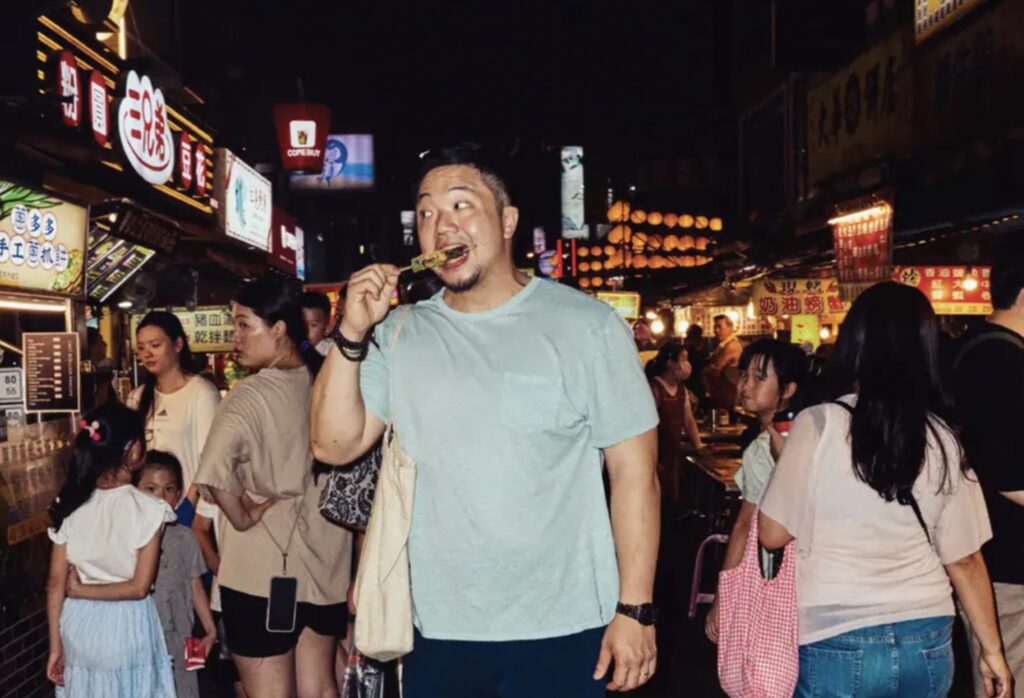
Photo by Alex Lau, courtesy of Hardie Grant
I was blown away by the book.
Chef Eric Sze: Thank you. That means a lot. We spent four years on it.
What were some references you discussed with your co-writer as inspiration?
When I’m doing research, it’s always online. I’m a visual learner. But Elyse is a massive cookbook nerd. So I knew I needed to work with her, and I’d be in safe and good hands because she has such a vast knowledge of conventional cookbook style.
Elyse and I spoke at least, I want to say, three-to-four times a week for two hours a call to brainstorm for the first three months, before she even wrote anything down. I could just shoot her memes on Instagram in the middle of the night, and she would immediately get it. In the beginning, it was such a hot slab of mess, and the way she repackaged it together into a coherent and linear story, it’s crazy. I wish I could take more credit for it, but really, Elyse came up with all of this. It’s my story. It’s my restaurants. It’s my food. But she formalized it all. I cannot take a single shred of credit for that.
Inspiration-wise, when we discussed photography with Alex, he brought up that when they shot Koreaworld, it was on location, which made it feel more vibrant. There was more energy; it didn’t feel staged. And so I knew from the get go that I wanted that.
It feels like you invested a tremendous amount of time, effort, and money into the book, which you can really see on the page. From my understanding of how the modern publishing industry works, with the travel and the time spent, I can’t imagine that you made much money on this endeavor. How did you pay for it, and how do you justify the investment to yourself?
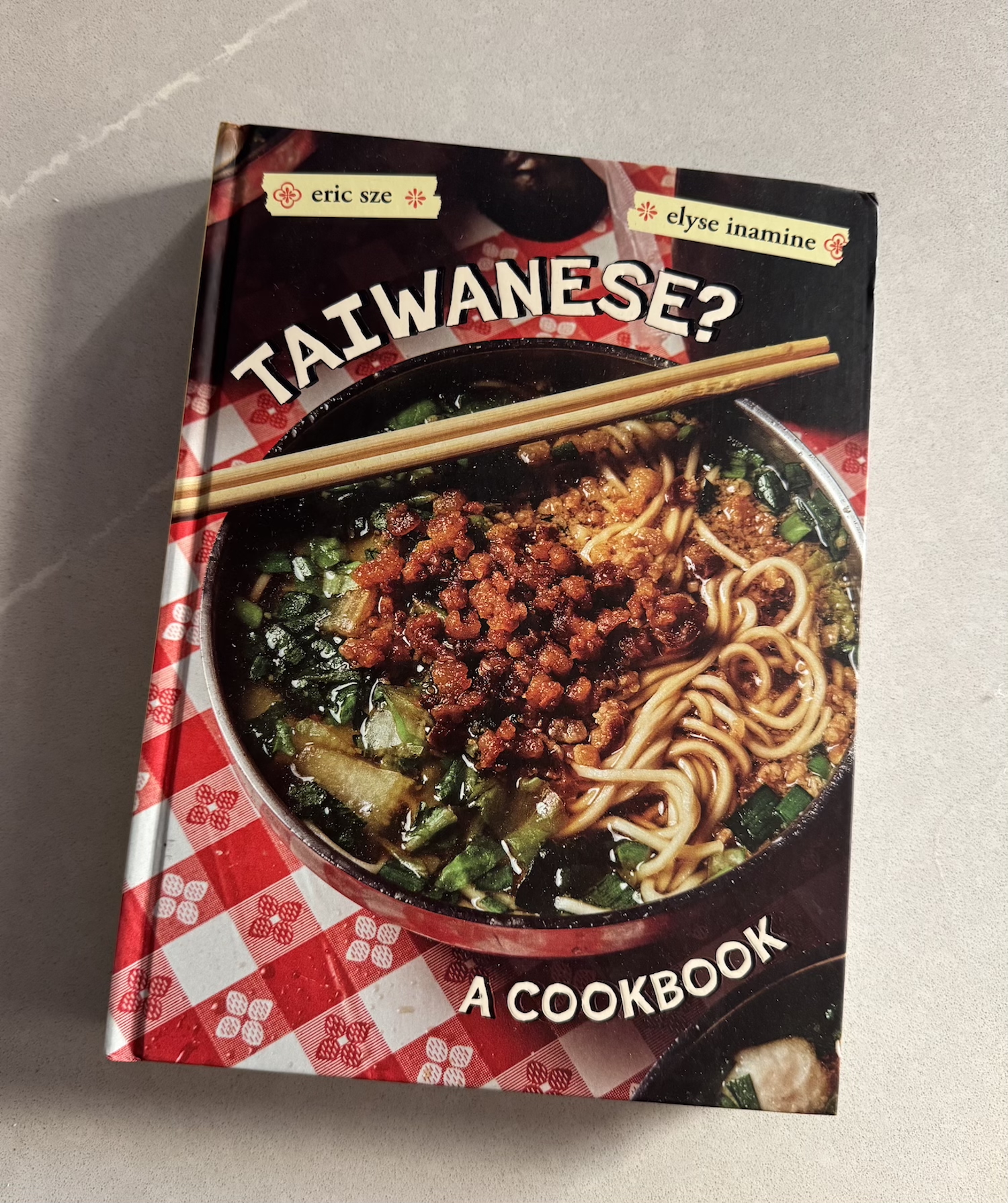
Photo by Abe Beame
Well Abe, it’s because I am stupid and irresponsible. I had known I wanted to write a cookbook because of my own ego, and I’m willing to face it. And if I want to stroke my own ego, then I gotta make it happen in the best way possible. To be real frank with you, our proposal got rejected several times, and we didn’t get exactly the advance that we wanted to get, so we took the rejection as fuel to write the best book we could possibly write, to shoot the best book we could possibly shoot. I know I am stupid because I took those rejections as inspiration and set a weird abstract goal for myself to make those publishers regret not buying our book. It was why I didn’t care about the cost of anything.
Did you get any sort of sponsorship? Were there companies or organizations that helped offset the cost of travel, including this trip you’re raffling off?
No.
(Laughs) Amazing.
Zero sponsors. The biggest cost of the book, by far, was the trip to Taiwan, as you can imagine. Three people flying from New York to Taiwan, staying in hotels, traveling everywhere. Food, thankfully, was cheap in Taiwan. But it got to a point where I just kind of stopped tracking the cost. Because I knew that there was no use. Elyse and Alex were very understanding. They didn’t ask for business class flights. Alex actually paid for his own flight. After we finished photography, we were in Taiwan for just shy of two weeks.
How should I put it? It was a very unorganized yet efficient shoot in Taiwan. But once we got back to New York, we basically had no more money left, and I was in the midst of closing one restaurant. So I didn’t really want to take too much money out of my own pocket to do this project, but it turns out I didn’t have to, because we just shot everything else at Wenwen because we didn’t have money to rent a studio, let alone a food stylist. So I styled all the food. It was a lot of going to Chinatown and picking up weird textures. Alex would be like, “Yo, we need blue.” So I would pick out a blue background. Or he was like, “Newspaper!” The scallion pancake breakfast wrap? The background is literally just aluminum foil, and we shot that in my apartment. I can’t believe how nice it looked. It was about being super scrappy.
I think now looking back, having no budget to work on this book allowed us to be extra creative. We had to squeeze something out, and it pushed us to really find the beauties in the nooks and crannies to make this book beautiful. And, needless to say, Alex and Elyse took a massive pay cut to make this book with me.
So, if I may just come to your defense a little when it comes to what the book cost you, I had an interesting experience at the G Spot food crawl. I was on line at Chrissy’s on Saturday. I was supposed to go with a friend, but neither of us realized how early they would have to be to get pizza, so they couldn’t make it. So I was by myself, standing in front of this kid, and I saw he was by himself, and I got him to agree to split a pie.
We got to talking over the hour or two we spent online. And what was fascinating is he had come from Great Neck for the day to do the full food crawl, and he had no idea that you own a restaurant. His relationship with you is entirely based on your food content online, which is funny because I only knew you as a restaurant chef. I didn’t realize that you had this impressive social media footprint.
I tell that story to ask: On some level, do you think about the book as a potential investment for yourself as a brand that lives outside the immediate promotion of Wenwen?
Of course, I’d be lying if I said I didn’t, right? It is an odd investment in my career, even though it will not return financially immediately. I think it’ll pay me back in different ways down the line, which is why we really took our time and made sure that this book is the best it could be.
We’re in a day and age where to have a shot at being successful, you need to have an online presence, and I’ve been fortunate because I started relatively early on. My friends at BuzzFeed put me on YouTube, when we first opened 886 in 2018. And then Munchies was still around, Eater was doing great, Bon App; I didn’t start doing that until recently, but I consider myself very fortunate in that respect, to have had those experiences. And I’m still trying to find ways to bridge the gap between that kid and you, so everyone knows that I have a restaurant and we can fill that 5 o’clock seating every day.
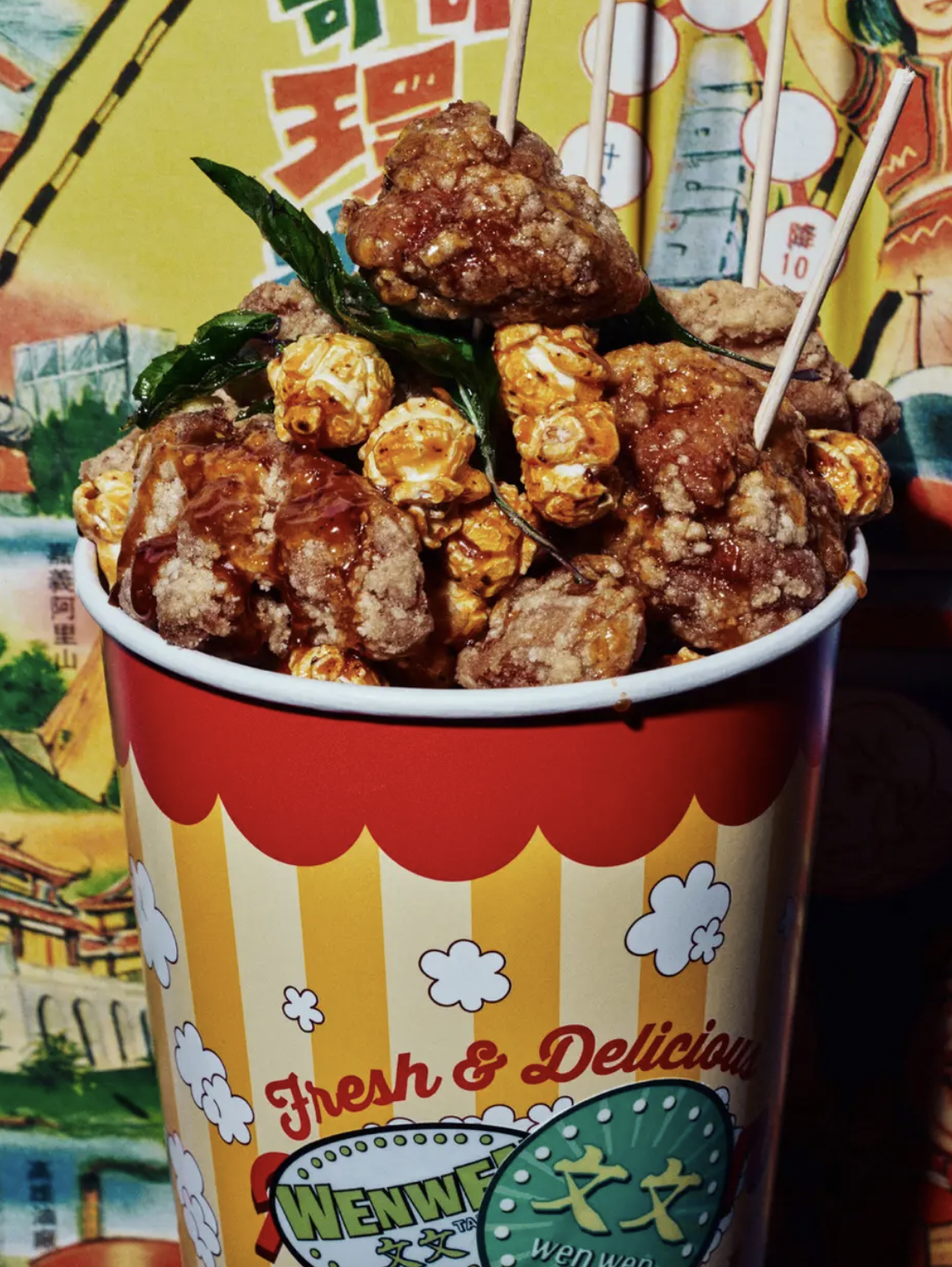
Photo by Alex Lau, courtesy of Hardie Grant
I feel like the more I learn about Taiwanese food, the less I understand. In the book you write something that I thought was pretty profound, which is “Taiwanese food and identity was forged out of survival and happenstance.” Could you expand on that and attempt to articulate a sort of unifying theory of Taiwanese cuisine?
It’s funny you ask, because that’s what the question mark in the title of my book is for. I’ve been running Taiwanese restaurants for the better part of a decade now, and I have no idea. I truly have no idea. And the more I learn, the less I know.
Taiwanese food is happenstance because it’s been forged through a very brief history. Before Japanese colonization there were just two categories: Fujianese cuisine, as well as indigenous Taiwanese cuisine. Then the Japanese came and implemented a bunch of changes. They brought miso, they brought yellow soybean and soy sauce production to Taiwan. They changed the dominant grain from long grain jasmine to short grain. They lightened the palate a lot more. They built agricultural infrastructure for shrimp farming, oyster farming, all within a 50 year time period.
And then after the Japanese left, the mainland Chinese KMT came, bringing an onslaught of different regional Chinese cuisines. You have Xian, the Sichuan, the Canton, the Shanghai, they all came from China with the KMT. It was an Eastern Asian melting pot of cuisine. Then you bring in the Americans. Who brought ketchup, the American style of dining. Americans sort of popularized eating beef; that’s the theory anyways. Nobody can really prove it. There are crazy sandwiches that are clearly American, but bastardized. There’s fried chicken sandwiches for breakfast that are considered Taiwanese.
So all these things contribute to the impossibility of defining Taiwanese as a “cuisine.” There’s just no one heritage or history, and it’s because of the complex and brief historical explosion of cuisine that it’s all over the place. So you get popcorn chicken and then oyster omelets. You get the beef noodle soup.
It’s all these things, but it’s all Taiwanese, and I think my job—because we’re still such a young cuisine and such a young culture—is to make sure that people at least know what Taiwanese is. Some person in the future will be more talented than I am. Their timing will be better. People will already broadly know what Taiwanese food is. That person can then begin to identify it. I think my job is to capture as much as possible. And the next person’s job is to narrow and funnel things and organize it.
I don’t know, that was pretty good! We end every interview by asking the chef what the last great dine-in or takeout meal they had in Brooklyn was.
I really, really love Scalino on Manhattan Avenue. They are a mom and pop Italian restaurant. Best Chicken Milanese that I’ve had in New York. Also, Border Town.
I really like this Dominican place on India Street. My team and I go there. Sometimes I bump into our cooks there just grabbing lunch. It’s called El Manjar Dominicano. They’re delicious. Very economical. Big protein portions, super friendly people. Crazy good oxtail.
Oh, I can’t forget this one. My favorite, truly a guilty pleasure of mine, is Peep’s Kitchen. It’s Korean fried chicken. They’re now in Scrappeland, all the way north on Manhattan Avenue. Peep’s used to be at the Kirbee’s location, and I think their lease was up, so they moved to Scrappleland. And sometimes when I’m feeling extra gluttonous, I go order 3 drumsticks and 6 wings and have like 3 beers by myself.
Sounds great.
Yeah, I really should stop doing that. But, the fried chicken is so good. They fry it to order. So it takes a little bit longer, but the juiciness is just unparalleled.