Photos by Karen Almond for The Met Opera
Souls Confront Eternity in The Met Opera’s ‘Lincoln In The Bardo’
Missy Mazzoli captures the transient space between life, death, and growing around grief in her adaptation of George Saunders' award-winning 2017 novel
Some spend their time on this earthly plane practicing varying degrees of righteousness in exchange for eternity in paradise. If, for some reason, they don’t make it to the pearly gates when they pass, the second best option, depending on interpretation, is purgatory. The Metropolitan Opera stage is currently exhibiting a representation of this limbo in an adaptation of George Saunders‘ Booker Prize-winning novel Lincoln in The Bardo, running from October 19 to November 14. It’s in the care of Brooklyn’s own Missy Mazzoli, marking the Grammy-winning composer’s Met Opera debut and the first time the company has commissioned and premiered a new opera by a woman in 143 years.
Mazzoli is not unfamiliar with the phenomenon of being a “first, or one of few. Throughout her studies, she was often amongst a handful of women in her classes and notably never had a female professor of composition in her eight years of grad school. “I do feel the weight of [being the first woman] when I’m pitching operas to companies who often regard operas composed by women as ‘risky,'” Mazzoli says. “Looking at the current landscape, or when I’m traveling around the country teaching, I see classes that have no young women in them.” The field’s glaring overrepresentation of male composers was the driving force behind the Luna Composition Lab, a non-profit founded by Mazzoli and fellow composer, Ellen Reid, that provides mentorship, education, and resources for young female, nonbinary, and gender-nonconforming composers, ages 13-18.

Photo by Karen Almond for The Met Opera
Mazzoli focused on building the sonic world of the bardo, but she and the creative team shared plenty of trust and synergism, working mostly independently, during the construction of the set. “Royce and I have a lot of say in who the director is, and the director picks the design team. But I’ve worked with many of these designers before and know they’re the best, so I really aim to create a situation where everyone has the freedom to do their most creative outlandish work,” Mazzoli shares. “I don’t intervene unless it goes against the music.”
There were only a few instances in which Mazzoli felt compelled to offer her input to the design team. One pertained to the puppets and costumes that appear on Ms. Traynor, whose character transforms into a boiler, a witch’s mouth, and pig heads from one moment to the next. “The prototypes were impressive, but they obscured her mouth, and we needed to be able to see her mouth when she’s singing,” Mazzoli explains.

Photo by Karen Almond for The Met Opera
Originally, the show was meant to close with Lincoln and Thomas Havens riding offstage together on a live horse, but the horse had other plans. “It apparently takes a lot of time to get on a horse, so I had to write all this [new] music to account for that. And then the horse was too much of a diva and wouldn’t let them ride it, so we improvised. We kept all the new music in there and created a quiet moment where the dancers are lingering in the graveyard right before Lincoln and Havens close the show, which was a coordinated effort between myself, Lileana, and our choreographer [Raja Feather Kelly].”
Saunders’ 2016 novel is rife with parallels between our current point in cultural and political history and the moment it depicts: when the country was at its most divided in the midst of civil war. The myriad horrifying and concerning ways it mirrors our modern world made it hard for Mizzoli to ignore as a source. Saunders wrote the novel with the same idea in mind. “I think people are nostalgic for a time when a president could be deeply involved in real life…I felt in the theater there was a deep love for the country we used to aspire to be given the current mess,” Saunders says. “Lincoln’s election was very close; if the North had lost, its very likely they would have negotiated a peace deal to reinstate slavery. And like today, there’s so much hanging in the balance, and you really don’t know who your fellow countrymen are.”
The show has proven to be a risk worth taking. As audiences nestled into their seats, the flickering of short-circuiting lights and ominous hum of the orchestra signal the start. The ornate, sheer lace curtain goes up, and a gentle yet disquieting tide of violins, triangles, and wind instruments rises with it. The audience is soon confronted with its first subtle twist, the sound of kazoos being played by the ghosts that fill the stage. Set in 1862, as the sun sets on the grounds of Oak Hill Cemetery, ghosts wake and chatter in the bardo, a Tibetan word that describes a realm between life and death. The ghost chorus sets the tone, evoking an atmosphere of a restless, crowded, joyless place.
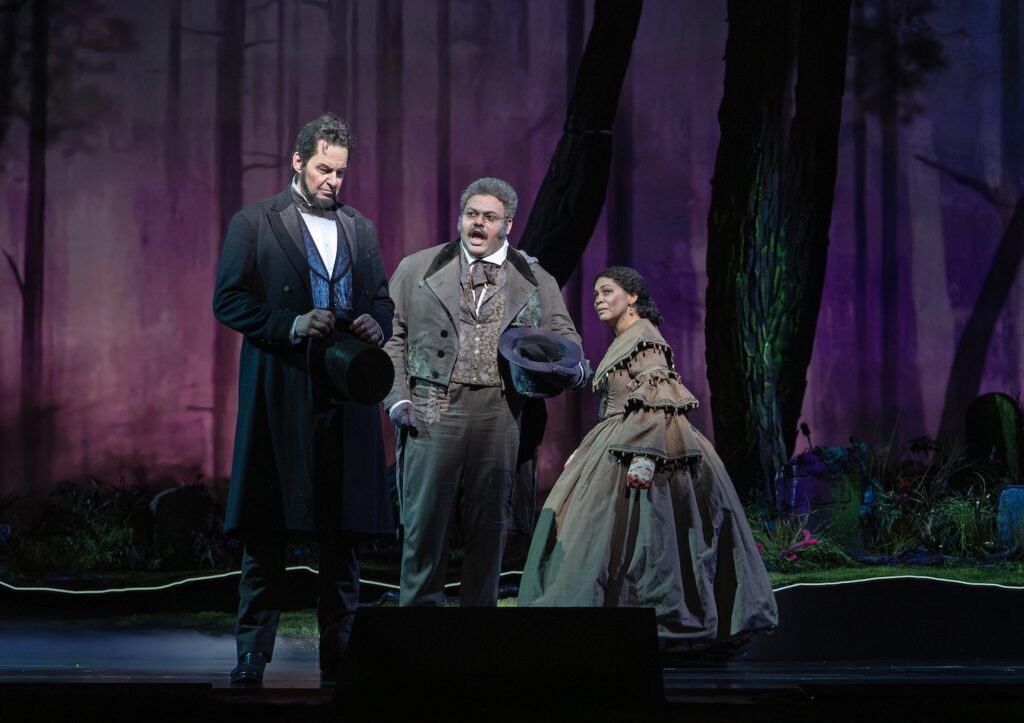
Photo by Karen Almond for The Met Opera
The idea for the bardo came about from a conglomeration of life experiences. From studying Buddhist beliefs about the afterlife, studying The Egyptian Book of the Dead, and being told about the experience of a close personal friend who was declared dead twice. In 2009, Saunders lived in an encampment for one week and wrote about his experience for GQ. He realized years after writing the book that residents of Oak Hill are represented by those he met in real life. “One of the details there was that, just like this graveyard, people didn’t want to be there, and since I was a newcomer, they all wanted to tell their stories, so I was kind of in the Willie role. This experience made it into the book, where people are there against their will and they want to go back to the other place where they were healthy, loved, protected, and had money.”
The opera makes great use of the age-old tradition of gender-swapping for the casting. “The idea for Christine [Goerke] came first… We asked her what her dream role was, and she said Peter Grimes, a tenor role always sung by a man in an opera from the 40s by Benjamin Britten. I thought that was fascinating,” Mazzoli says. “So I wanted to write a role where she can inhabit someone different—in this case a man—and be really funny. It’s a rule of thumb that if you make one unconventional decision, that you have it reflected somewhere else in the show. So that gave us the idea of working with Anthony as a corollary.”
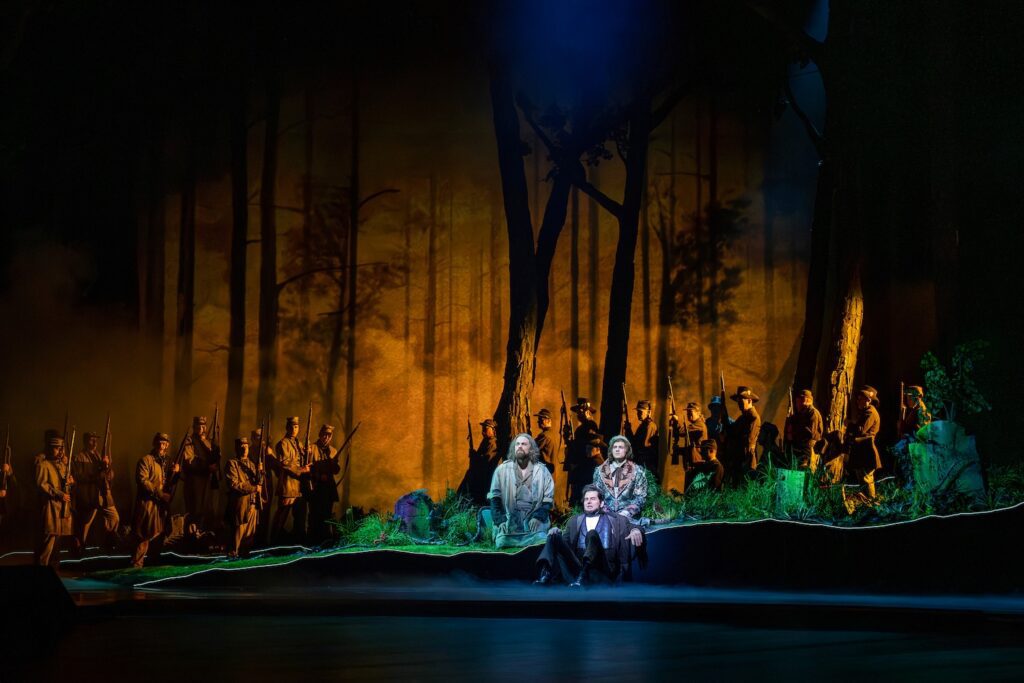
Photo by Karen Almond for The Met Opera
Many of Mazzoli and Saunders’s ideas about the afterlife are similar. Mazzoli became a certified death doula in 2021 and helped guide her family through her own father’s passing in 2024. “In terms of writing the opera, I think it helped me craft these lighthearted scenes for Willie. The trio at the end, singing ‘The things of the world are with me still,’ is a reflection of people clinging to parts of life at the time of their passing that they never thought they’d cling to. They’re not obsessing about fame, career or homes; it’s always things like, ‘Standing on the beach when I was 14,’ or ‘Washing the window of my new apt on a sunny day.’ Those are the things that stay with us and that felt very accurate to my experience of working with dying people.”
Lincoln in The Bardo represents the latest note in The Met Opera’s expanded programming groove, appealing to new and veteran audiences with diversely sourced shows, star-studded premieres, and an “Opera For All” lottery, in partnership with the Mayor’s Office. “The Met has more commissions from women in the works. Even since they commissioned me, they’ve also commissioned Kaija Saariaho’s Innocence and Gabriela Lena Frank’s El Último Sueño de Frida y Diego. So that’s already tripling the number of women who have ever performed at The Met, bringing the number up to a whopping 5 of us,” she laughs.
For anyone intimidated by the prospect of attending their first opera, Mazzoli’s advice is pretty simple. “These are stories about our shared humanity, and opera tells those stories in grand explosive fashion. So the key is: Don’t go into it thinking you need anything; just let it wash over you.” For Lincoln in The Bardo, in particular, you don’t necessarily even need to go into it. The show’s final performance will be livestreamed, with an intro from Saunders and the screening of a documentary produced by Duo Lipa’s Service95 at intermission, via The Met’s YouTube page to keep up with the overwhelming demand for tickets.