Photo by Andreas Rentz via Getty Images
John Turturro is The Only Living Legend in Park Slope
Making sense of New York's rapid, unrelenting shiftiness with the acclaimed actor and longtime Brooklyn resident
In the graffiti world, there is no higher distinction than “All City.” It’s a badge worn by taggers indicating they’ve touched all five boroughs with their work. All City writers are up on every line; they are known, and have made their impression, in every corner of New York. And if it’s an honorific other formats can earn, Noah Segan’s The Only Living Pickpocket in New York—now playing at BAM—might get it twice. The film is, yes, shot in each of New York’s five boroughs, but its All City status is cemented by its star, arguably the “most New York” actor of stage and screen we have left, in the great John Turturro.
“Well, my mom is from Brooklyn,” the longtime Park Slope resident informs me, from his home, via Zoom, on a recent Wednesday afternoon. “She was in an orphanage, St. Joseph’s, and she went to high school right across from the museum. So I was born at Lutheran Hospital, but I didn’t grow up here. My friend Brandon Cole, who moved to Carroll Gardens from Williamsburg, he started taking me around when I helped renovate his building in 1980, I think it was. When I moved here, it was in ’88, and it was sort of eye-opening. I had a little co-op on Prospect Park West, and there weren’t a lot of restaurants around. The farmer’s market wasn’t crowded. I was off the F train, which was a slow train. Then when we moved to where we are now, near the Q and the 2-3, and it’s been a great neighborhood to raise kids in. But to see how much has changed, you know? It’s unbelievable, the explosion.”
Pickpocket is a movie fascinated by the rapid, unrelenting shiftiness of that geography that doesn’t try to obscure subway station and street signs at intersections outside of Sheepshead Bay vape shops or Midtown parking lots and weaves these locations and their personalities into each scene. The film is built around Turturro’s Harry Lehman, a native son working as an independent contractor in an antiquated line of business—the lone pickpocket in a post-cash world. Harry is an honorable gentleman crook out of Bresson or Melville, if they made movies about Belmont schnooks complaining about the jacked-up price of Yoo-hoo. His world is intimate; his only real family or community are the street and the black market economy that runs on greased palms and feeds off transplants and commuters and finance douches.
The plot kicks into gear when Harry breaks into a restored muscle car and ends up with his hand in the pocket of the wrong crypto, VC-fluent scion of a crime family more sophisticated, ruthless, and powerful than he is. It’s a charming, throwback, street-level set-up representing a city turning obsolescent by design, making way for the city rising up in its place. This quality is what makes Pickpocket a precious antique; like its protagonist, a relic they simply don’t make anymore. Segan clearly set out to make a “New York Ass Movie,” one it would be impossible to describe without invoking “Lumet,” the God of New York cinema. Composer Gary Lionelli’s score quotes West Village Jazz and lush orchestral South Bronx disco. The cast is padded out with New York-fluent, sturdy hands, rappers and LaGuardia graduates like Karina Arroyave, Steve Buscemi, Giancarlo Esposito, Ad Rock, and John’s cousin Aida (perhaps better known in the tri-state as Janice Soprano).
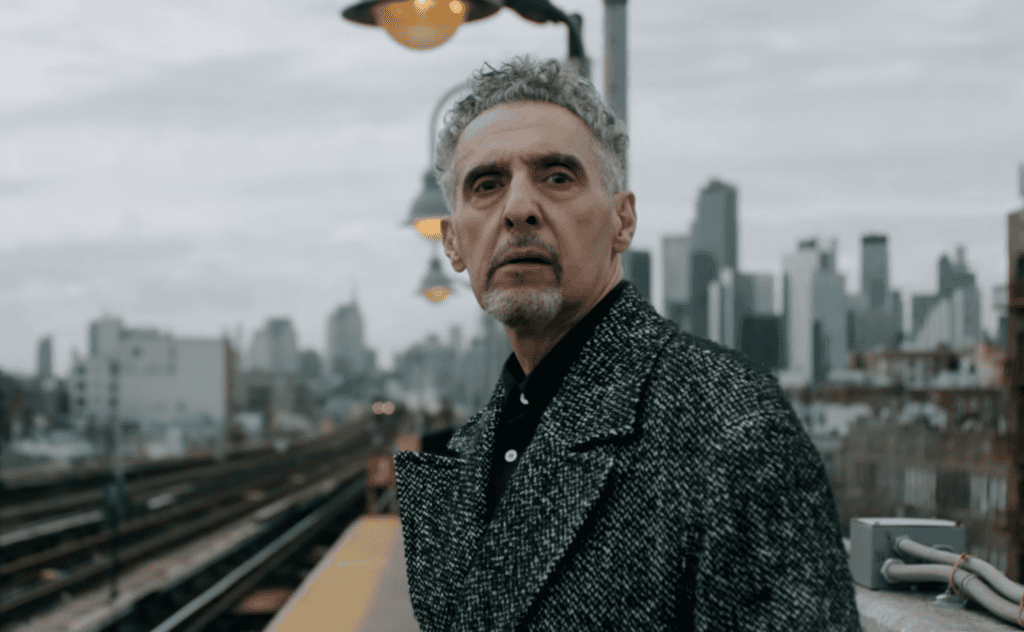
Turturro is, however, the glue in every frame. You can’t watch him on screen without seeing Pino Frangione, or Barton Fink, or Herb Stempel, or the 100+ characters he has played over four decades to contribute nervous, irritated, or irritating energy to films made by Spike Lee, Martin Scorsese, or any number of American masters when they need the perfect dash of authentic New York. The movie understands this and mines his hard-earned iconography. But in Pickpocket, we get an older, wizened Turturro, swaddled in comfort-forward peacoats and cowl necks and rugbies and cardigans and brushed leather loafers, with a fresh salt-and-pepper high fade blending into a full crown of curls. His face is still made entirely of right angles and folds—a postmodern Italian geometric assembly that is as easy to buy as Jewish or Puerto Rican or any number of vaguely outer-borough ethnicities—but those edges are rounded off, softened by time into something warmer that perfectly matches Harry Lehman’s affable, huggable energy in the film. It is closer to the Turturro I have “known” as a Brooklyn transplant who has lived off the Q train for 20 years.
Courtesy of Sony Pictures
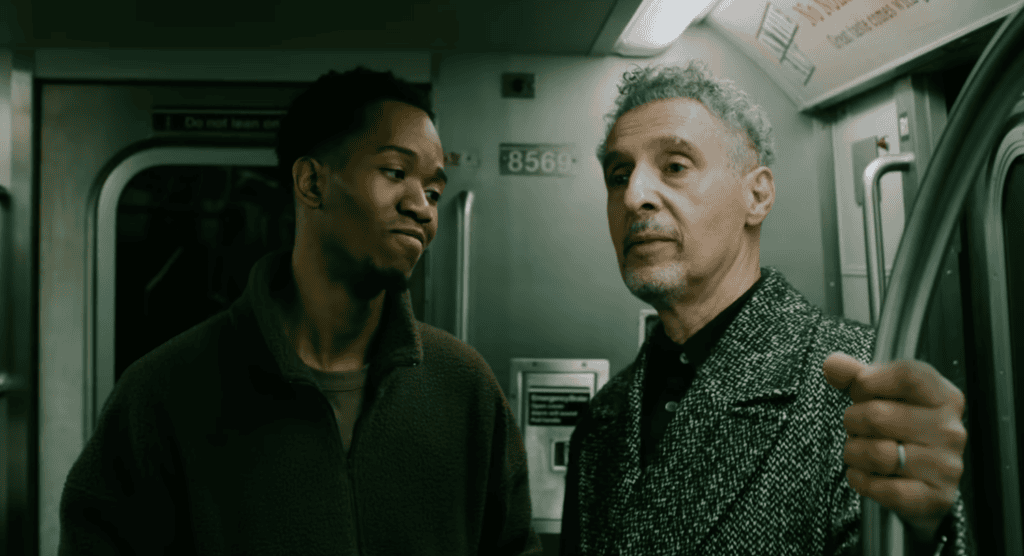
Longtime Q riders all have their Turturro run-ins and anecdotes: Sitting next to him on a weekday afternoon resisting the urge to say “Hi” (because this is, after all, New York); trying not to sneak a peak at the script he’s leafing through with one hand as he hangs onto a pole with the other; the time he gave up his seat for your pregnant wife; his bemused appreciation of a particularly acrobatic “SHOWTIME” performance taking place as the train glides over the south-facing side of the Manhattan Bridge. Pickpocket relocates Turturro to the Bronx (because Segan is from there), but in the theater I pumped my fist when I realized he was still working off the B train, which shares a line in Brooklyn with the Q. Everyone who has shared that commute, between Park Slope and the city, feels a sense of pride and ownership over the actor; he’s our local celebrity, and means more to us than the ostensibly more famous figures who fill the city. This is because the Queens-born-and-raised product has never carried himself like a generational character actor in the 40 years he’s lived west of Prospect Park, where he raised his family.
Turturro has maintained a residence in L.A. off and on over the years but has always called Brooklyn home. It’s been convenient—his wife never wanted to live in California and his mother was a widow who moved to Europe, making New York the perfect midpoint—and he’s simply in love with the history here. He’s the kind of guy who uses “We” when referring to the borough, like they’re his beloved Knicks. “We merged with Manhattan in 1898. Barbara Stanwyck, Jackie Gleason, Jerry and Meara Stiller, Woody Allen, Mel Brooks, Barbara Streisand, Spike. People who really affected me came from here. You go on that walk; in the Botanical Gardens, I’m there too,” Turturro says. “I’m happy to be associated with it. It’s the place I’ve lived the longest in my life. I’ve fought, even in my own movies, to set them here and shoot here.”
These days Turturro spends a lot of his time looking back at a version of the city that is being slowly washed away by the tide of development in an increasingly prohibitively expensive Brooklyn. “There’s a lot of things I’m nostalgic for that have been lost. When I was young, I could go do so many interesting things, and I could afford to do them, even though I had no money. The city was so much more affordable,” Turturro says. “When I do plays at BAM, I always want to make sure that there’s affordable tickets for younger people, because I don’t want to just perform for rich people my age. I think that’s important, because it opened my eyes to so many things.”
Courtesy of Sony Pictures
Turturro has noticed, as many of us have, that the increased living expense has had an impact on the socioeconomic diversity of the city, which has naturally changed its culture. “I used to go to Eastern Athletic Club, right off Grand Army Plaza. I had a pickup game there; you can’t beat that workout. I loved the combination of people who would play basketball together. It was like everyone. And, you know, things would go flying: Braids, yarmulkes, different languages. And they sold the building, and let go of the gym, and I really, really miss that.” Turturro says. “It was a great meeting place, and a very spontaneous one. It was definitely a loss because it was really a community center.” His favorite old neighborhood haunt is Al Di La, the Northern Italian time machine that helped usher in the modern era of “New Brooklyn” restaurants at the intersection of Carroll Street, where he’s friends with management and has conducted several interviews over the years. And he loves Green-Wood Cemetery; his mother and older brother were buried there. He has a plot waiting.
But Turturro appreciates what Brooklyn has become as well. He enjoys the walk down the bustling commercial strip on 5th Avenue he takes to Liberty games at Barclays, where he’s a season ticket holder. Over the past four decades, a cohort of stars he’s now friendly with have joined him in the borough, including Ethan Hawke, Bobby Cannavale, Tom McCarthy, and Amy Ryan (Turturro believes he is the longest tenured Brooklynite in the industry, besides Spike Lee, of course). “It’s fascinating, how the new groups have come in, and then other groups went somewhere else. And then a lot of the people who left, their kids have moved back to places like Eastern Parkway, where they came from. When I performed at the [BAM] Harvey, it really felt like I was performing for a new, young community of people. It’s great,” Turturro says.
As he’s reminiscing on restaurants, basketball games, and neighbors lost to time, it’s easy to think of Turturro as yet another long-tenured, nostalgic New Yorker harboring grievances, as well as Harry Lehman, the pickpocket he plays in his new film, who believes in the small human gestures that were once foundational to the daily interactions New York was built upon, which is largely the point. The character, and the local celebrity, are virtually indistinguishable (besides “the whole crime thing.”) “Harry is this guy, and everything has changed around him, personally and professionally, and I think that is a constant here. Whether it’s Flatbush Avenue, all those new buildings, and now the bus lane, it’s always changing. The only constant in New York City is radical change.”