Courtesy of NEON
Seeking a Friend for The End of The World at New York Film Festival
Films about broken systems and bleak futures dominated this year's festival
It’s early on the first proper screening day of my fourth year attending the New York Film Festival (NYFF), when the crowd is alerted that the packed, 35-year-old, 268-seat Walter Reade Theater will have to be evacuated. NAZA, the new documentary from half of the Oscar-winning team behind No Other Land (Yuval Abraham and Rachel Szor), the best and most important film of 2024, is debuting their new film for us, the people credentialed as Press and Industry members at this year’s fest (its 64th). But first, the organizers, Film at Lincoln Center (FilmLinc), need us all to step outside.
We pace around taking in the late September morning air overlooking 65th Street, nervous for this film and excited for another season on the Upper West Side. The tiered campus of Lincoln Center is more than a coupling of modernist buildings carved out of Italian limestone, more than a few movie theaters, a few restaurants, a music school, and an opera house. It’s an ideal, the pinnacle of a kind of sophistication and intellectual life grounded in the study and pursuit of the humanities that has always felt impossible, to me at least. At the Lincoln Center that exists in my imagination, the air is always crisp, the leaves are always amber and gold, and the sidewalks are packed with young, elegant, ambitious artists of the highest caliber, string instrument cases slung over their shoulders, stacks of collated sheet music in the crooks of their arms, in a hurry as they take distracted sips of coffee from one hand while clutching a yogurt or salad bowl in the other. Gershwin is always playing in the background, and the light of the future is flashing in their eyes. It is not the last bastion of human civilization on Earth, but if you needed one, you could do worse.
NAZA is the hot-button film of the season. It caused controversy in America and Israel, where there was talk of revoking Abraham and Szor’s citizenship, and protests from Zionist groups in spite of the fact they hadn’t seen the film—because it hadn’t premiered yet. It is mostly comprised of a series of interviews conducted by Abraham, bathed in shadow on Israeli rooftops, where functionaries in the Israeli military and government speak candidly about the genocide in Gaza, revealing the project as a kind of Stanford Prison Experiment for the Holocaust, testing the use of A.I., presumably for future colonial exterminations. Much of the news relayed in the film had already been broken elsewhere, but it is haunting and chilling for the candor its executors have with themselves in doing their terrible, deeply impersonal work.
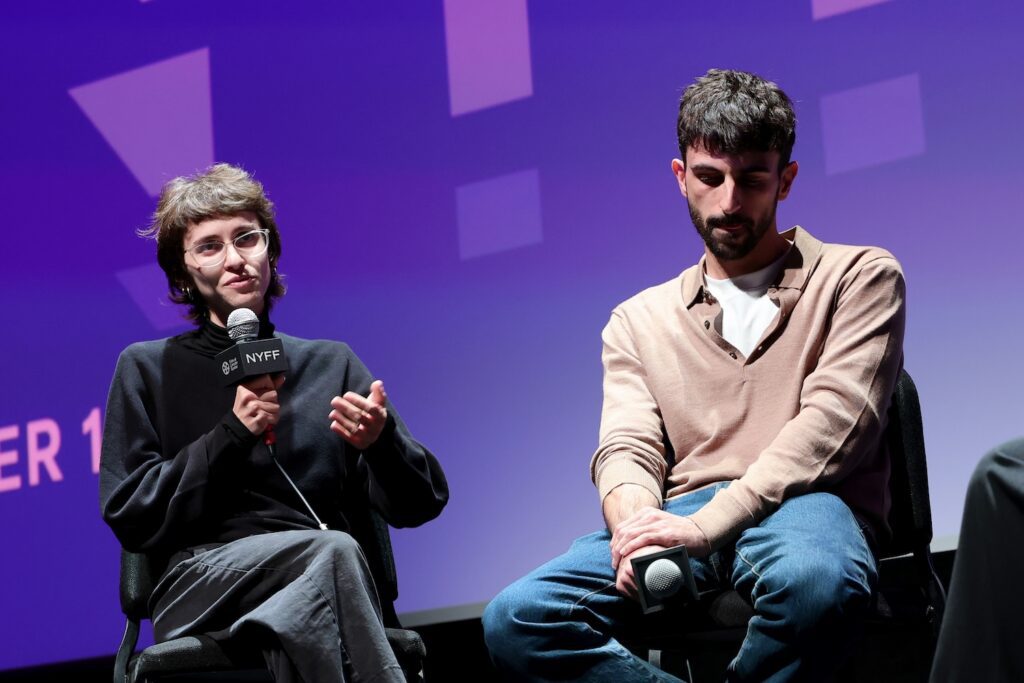
Rachel Szor and Yuval Abraham speak onstage at the NAZA premiere during the 64th New York Film Festival at Alice Tully Hall (Photo by Dimitrios Kambouris via Getty Images)
It almost feels unfair to qualify NAZA as a proper film in some respects, compared to the rest I’ll be watching. But if we evaluate film by how it makes us think and how it impacts us on a visceral level, it’s a work of unspeakable power that is being treated properly as an act of public service and education the world needs to have access to as soon as humanly possible.
Because of NAZA’s controversial nature, FilmLinc has emptied the theater to take the unprecedented step of asking all critics and industry members to submit their phones for the duration of the screening, presumably in fear of a provocateur on either side of the aisle grabbing illicit footage from the film and posting it.
The phone issue was announced suddenly, and the solution seems equally impromptu. As we file back into the theater, we will hand our devices over to FilmLinc employees who will fasten them in envelopes and label them with Sharpies, having faith the audience will abide by an honor system. A few people will be annoying about this relatively simple request; the rest of us will be understanding of FilmLinc’s concerns and grateful for the privilege of being among the first people on Earth to see a historically important film.
As some entitled individuals on line complain and bicker, insisting they can’t part with their phones for 77 minutes—or in some cases claim, with a straight face, that they don’t own phones—the FilmLinc staff tries to help them understand why the small group of organizers of this event, who make miracles happen for us every year, have deemed this precaution necessary. This patience, this grace, the small connection they fight for in the face of intolerance and selfishness as we wait to watch a film about the world being systematically destroyed by robots, is as good a theme or metaphor for this year’s festival as any.
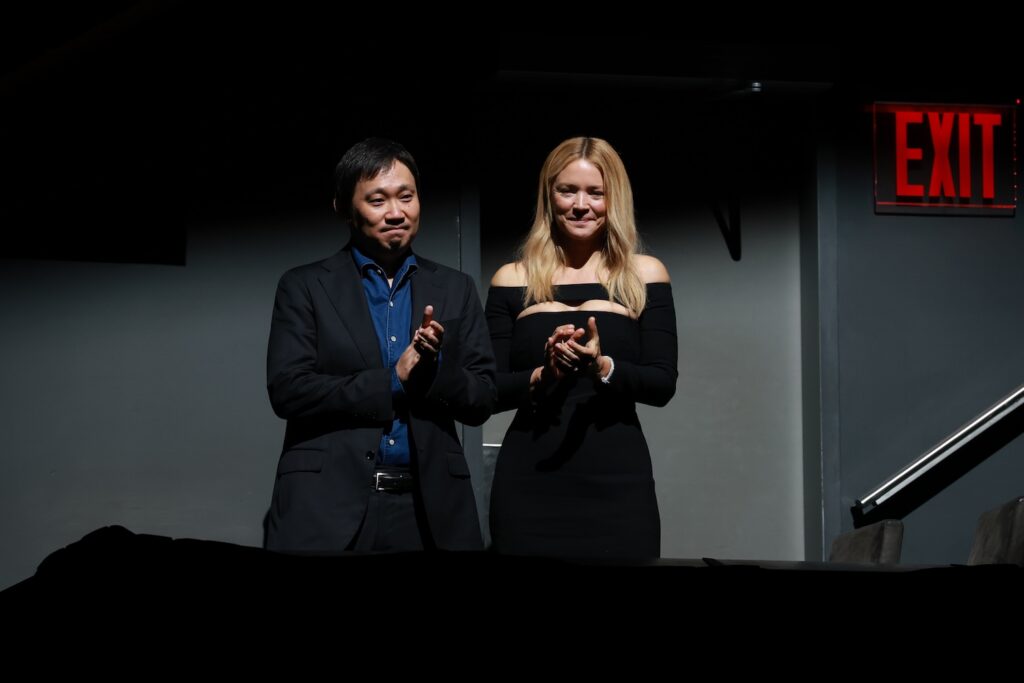
Ryûsuke Hamaguchi and Tao Okamoto attend the All of a Sudden premiere at Alice Tully Hall. (Photo by Arturo Holmes via Getty Images)
Of course, it’s impossible to draw a single theme from a film festival that featured 119 movies I’ve only seen a small percentage of, but of the movies I saw this year at NYFF, a tangible throughline could be finding slivers of humanity in the wreckage we’ve made of our world, as our institutions collapse around us.
Andrey Zvyagintsev’s crowd favorite, and future Foreign Oscar nominee Minotaur, is a Black comedic Chabrol adaptation set in the middle of the Russo-Ukrainian war. Russia empties out, things fall apart, and one white collar businessman strains to keep his work and home life in order. Dmitriy Mazurov is brilliant as the flailing patriarch Gleb in what appears to be a family drama concerned with subtle tell-tale gestures and signs a city and a family are unraveling. Then the single best set piece of the year not belonging to the Resident Evil cinematic universe happens, and our entire understanding of the film and its point changes brilliantly, from Dostoevsky to Scorsese or David Chase.
The stakes are somewhat smaller in Ryusuke Hamaguchi’s All of a Sudden, the hilariously titled near-200-minute film from a long-form master. It’s about French nursing home director Marie-Lou Fontaine (Virginie Efira, deserving of much of the praise she has already received) and her attempts to train her staff on an experimental, more humane style of personal service. She is doctrinal and abrasive in attempting to institute her philosophy of radical humanism against the stubbornness of human nature and the rigidness of the capitalist system she exists within. This softens when she comes into contact with Mari Morisaki (Tao Okamoto), an experimental play director with terminal cancer who is actually living according to the principles Marie-Lou espouses.
I felt the strain of its runtime in ways I didn’t while watching 2015’s five-hour, equally hilariously named, Happy Hour—let alone Hamaguchi’s 179-minute 2021 “Best Picture” nominee, Drive My Car—until one pivotal scene. That scene is, what at least feels like, a 30-minute, literal whiteboard lecture, complete with diagrams, about the fight to preserve humanity and selfhood in the end-phase capitalist meat grinder. It elicited the occasional snicker from the audience and brought to mind Kwame Ture’s late-career didacticism. What is remarkable is how immediately after this scene, the film clicks into place and becomes a spiritual experience that provokes laughter and tears in equal measure, and how Hamaguchi once again teaches us that length can be used as an incredibly powerful tool.
Tender Loving Care is also concerned with compassion at the end of life and serves as the perfect summation of Mike Leigh’s tremendous career. In what is perhaps his final film, Leigh centers professional community caregivers in a filmography broadly concerned with working-class folks and their daily mundane joys and struggles. Amy and Birdie (Kate O’Flynn and Marion Bailey, both riveting) are two middle-aged soulmate social workers who ooze love in every direction but have had trouble finding it. They move back in together and prepare to say goodbye to Amy’s father, Geoff (Paul Jesson), as he begins a slow and final decline. It is as warm and generous as any film Leigh has ever made, which is saying a lot.
In Cristian Mungiu’s Fjord—a Palme d’Or winner that didn’t go over quite as well in New York, anecdotally—the focus shifts from the end of life to its beginnings, when child protective services are used in crunchy, progressive Norway as a lever of xenophobic hostility and violence against a family of strict, religious Romanian immigrants and their children. The hypocrisy of the state and the relationships it is breaking up—between parent and child, siblings, friends, and neighbors—are deeply felt, and the film ends with a literal caution to the progressive world not to fall victim to the same prejudices and draconian policies they are quick to judge other political parties and cultures for exploiting.
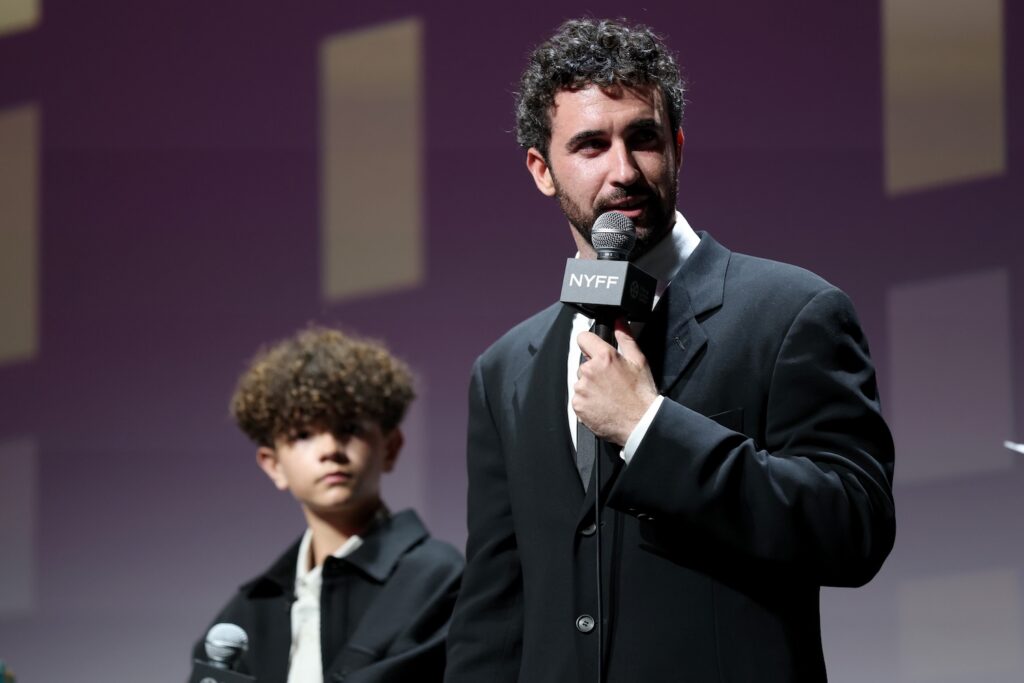
Reggie Absolom and Jordan Firstman speak onstage at the Club Kid Intro and Q&A during the 64th New York Film Festival at Alice Tully Hall (Photo by Dominik Bindl via Getty Images)
Jordan Firstman’s Club Kid tangles with CPS as well, but here in New York, where each bodega awning and Bushwick music venue is filmed and treated as importantly as the deep, diverse, hilarious cast of majority queer characters. Where Fjord is dry and ponderous between emotional crack-ups, Club Kid is open-hearted and proudly embraces its middlebrow Miramax 90s genre beats. I’ve watched all those movies and can say with conviction Firstman has topped them with a father’s coming-of-age tale. For any critiques of plot convenience Club Kid may be found guilty of, it makes up for them by presenting a specific world and culture you don’t have to actually be a part of to understand intimately and immediately. It’s a world that, ten years in, Firstman’s Peter is drowning in until his newly discovered son offers a way out.
Rosalind Eleazar’s titular character in Misty Green is doing everything she can to stay a part of her world as an actor on the other side of the country in Los Angeles, but a broken, racist, and misogynist industry veering towards its own end doesn’t make it easy. Misty’s abrasiveness and poor decisions don’t do her any favors, but the question that seems to bedevil viewers and critics of Chris Rock’s fourth film in over two decades lies in whether Misty’s behavior is a byproduct of her resentment of this system or Rock’s hatred of women. By the time Misty chooses her fate and her mentally ill brother (a mixed-bag performance from Daniel Kaluuya after some time away from the screen), the answer is clear enough—to me, anyways.
I still struggle with what exactly happens at the end of Sandra Wollner’s Everytime. It’s a heartbreaking and brilliant film about three worlds being shattered, then colliding, when a teenage girl accidentally falls to her death. In Everytime, Wollner has made something profound about subsuming our grief in the digital ghosts left behind and offers a blueprint for future filmmakers on precisely how to mine these footprints, which we increasingly all have from birth, to devastating effect. Every tangible explanation I’ve been able to come up with for its ambiguous conclusion can be taken apart, and Wollner is clearly uninterested in leaving us with pat and easy answers, so I won’t try one here. What I will say is, even if the end doesn’t work for you, Wollner’s depiction of her lost girl via phone-captured videos, voice mails, and text messages feels as real as any flesh-and-blood representation I’ve seen this year.
The struggle to fairly and accurately represent in good faith a person and their struggle is front and center in Lee Chang-dong’s long-anticipated Burning follow-up, Possible Love. The title can be interpreted as a kind of question posed to the two married couples—one affliuent, the other salt of the earth—at the center of the film. Sang-woo (Zo In-sung), a son of wealth and privilege, and his bourgeois documentarian wife Lee Ye-ji (Cho Yeo-jeong) come into the orbit of a working-class couple, Mi-ok (Jo Do-yeon) and Ho-seok (Sul Kyung-gu), and immediately seduce them because Lee Ye-ji wants to include them in her film about a factory strike and subsequent layoffs as depiction of the reality of proletarian plight in the rapidly shrinking, globalized Korean economy. The couples go out for soju, go on vacation, and bond as the line between friendship and artistic vampirism blurs, begging the question the title suggests. Lee Ye-Ji wants to believe she has a real friendship with Mi-ok and really cares about Ho-seok despite their differences in taste, education, socio-economic background, and lifestyle. But to paraphrase Thom Yorke, we’re never sure if she’s only being nice because she wants something.
“Paranoid Android” is quoted halfway through Luca Guadagnino’s Artificial, an unsubtle reference in an unsubtle film from an unsubtle filmmaker about the birth of generative A.I. and the potential impending death of the human race. Yura Borisov’s Ilya Sutskever is a computer engineer who seeks out human connection and finds it, first in Geoff Hinton (Mark Rylance), a professor at the University of Toronto, who shares his ravenous curiosity and love of solving problems for the good of mankind, and Sam Altman (Andrew Garfield), who shares his love of action and progress. Altman and American ambition predictably win the day. In the end, the film’s Greek tragedy lies in how Ilya’s hunger for human connection, and belief in his friends, may wind up destroying mankind’s brief, terrifying, beautiful stay on this planet.