Photos by Abe Beame
The King of “New York”
How The Kid Mero survives, and thrives, at the end of media
It’s around the lunch rush, early afternoon on a summer Monday in a studio on the southern edge of Manhattan’s Chinatown, but Joel Armogasto Martinez is working hard. The all-purpose Bronx-entertainer-turned-New-York-City-institution—affectionately referred to as “Mero” in his hometown—is on the mic, recording one of his three concurrently running podcasts, discussing the worst moment of his life. “I’ve been so down-bad, bro. I look back at how down-bad I’ve been, and I’m like, if you was there in that hallway? In those Ps? I’m selling dummies and like, I’m grown. What am I doing, bro? It’s three in the morning. I just sold this n**** sheetrock? What is going on?” Mero asks, describing passing off stairwell debris as crack with a city kid’s humor and candor. “This can’t be it. I got to do something. I gotta make shit shake.”
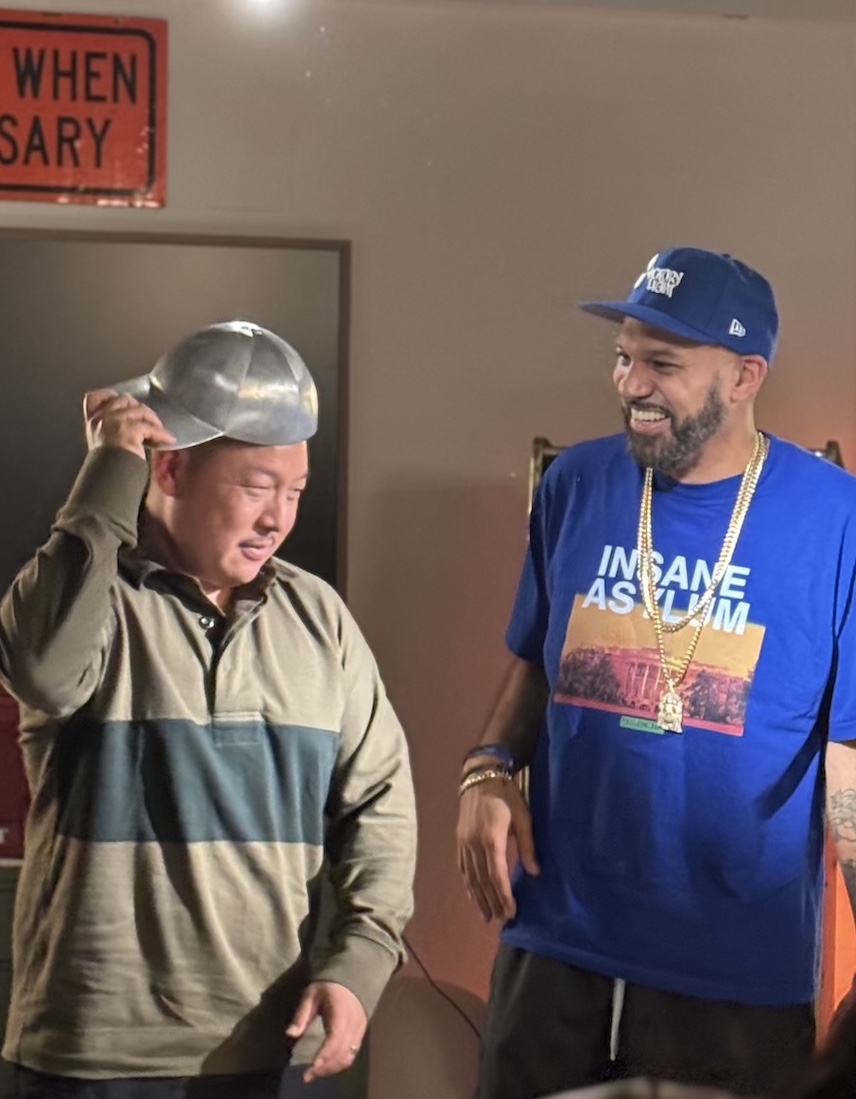
Photo by Abe Beame
Mero’s guest today is chef and author Eddie Huang, a former VICE co-worker who, in spite of growing up in Florida, came up in the same era of media and helped Mero spread the gospel of “New York culture” that lives in the collective imagination when it comes to this city online. “When you’re not getting [money], every immigrant parent sounds like Cam’ron: ‘If you can’t get paid in an Earth this big, you worthless kid,” Huang raps, pausing where the “Losin’ Weight” lyric he can’t recite would go. “We’re all first-generation kids. There’s something about that,” Mero responds. “It’s pressure. You gotta get it. I didn’t come here for you to fuck around. You know what I’m saying? Like, you got to go make money, that’s it. That’s the fucking KPI n****: make money.”
The lively conversation is spiced with Dipset quotes and references, as well as the style of speech Cam’ron and his Harlem crew introduced to the NYC rap lexicon in the first decade of this century. It’s detail-rich and bizarre, a vernacular composed of clothing brands, local restaurants, strains of marijuana, prison slang and calibers of gun that characterized much of the writing and discourse on blogs and social media in the late 2000s and into the 2010s; a kinetic lingua franca rife with granular street knowledge references employed with dumb/brilliant Dadaist abandon that qualifies its user as a hip-hop conversant intellectual that can flex between block and boardroom. It’s what made debating everything from mixtape rap to film to politics so playful and exciting during that period of “high” and “low” brow entertainment and launched Mero’s career as one of its main progenitors and innovators online.
This particular podcast—not to be confused with Carmelo Anthony’s 7PM in Brooklyn or the podcast form of Hot 97’s Mornings with Mero—is Victory Light, which effectively revives a defunct blog of the same title that Mero kept in the aughts, writing in all-caps missives while he worked as a paraprofessional at P.S. 117 in Briarwood, an elementary school he once attended. It was that writing that first got him a following and public acknowledgment from celebrities like Anthony Bourdain and Wale in a class of Twitter-comedians-turned-media-stars that includes Huang, Rembert Browne, Jason Concepcion, Jaboukie, Big Ghost, and A$AP Yams, among many others. Mero has ancestors in his profane, character-filled, New Yorkian comedy—Star and Buc Wild, the Ego Trip collective, the Jerky Boys, or Cam’ron himself—but it’s this corner of the internet that best contextualizes his art.
All good comedy is built on a foundation of specificity, but Mero’s humor trades on hyper-regional totems and proper nouns that might feel a little alien to even some born-and-raised New Yorkers. He soon found they had universal appeal. When we’re discussing Dominican restaurants he fucks with, rather than reeling off any by name, he recommends I seek out “anywhere that got a Spanish lady with big arms behind the counter.” When Mero tells a story about throwing the ecstasy pills he once sold into a fish tank so his mom wouldn’t catch him bagging up, they aren’t “pressies”; they’re “Triple Stack Supermans.” When explaining what he loves about working at Hot 97, as opposed to the narrower internet and podcast spaces he once occupied, he shares an anecdote about smoking a blunt with a fan backstage at this year’s Summer Jam, who he describes as “a Puerto Rican with a nose piercing who works at C-Town.” This torrent of reference may inspire you to do some Googling, or you may simply allow it to wash over you passively, with context clues directing where the laughlines go if you don’t understand exactly why you’re laughing, reassured with the ineffable sense that you are hearing truth. These colloquial localities are at the root of how Mero turned comedy centered around the microcultures of his limited city experience into a global brand.
“Mike Francesa, of all people, told me, ‘Don’t worry about being too New York. If you got New York, everything else doesn’t matter.’ So I thought about it in that way, like if half of the millions of people who live here fuck with you, you’re good,” Mero explains, when I ask if he was ever concerned his humor was too niche. “The other side of that is there’s movies about this fucking place. It’s special. So when you’re from here, there’s a certain attitude, and people love that shit. They think, ‘These people are either insufferable or they’re the coolest motherfuckers on the planet, the most swagged-out people on Earth.‘ There’s no in-between. If I’m gonna get pigeonholed as ‘The New York Guy,’ great, because then every time you need a guy from New York, you’re gonna hit me up.”
This pigeonholing, the not just “I <3 NY” but “I AM New York” association that Mero has built—beginning with his blog and Twitter account, running through his partnership with fellow Bronx kid Daniel Baker, or Desus Nice, exponentially growing from their Bodega Boys podcast to Desus & Mero, the VICE half-hour turned Showtime talkshow, to his burgeoning solo career—made him the intuitive choice when Hot 97 needed a new AM anchor.
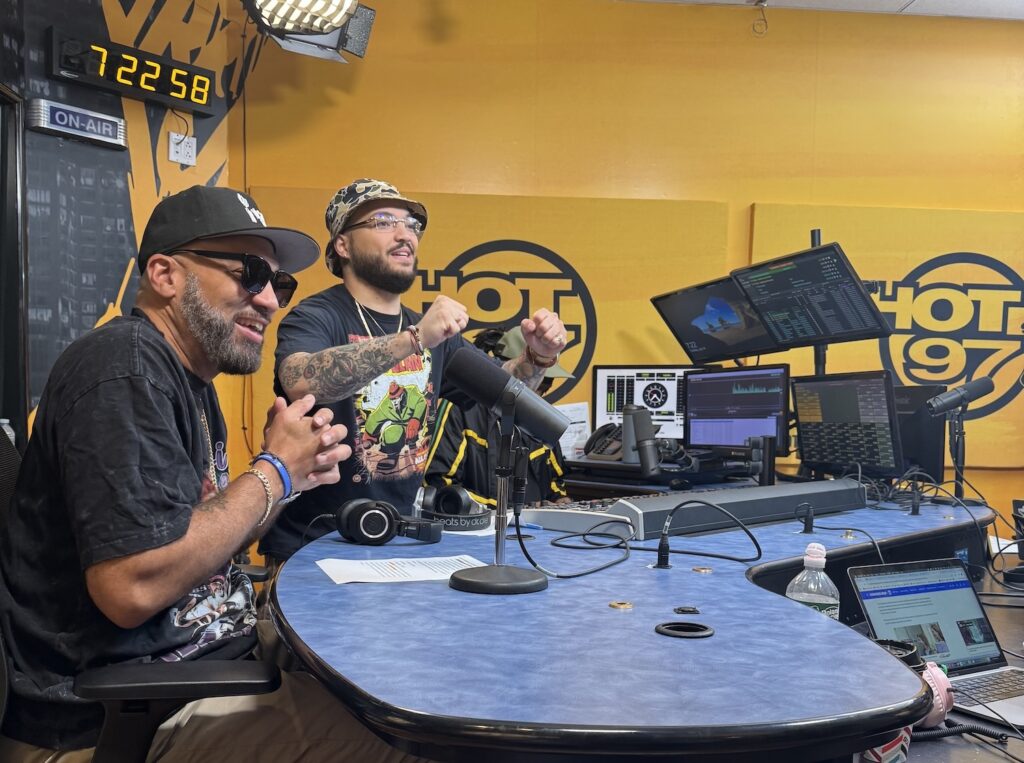
Photo by Abe Beame
“20 seconds… Headlines,” the journalist and show producer Jayson Rodriguez announces to the room in the Hot 97 studio on a generic Garment District block. He slides freshly printed single pages with large, bold-faced, and bulleted talking points in front of the hosts of Mornings with Mero, where a lively debate is put on hold as the countdown to air ticks to zero. Mero pivots mid-thought, welcoming back the listeners from 15 minutes of Hot 97’s algorithmic monotony (Lil Uzi Vert, Tems, Fenix Flexin, The Weeknd). I’m sitting next to the host, positioned in a blind spot between cameras that capture breakouts for vertical video and broadcast the show live on YouTube.
Today, Mero was 20 minutes late. The excuse du jour: a fenderbender that resulted in bridge traffic. He’s “Bronx middle-aged backpacker fly” when he arrives, in Purple Lobster Dunks, two fat gold link chains, a Lewis Hamilton tee done in the style of a No Limit pen and pixel album cover, and a black Victory Light fitted pulled low over his face, which is now defined by a greying beard, a gap between his front teeth, and large, round, bright eyes he can bug in amusement or exaggerated shock for comedic effect, and are constantly, actively dancing in their sockets, presumably scanning his immediate surroundings for the next bit.
Six months into the run of his era as the show’s host, Mero’s Hot 97 on-mic persona isn’t relatably naturalistic in the way his fans have come to know and love his podcasting. He delivers radio business—introducing segments or encouraging listeners to dial in for Summer Jam tickets—in a style that approaches self-aware character work, with a native accent and voice that has been chopped on a griddle and fried by decades of White Owl and Dutchie abuse.
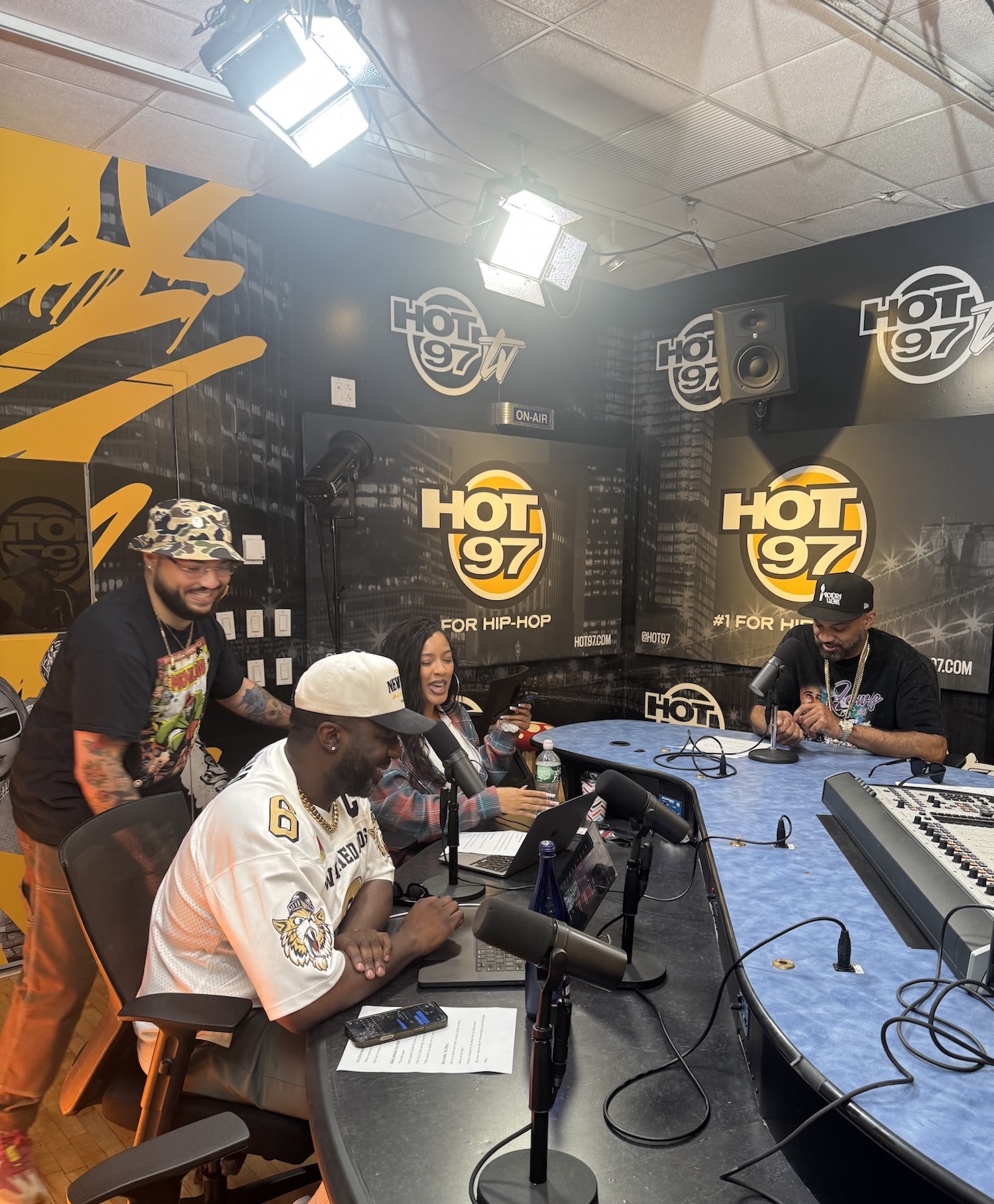
Photo by Abe Beame
The show is at its best when he brings in a sparing partner. These are his co-hosts Miabelle Bocicault, multi-faceted culture commentator Kazeem “Kaz” Famuyide, Hot 97 legend and on-air engineer Shani Kulture, and Mero’s fellow DeWitt Clinton High School alum DJ Kast-One, as well as the city of New York, in the form of Hot 97 callers. Together, this room and the city around them have created a tangibly fun work environment that jumps out of the radio speaker. Miabelle reads the news—need-to-know essentials like alternate side parking changes, Mamdani updates, Shaderoom-level gossip, the weather, and the requisite demand to employ deodorant with aluminum—as Mero seasons the report with an infinite roster of impressions (Lil Boosie, Juelz Santana, Kendrick Lamar, Jadakiss, Funkmaster Flex, Curtis Sliwa, French Montana, a stock benzo-addicted character) and running punctuation in the form of ad-libs (“That Part!”, “¡Qué lo que!”, “DAMN.”) But his secret weapon is an inclusive, addictive laugh that escapes from him.
The show has been a success, reaching #3 in the market for their timeslot in February, showing a 30% gain in the 18-49 demo year-over-year, and, ratings aside, is universally beloved, flooded with praise and congratulations from everyone, including Peter Rosenberg, Laura Stylez, and Ebro Darden, the venerable trio Mero’s team replaced. It’s a reflection of the fact New Yorkers tend to root for Mero, accepted as a true native son made good. He attributes his popularity to the show’s ability to marshall a distinct city energy New York radio had been lacking. “Everybody here graduated from a New York City high school, and that’s probably why this show reminds me of when I used to teach. This is like my home room. Kaz is the jock, Mia’s the pretty girl who will tell you to shut the fuck up. Shani’s the cool Rasta, Kast is the graffiti maniac, and I’m the class clown, ADHD, Dominican kid. It’s all a beautiful fucking tapestry.”
Mero compares his program favorably to his main competition, Charlemagne tha God’s The Breakfast Club, a program nationally syndicated via iHeart and Netflix. “My hope is our audience will tune in and think, They’re funnier, they’re younger, they’re more tapped in, they’re not messy for the sake of being messy. They’re ‘New York,’ and I fuck with that. I’ve driven through where Charlemagne is from on my way to Florida on a road trip. Monks Corner [South Carolina]. I never went again, because I feel like if the sun would have set, I would have been in trouble.” Rodriguez confirms the setting is the spine of Mornings with Mero in a way national programs can’t and don’t aspire to be. “The main thing is this is a New York show by design that has a sense of humor and perspective that’s very much in alignment with the city. It’s a show that proves its love for New York City everyday,” Rodriguez says.
Rodriguez has put as much work as anyone into thinking about how to translate Mero’s free jazz chaotic brilliance to the regimented confines of drivetime radio. “Mero thinks he’s super unpredictable and hard to follow, but if you look underneath the hood of it all, he pays close attention to his mechanics of comedy. He’s a really densely constructed ball of dangerous Bronx energy with whipsmart, bookish self-education from smoking a lot of weed and ciphering with his community,” Rodriguez says. “The work is providing the environment for these amazing, combustible moments Mero creates. When he’s in a flow state, it’s almost like he’s possessed. I don’t like to call it unpredictability because it’s reliable. He’s a master improviser.”
I get to see one of these moments occur in real time when a “Mind of Mero” segment—in which the host solos an op-ed take-grenade aimed at any exposed cultural nerves in the city—veers too close to a topic from a few months earlier. In honor of the 30th anniversary of Reasonable Doubt and Jay-Z’s recent Yankee Stadium residency, Mero immediately pitches an alternate: That It Was Written, another pillar of New York rap turning 30 this year, is the superior album. The gasp—and laugh—the room lets out instantly confirms they’ve found the right issue for the day; the blog post that would have gone viral in 2006, the Tweet or debate between twentysomething rap nerds that might have come to blows on the Q train, identified and platformed by a seasoned arbiter of his city’s taste.
Mero goes on-air and presents his case. “Argue with a wall, argue with Sauce Money, OR ARGUE WITH ME! 212-223, 9-7, 9-7.” The phone lines light up, and Jayson begins screening callers, requesting they turn down their radios, and refrain from cursing live on-air, before connecting them.
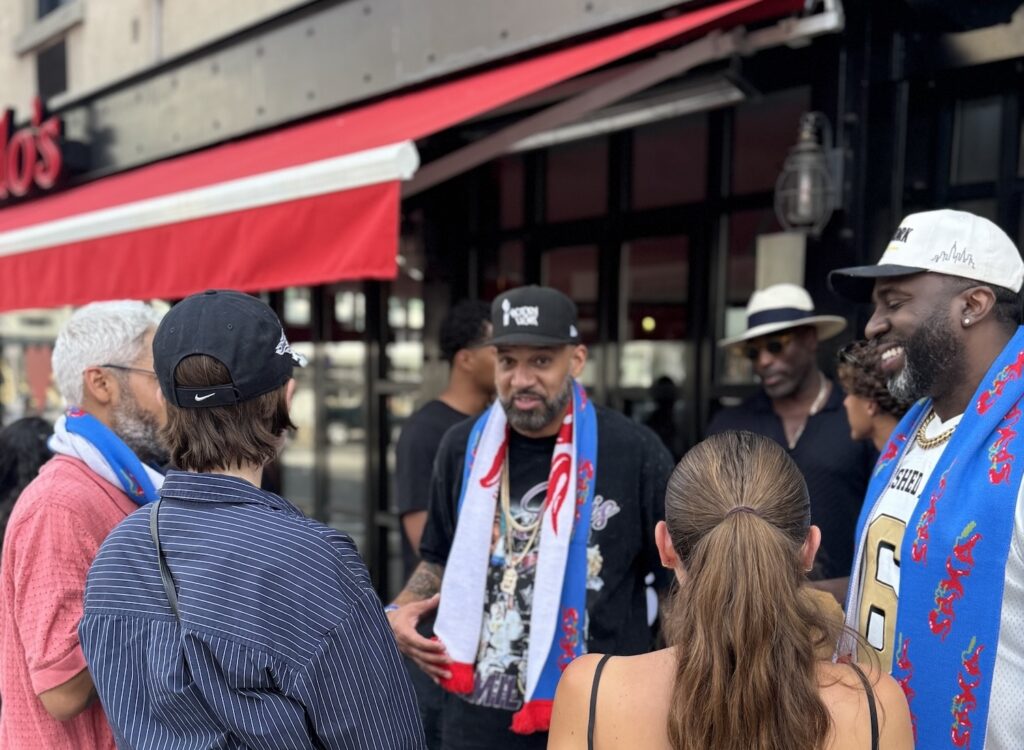
Photo by Abe Beame
What defines New York City as a culture? Maybe it’s some amalgamation of shallow signifiers—work boots, breakfast sandwiches, fat cap markers, slang, a genre of music, a basketball team—that creates an aesthetic in the aggregate. Maybe it’s the bizarre energy produced by a specific alchemy of global diasporas that have massed around one densely populated island. Or maybe it’s an ethos, an attitude, a diamond produced by institutionally racist oppression and socioeconomic pressure that makes people perpetually hungry, angry, impatient, and in some cases—where intelligence, talent, ambition, and a nose for opportunity spark in the right individual—resilient and impossibly resourceful. It’s not a terribly original thought, but an important one nonetheless, when considering Mero’s journey through media, particularly over the past five years, as he cleaved himself from the creative partnership that made him one half of a household name.
Between his blog and his social media presence, there were several early experiences that have proved formative in how he’s moved through the entertainment industry as his influence and following began to grow. The first was a DM from a Comedy Central writer to submit a packet for a show they were launching that became Key & Peele. Mero wrote three sketches and waited on what he was sure would be a job offer. “They were like, ‘Yeah, like you’re a little too raw. It’s a little too real. We’re trying to be less rated-R,'” Mero recalls. A decade and a half later, he can still recite the sketches verbatim by heart and, with little to no prompting, and sells the premise and punchlines of each bit with the passion a writer never loses for rejected pitches and killed stories.
One of these jokes had its root in the Scrabble words his friends would try to slip past him when they would play over a few drinks, but evolved into a bit about football players like former Jets left tackle D’Brickashaw Ferguson, “a hood name that sounds made up.”
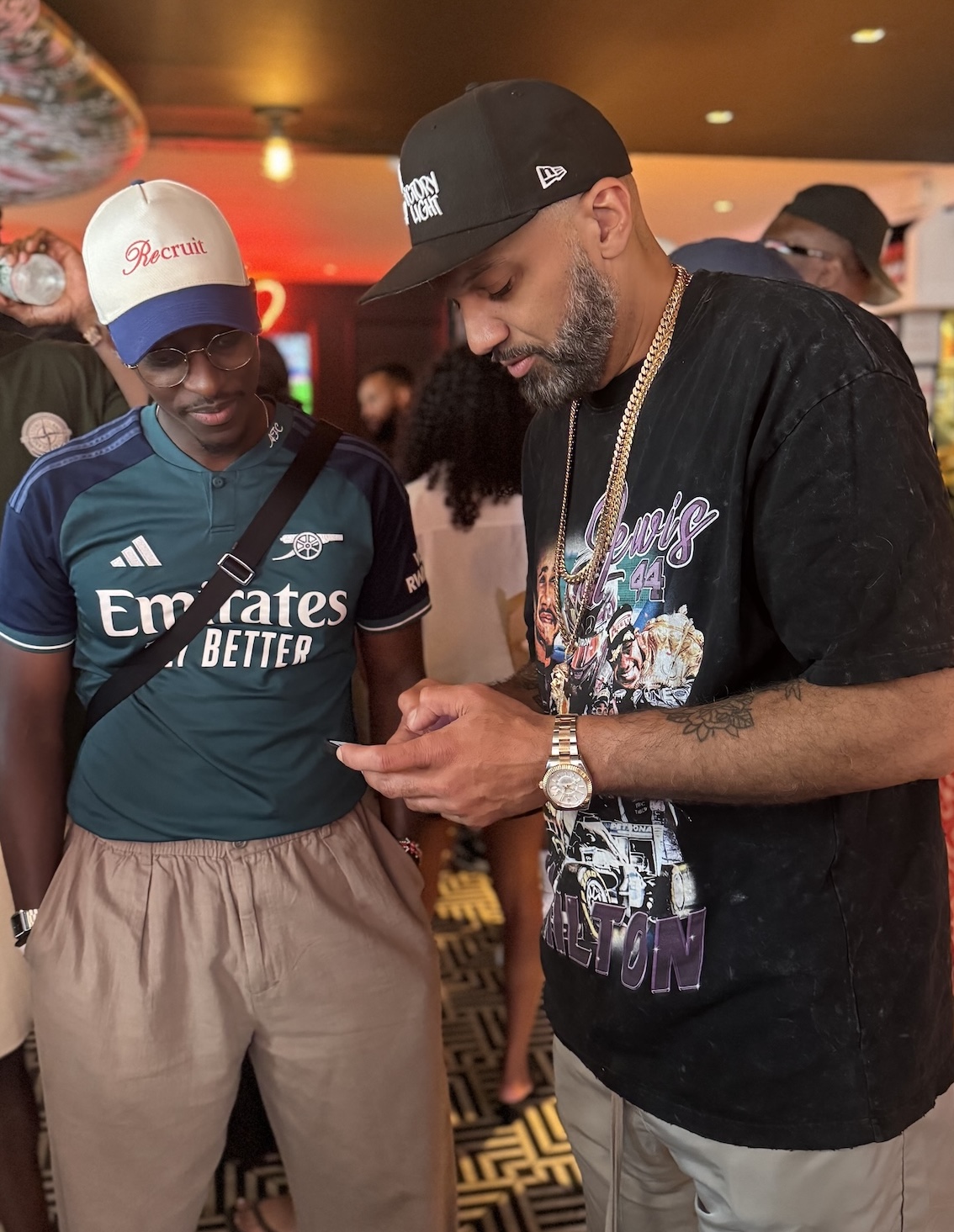
Photo by Abe Beame
If you’re at all familiar with the show, you know where this is going. “It made me see the game is the game. I sent in a bunch of shit. I didn’t have no agent, I didn’t have no management, I had nothing. So that smacked me in the face early. I was just like, ‘Okay, cool. Bet. This is never happening again. I’m not giving y’all shit,’” Mero says, still pissed. There was also an unproduced TV show he developed with Vampire Weekend’s Ezra Koenig. They had bonded over their shared history teaching in New York City public schools and ended up selling FX an NYC version of Abbot Elementary years before Quinta Brunson’s Philly-based sitcom became a blockbuster hit.
The experience gave Mero a taste for how lucrative and wasteful the industry could be. He was paid $40,000 for his effort writing an unmade pilot, more than he made in a year as a teacher’s assistant, and it radicalized him. “From there I always was like, ‘Yo, I’m broke as fuck.’ Even if I was getting five million, I’m like, ‘Yo, I’m broke, I’m broke.’ So I know I got to do the whole agency song and dance shit, but once I get this super bag, I’m trying to do my own thing. I’m not trying to be under you the whole time, and then you can just get rid of me whenever you feel like it. I don’t need to go try to chase Hollywood. Fuck Hollywood, the Entourage days are over. There’s no more Vinny Chases,” Mero says. “My agency is not calling me with anything. If anything, I have to tell them these people approach me. So you gotta go out there and get it, and New York is the fucking home of go get it.”
This focus on independence and self-sufficiency characterizes Mero’s career path and worldview when it comes to his ideal model of the entertainment industry. He sees the future of media as a lean, run-and-gun, zero-overhead proposition, pushing back against the extraneous scaffolded costs of corporate entertainment production. If you can still deliver “good”/profitable content on this shoestring, it makes the self-sufficient creative an incredibly valuable asset to advertising and budget-starved corporations, like the one that owns Hot 97.
Mero generally operates with the exuberance of a guy overjoyed, near shocked, to be successful doing what he loves, but reserves his bitterness and disdain for the top-heavy model that bloated the show he built up with a friend and two microphones and eventually torpedoed it. “You’re spending millions on a writer’s room for a show that’s like 95% off the dome. For political consultants, security, paying these white people to write jokes about East Tremont. I come from outside, so I’m looking around like, ‘Yo, are you motherfuckers laundering money?'” Mero says. “This shit is volcanic coming out of VICE. Magma hot. Y’all motherfuckers took it, overproduced it. You got a wack-ass third-party production company in there, and you fucked up the perfect lightning in a bottle. It was just bad leadership, and none of the motherfuckers got jobs now.”
Stepping on his product was bad enough. Far worse was what Mero describes as Showtime’s constant interruption of his prime directive: Chase the bag. “They were straight blocking opportunity. They wanted a piece of everything. My ethos the entire time was just like, ‘Yo, TV is not dead, but it’s dying. So let me keep one foot in here, because Coca-Cola and Verizon and Beats will not hesitate to give motherfuckers $150K to do some random shit for y’all.’ But then it was also like, this podcast is paying me more money than the fucking show. It wasn’t adding up.” Today Mero runs his career and his business in a way that matches his stripped-down, pragmatic philosophy, with a tight circle of vetted, fiercely loyal people he has identified and collected at different stops along the way, each an expert at the job of getting all the bullshit out of the way so Mero can be Mero.
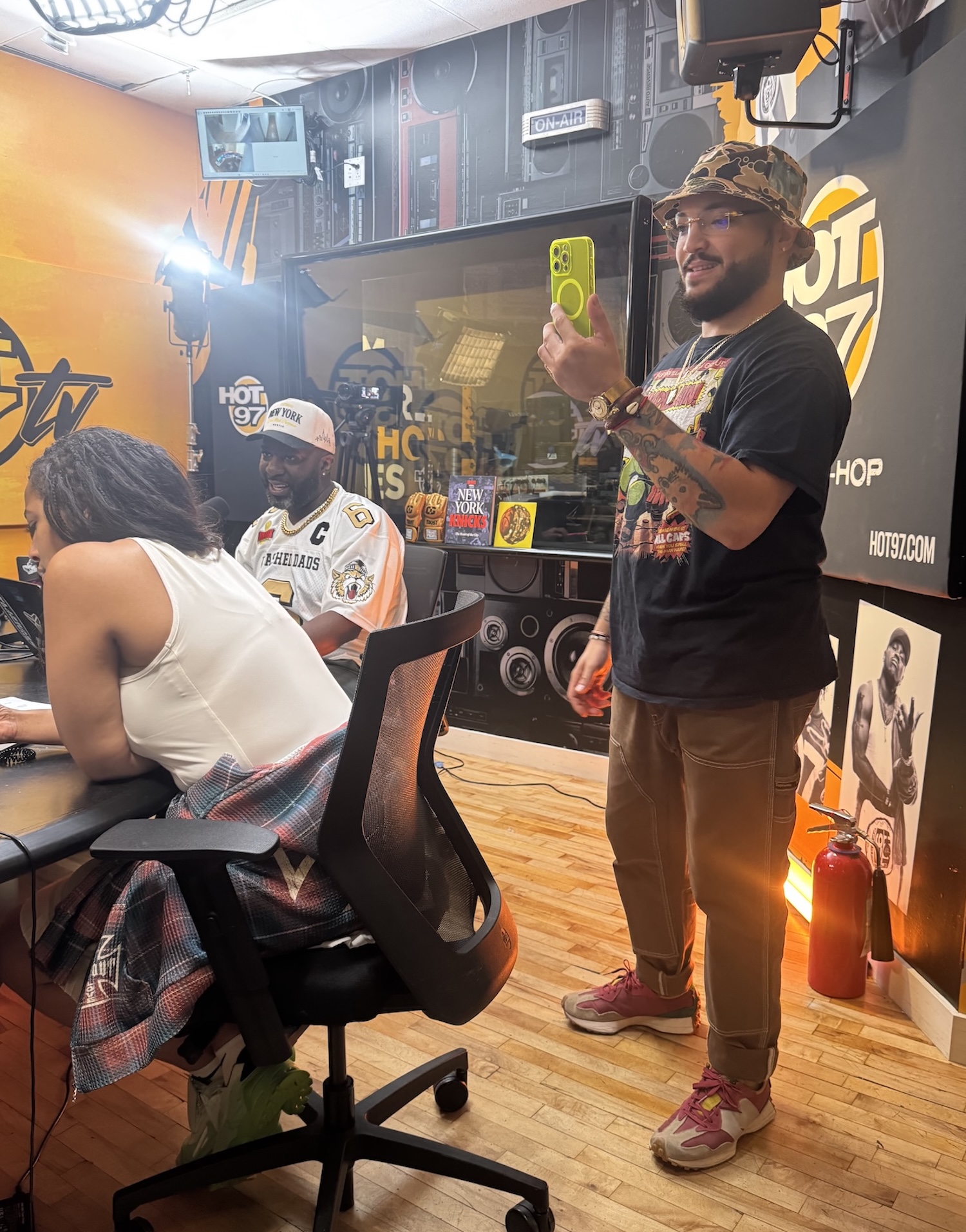
Photo by Abe Beame
The current Hot 97 studio, moved by new ownership from its old space on Hudson at the bottom of the West Village, was described as “Spartan” by Jon Caramanica when he shadowed Mero on his first day at the helm, and not much has changed since. Gone are most signs of its legacy that once decorated the old, Cooperstown-like studio. The most culturally and historically important radio station in the history of New York City is now a white box late-capitalism staging area that resembles a stash spot, a utilitarian satellite lacking an attachment or permanence worth personalizing. Rainey Ovalle, a Dominican from East Tremont with a frankly disconcerting fully tattooed skull, who runs social media for Hot 97 as well as Victory Light, puts it best: “This shit looks like The Backrooms.” The morning I sat in, the WiFi at the studio was spotty. “We in the Garment District, man. They used to have kids in here sewing and shit. There’s still asbestos in the ceiling,” Mero jokes, but it’s the ideal setting for him.
In radio, he’s found the relationship he wanted out of television. This zero-frills operation is a comfort zone, with his own team, calling his own shots, booking his own side hustles, and keeping 100% of the related income, with a platform that still offers cache and opportunity to blessed networkers like Mero, who have a hardwired New York City work ethic. The barren studio serves as an apt metaphor for the current state of this decaying industry and the type of talent that is built to navigate and thrive in the wreckage of our dystopian present.
I first met Mero at a taping of 7 PM in Brooklyn in June. He had woken up at 4 a.m. that day for the morning show, then made an appearance on ESPN with Steven A. Smith and Cam’ron, before coming to Red Hook for what would be a six-hour recording session. The night before, he’d hosted an NBA Finals watch party uptown with his recently made fast friend, the Queens kid Mayor Zohran Mamdani. The next day, he was heading to Michigan for a hosting gig with More Perfect Union, the progressive news organization that flies him out for occasional events even though there is very little overlap in terms of “vibes”; they simply love Mero. In addition to Victory Light, which is branching into a white-glove production company that makes content for other internet projects, he also has four kids, all under the age of 16, and is currently writing a book of essays on “parenting and marriage and all that shit for Random House. Shout to Ben Greenberg.”
When the 7PM session finally finishes, 16 hours into his workday, Mero sprawls on a leather couch in the lounge area of Carmelo Anthony’s palatial loft, where a registered nurse practitioner named Trevor sets him up with an IV drip to replenish fluids and vitamins. Hooked up to the bag as Trevor monitors, Mero rolls a blunt and lights it, putting it in rotation with Kaz. Kaz takes a few hits, and suddenly the comedy of the situation dawns on him. “Is he supposed to be smoking this shit while he’s doing that?” Kaz asks, semi-concerned but mostly amused, holding up the blunt and gesturing towards the IV. Trevor shrugs. “I wouldn’t exactly recommend it.”
Mero laughs, pleasantly exhausted, and with no corporate entity garnishing the “10 bands” he makes per episode. I find it appropriate that even in this moment, taking a break from the eternal hustle for some necessary self-care, he is doing shit on his own terms.
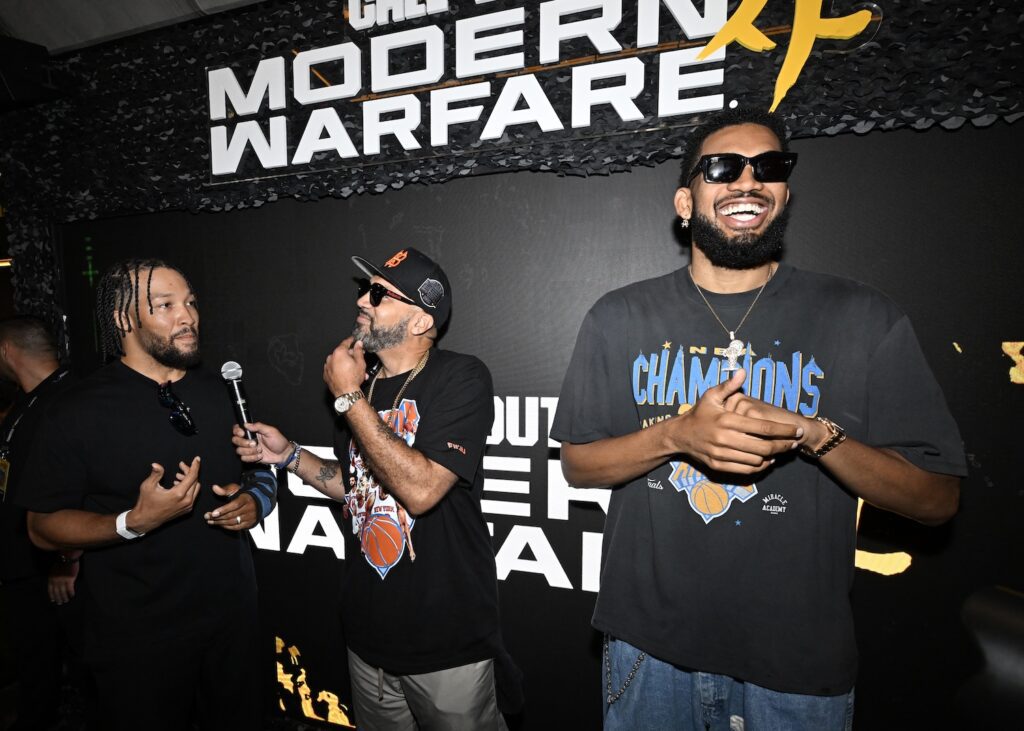
Photo by Eugene Gologursky via Getty Images
After the morning show and a post-show Memphis Bleek interview, I was invited to tag along with Mero and Kaz to a gig hosting an event downtown. We get into a black, double-parked Escalade outside the studio, and I meet Sneif, a skinny dude sleeping behind the wheel in a Desus & Mero shirt. Snief is either from Detroit or irrationally protective of the Pistons if you happen to shit on them while debating the Knicks’ chances of winning the East next year without Mitchell Robinson. Mero tells me he met Sneif on set at Showtime and folded him into the team.
It’s explained to me, as we head downtown, that the beloved UK chicken chain Nando’s has opened a pop-up restaurant/lounge on the corner of Bowery and Broome for the World Cup, and a sports media company called offball is hosting a watch party of the Spain-France semifinal, which, in addition to England and Argentina, forms a final table Mero refers to as “The Big Four Colonizers.” The space made for a beautiful, if somewhat impractical, location for a World Cup HQ; elegantly appointed, yet constructed entirely of choke points and obstructed views of the two large adjacent flatscreens hung from the walls. It was free food and open bar for the less than 50 uniformly wealthy and attractive people hanging out, and I took advantage of both while ostensibly reporting.
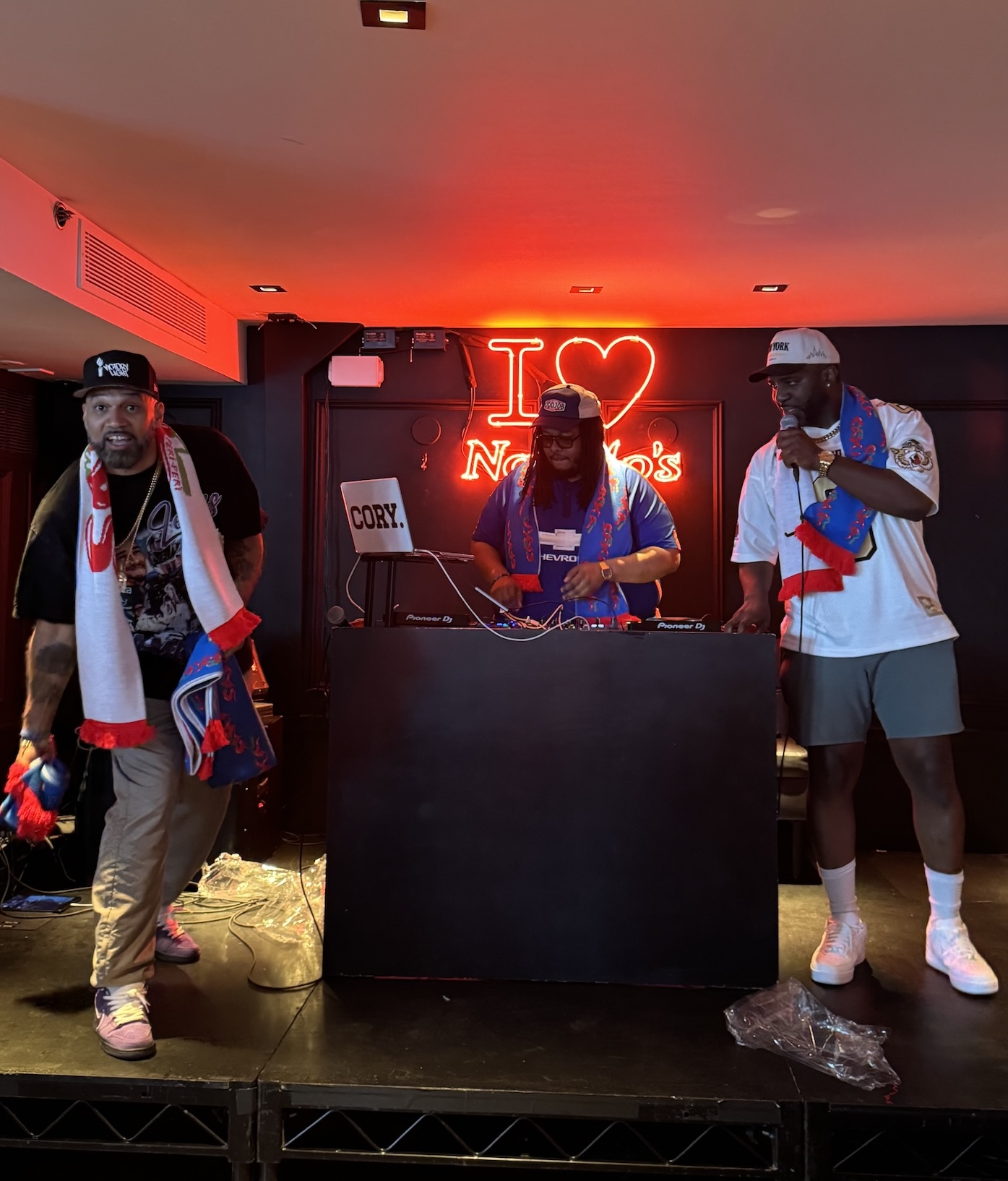
Photo by Abe Beame
There was a lot about the event that was hard to wrap my head around. For instance, why is Nando’s doing this? They have announced no plans to extend their brand to New York, but had rented and outfitted this beautiful, exorbitantly expensive commercial corner space for a month and were now—to no end anyone connected to Nando’s could properly articulate to me, besides wanting to offer fellow Brits a “home away from home” experience for the tournament—giving away free food and alcohol.
Mero had been schmoozing for roughly an hour before taking the initiative to try and find an organizer for the event and ask what, as “host,” was actually expected of him. The answer was not much. As the game wore on, Mero and Kaz were corralled into a corner to take a few pics and record a few snippets for socials. After the game, they briefly jumped on a makeshift stage where the DJ and sports Twitter influencer Cory Townes was spinning. They say hello, crack a few jokes, and shuffle off. Bag—he ballparks between $20,000 and $40,000—secured.
This is not to suggest Mero didn’t earn his money. I shadow as he circulates, working the room, shaking every hand, sharing meaningful conversations, and having at least one good laugh with each old professional connection, or European who has no idea who he is, with no discernible shift in energy or focus. It’s balletic, athletic, artistic socializing. He’s having a great time, and so is everyone else, but it’s blurring the line between work and fun. Rooms like this one have led to many bags in the past, and will provide many bags in the future.
“You put somebody from New York on a desert island, they’re gonna find some bullshit to talk about. ‘This fucking palm tree, bro. Every other palm tree over here is leaning to the right. Why are you leaning to the left?’ It’s always having an opinion on some shit,” Mero tells me. “Being here instills a natural curiosity in you because you’re growing up in all these weird, diverse situations and you’re always trying to understand where people are coming from. It makes you an anthropologist that can find ways to connect to anyone.” This is both true and somewhat unfair to Mero, as this city is full of brilliant, hilarious, charismatic, wonderful people who are never able to move past selling sheetrock in glassine bags to crackheads in East Fremont. Jayson Rodriguez agrees. “Some say [Mero’s] talents are humor or his intellect, but I think underneath it all, his real talent is spotting the right people and connecting with them.”
The event has a kind of This is Your Life quality. Former co-workers from VICE, whom Mero hasn’t seen in years, approach to trade memories and reflect on that wild, reckless halcyon era of internet media. The legendary Hotspur and Arsenal center back Sol Campbell corners Mero for a while; the two had connected years ago at some party Mero couldn’t exactly place. Writer Rembert Browne appears and wraps Mero in a bear hug, spending five minutes praising how far he’d come. “It was preordained 15 years ago. We were all supposed to get here together,” he says. Kaz and Mero get alerts and are simultaneously informed that over the weekend, the Fanatics Fest event they are hosting together will be a Call of Duty grudge match between Jalen Brunson and Karl Anthony Towns. Mero steps outside for a moment to take a call and ends up in a cipher with two random kids smoking a joint, returning with a pocket full of pre-rolls they gave him to promote the weed company they’re getting off the ground. It’s a bizarre, rapid succession of nothing but amazing come-ups that feel like some kind of simulation of a game that you win after entering a cheat code.
I’m basically done reporting, so I hang back in a corner with a free, cold beer, watching Mero in his element: Blunted, on the Bowery, getting paid to eat wings with a touch of char and tang that fucking slap, bonding with strangers and watching a World Cup match on a mid-summer afternoon. “For the longest time, bro, I was always like, I’m just happy to be here. And at a certain point, if you keep that attitude, motherfuckers will walk all over you, like you got ‘Bienvenidos’ on your fucking forehead. I can’t be that guy. I was never that guy in my personal life, outside on the block.” Mero told me. And he isn’t that guy anymore. What he understood before most is how quickly the ground is dissolving beneath us in media and that the game has always been fucked up and closed off to guys like him. It is precisely because these are the end times that he’s been able to jam through the industry’s door and use that sliver of space to break through culture.
The event was still going on, but Kaz and Mero’s jobs were done, so we exchanged pounds and they piled back into Mero’s black Escalade, woke up Sneif, and drove off on cobblestones, west down Broome, en route to the Holland Tunnel. Mero had a longer ride home ahead of him. He had, after all, achieved the ultimate dream and lifelong ambition of every true New York City kid: Get rich, get off the block, and move to New Jersey.