Photos by Atoosa Moinzadeh
The LQQK of Love
How to build and sustain a multidisciplinary DIY brand, according to LQQK chief Alex Dondero
“Sometimes, I worry about losing the plot.” It’s a sticky Wednesday afternoon in June, and Alex Dondero is mulling over what it means to make art in the trend economy. The founder of LQQK (pronounced “look”), a print shop and local creative hub, located in Bushwick at the heart of what he calls the “Graham Avenue Garment District,” is seated across the table from me, an industrial-sized fan blasting behind him. In his latest studio on McKibbin Street, the walls are adorned with the books, records, and trinkets he and his friends have collected over the years; to my left, racks of defective garments are hanging to dry, given new life with a tie-dye job by artist Kevin Emerson.
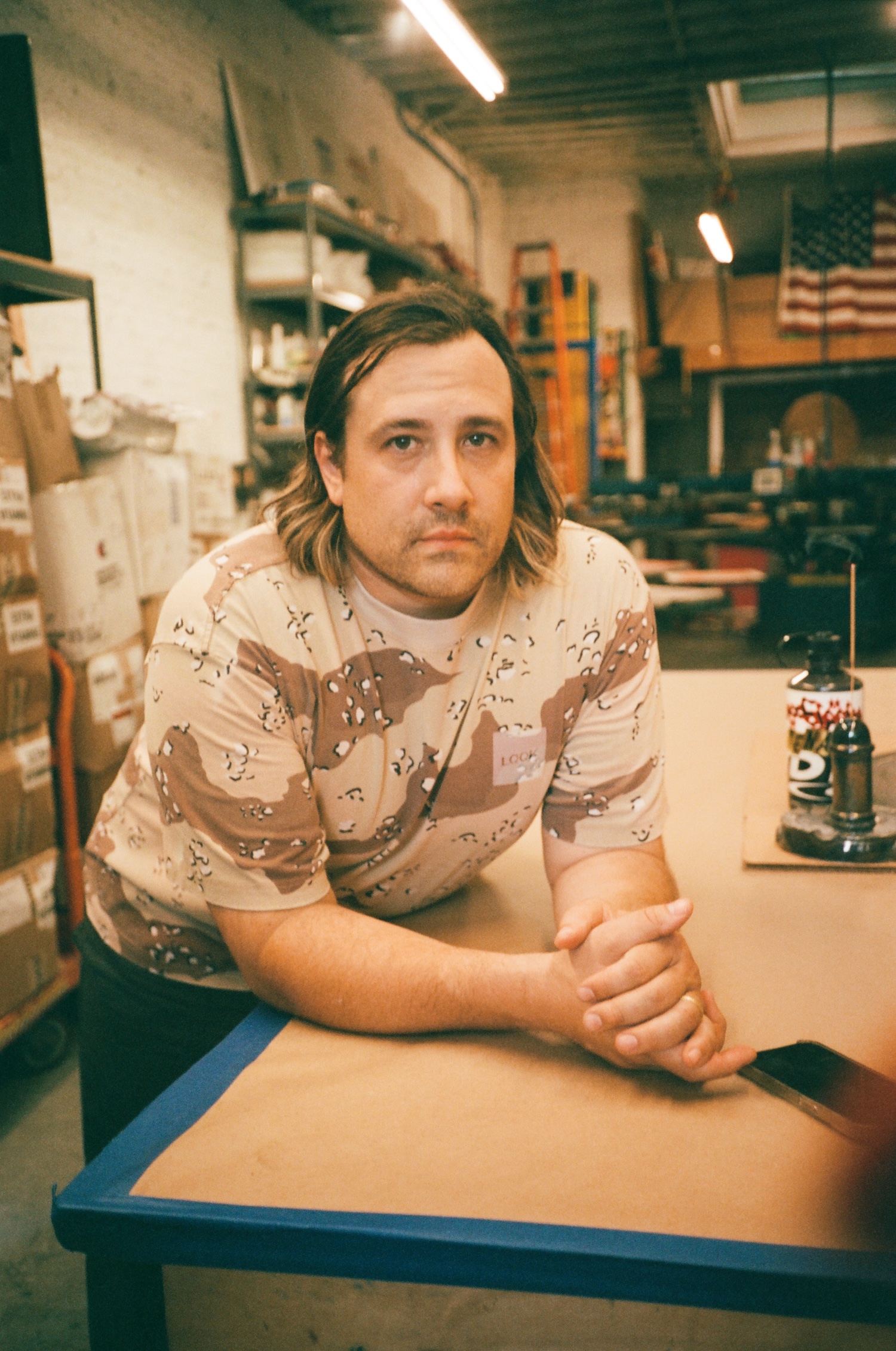
Photo by Atoosa Moinzadeh
This summer marks 15 years since Dondero signed the lease on his first studio at 80 Manhattan Avenue, just a block over from the current LQQK campus, and Dondero’s asking the question of this moment and every preceding one, which has plagued fashion and streetwear designers at all levels in recent decades. When once rebellious, countercultural skate brands build releases around high-volume mainstream cash grabs, designers like Dondero hold firm, even in the midst of a recession, increasing rents, and the subsumption of subcultures. “I know I haven’t,” Dondero asserts, because “as long as your network and your community stay strong and support you, the path is clear.”
LQQK’s core team consists of project manager Ande Jonas, design lead Aaron Levin, and designers/screenprinters Henry Plesser, Toya Horuichi, and Jordan Barrett. “Of course, everything starts in the studio,” Dondero says. Neighbors like Arena Embroidery, graphic designer Joe Garvey, fabricator Emma Seinkiewycz, and the aforementioned Emerson are tapped frequently. “If we can’t do it on this block, then we do it in the city,” Dondero explains, citing the communities he serves and is supported by as central to the work. “Can’t do it in the city? Then we go to our overseas network.”
Sustainability and a wasteless mindset are at the heart of the brand’s ethos, even as it evolves and expands. Since its founding in 2010, Dondero’s collective has bloomed beyond a print shop into both a clothing and record label. They even had a coffee and retail operation for a short while a few minutes away at 109 Montrose Ave, where locals could comb racks of current and archival LQQK collections and items from the micro-labels and brands in Dondero’s orbit of DIY clothiers and designers, cold brew or drip in hand. It’s a scrappy and aspirationally resourceful unit that never thinks small; previous projects include collaborations with Vans Vault, N. Hollywood, Dover Street Market, Reebok, a one-off with Chanel, and roles in massive cultural moments like Drake’s If You’re Reading This It’s Too Late, YEEZY Season 1, and ICNY, Mike Cherman’s high-vis Chinatown Market predecessor.
In celebration of LQQK’s 15th anniversary, Dondero spoke with Brooklyn Magazine about life in his latest studio, how storytelling factors into his printmaking and design theory, and what’s still ahead for the label and the minds behind it.
(This conversation has been edited and condensed for clarity.)
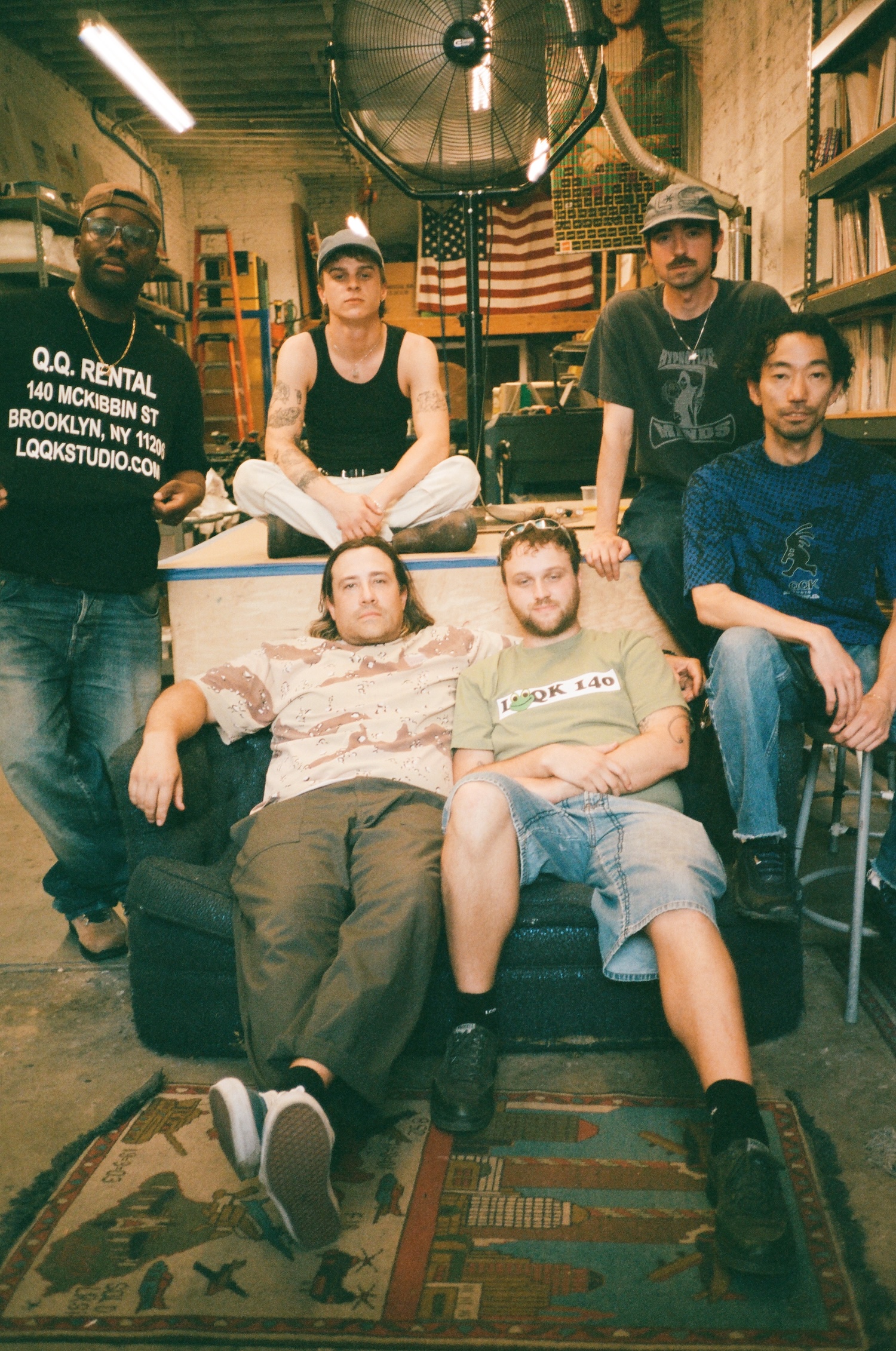
Photo by Atoosa Moinzadeh
How’d LQQK Studios get started?
Initially, the studio concept came from just needing a shared space for a lot of like-minded people. I’ve been screen printing since high school, but as far as like wanting to pursue it professionally, I think I kind of discovered that in college. I graduated from school in Baltimore, but I knew I wanted to live in New York, and it felt too difficult to move the print shop that I had started there while I was in school up to New York. So, once I found a bunch of friends that also needed shared space, I eventually realized that I probably could do it as a full-time thing.
You opened the studio in 2010 in a different location at first, right?
Bushwick has always been kind of like our home. We were further down the street, kind of in between the Morgan Ave stop and where we are now. Then we moved over to the 80 Manhattan location, and we were there for, like, nine years. We’ve been in this space for six years now.
Right before COVID-19, I signed the lease for our current location. We had outgrown [109 Montrose Ave]. That’s where I kind of discovered what I was really into and what we were doing. We outgrew it probably year two, but stayed there for another seven years because it’s scary running a business, and when you’re worried about your overhead costs, it distracts you from making the creative decisions that you want to be focusing on. I wanted to focus on running a brand and starting a brand and helping other people produce stuff without having to worry about if I can pay rent.
How would you describe the neighborhood and the environment you were starting this venture in? Today, we have an ecosystem of similarly scrappy designers and brands in Bushwick, like Secret Riso Club and Homerun. But it seems like you guys were one of the first embracing that DIY print spirit.
The first apartment that I ever actually had in New York was one block away from here. So this neighborhood always felt familiar. There’s Graham Avenue to Meeker, where you have the Italian side; where it crosses over on Metropolitan, it becomes more of the Puerto Rican side. It’s an incredible avenue that I think has a lot of mom-&-pop retail for such a long stretch, and I think a lot of people from my generation find it to be their starter neighborhood. So there’s kind of a nostalgia, and I think for a lot of non-native New Yorkers able to mingle and be in community with a lot of the traditional communities that have been here for generations.
For a long time, this area was skipped over, and development went kind of straight to the Morgan/Jefferson area. So this neighborhood always felt like a little secret, a little gem. Now when I say I’m on McKibben, people are always like, “Oh, like McKibben Lofts?” and I’m like, “No, like we’re not really near the McKibben Lofts, even though we’re on McKibben Street; they’re way further down.” Like anywhere, it changes, but it still feels very local and special around here.
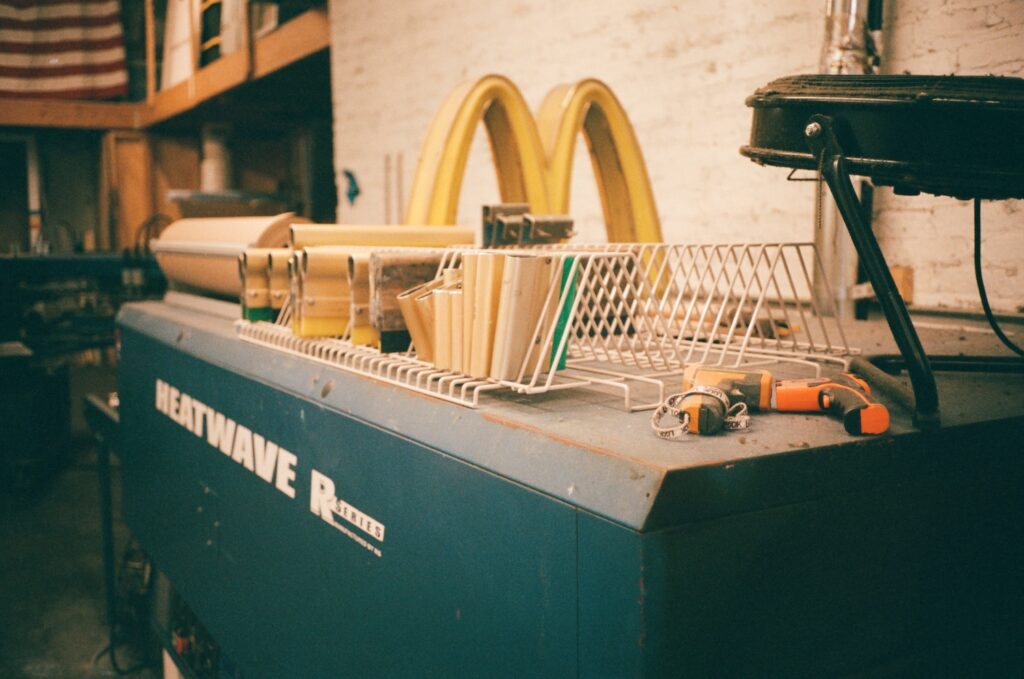
Photo by Atoosa Moinzadeh
When you were starting LQQK, did you feel like Bushwick, or Brooklyn in general, lacked spaces like this? Was there a need, in your view, for this kind of creative hub?
It’s really tough coming from a place like Baltimore, where space is just so readily available and so affordable and so easy to come by. I went from not paying rent for a studio space to all of a sudden being like, “Holy moly, this is incredibly expensive!” And I think New York attracts the most creative people. There’s always this influx of incredibly talented people that goes beyond art. It’s like every field, any industry—people want to try and dip their toe in and see if New York is for them, because they know how much opportunity there is here.
Whenever you mention Baltimore, I can’t help but think of Carpet Company.
Totally. I think those guys have picked up where my generation had kind of left off, which is really cool, because, you know, I was part of this wave of indie and DIY culture. It’s nice to see Baltimore still doing its thing.
Post-pandemic, that whole conundrum with real estate and physical space, and that tension, became especially real. I think across the country, cultivating third spaces is much more difficult.
I think with artists in general, obviously financially, on the totem pole, young creatives are pretty low. So finding spaces and finding studios and shared opportunities is something that is essential and super important. This neighborhood, particularly, isn’t known for that anymore. But I hope people are willing to find a way to do the work and keep that DIY energy alive. I just think that real estate is one of those things where it’s not getting cheaper, so it’s just going to get harder and harder, unless you move further and further out.
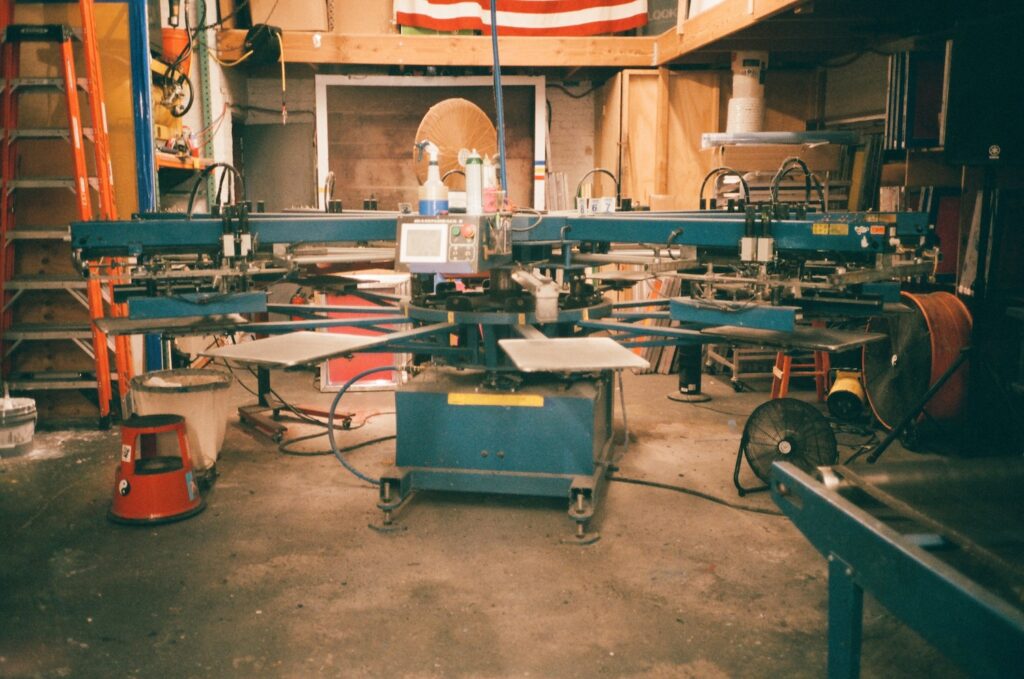
Photo by Atooza Moinzadeh
You guys started out as a printmaking studio but then expanded a little bit into clothing and events. How did LQQK evolve into more than just a studio?
I’m not really interested in fashion per se, but I am interested in clothing. And the more I printed for other people, it made me think, Wouldn’t it be cool if we made our own version of this? I think that’s kind of how that evolution started. Meanwhile, I always wanted my workspace—or an environment I created to have people work in—to feel like a clubhouse, feel like a place to hang out, feel like something that is inviting and comfortable and makes them just want to spend time there, because there’s nothing worse than being in a sterile environment where you’re just looking at your clock, waiting for it to wind down to the end of the day to get out of there. We have people coming in and out of the space all day long, just saying hi, visiting, seeing what’s up, and I think that is awesome.
I hope people understand the motivation behind it. I find there’s a lot of noise out there, and it’s hard to sift through. Sometimes even I worry if I’ve lost the plot. I know I haven’t, but you know it’s hard to not get distracted sometimes by the other things going on, the trends that are popping up. I think as long as your network and your community stay strong and support you, the path is clear.
Do you feel like you’ve developed a certain ethos, or approach, to design, fabrication, and textiles?
Yeah, I think I have a ton of guidelines and an ethos that I try to follow, which is ”Don’t create anything that you wouldn’t see yourself wearing,” for example. That’s really important, and it’s hard when trends are so in our face and so visible in the modern era. You don’t want to lose your own narrative.
I draw a ton of inspiration from heritage brands like Carhartt, Dickies, classic military silhouettes like camouflage, and even brands that don’t exist anymore. I think making sure your references and your influences are rock solid, and then making sure your interests and motivations are rock solid, is also something that needs to be part of that.
When it comes to fabrication, I have this idea where, if we can, we make it literally in-studio. If we can’t make it in-studio, we make it on this block. We have our very talented friend Emma, who does a lot of fabrication for us, our friend Kyle, our friends at Arena Embroidery, are all literally on this block. We call it the Graham Avenue Garment District. If we can’t do it on this block, then we do it in the city. Can’t do it in the city? Then we go to our overseas network. So, for me, it’s about keeping that kind of mentality. When it comes to screen printing, that’s the main thing we do, so of course we do it in-studio. My brain is hardwired to try and do it myself first.
How do waste and sustainability factor in with that?
Big time. I hate sitting on overstock stuff. I don’t have a big ego to think that everything I produce is going to sell. Although I would love that, I know that it doesn’t happen. So when it comes to me buying stuff for our web store, or you know, in-person retail, I buy or produce and order very slim, because as much as I want to think that something’s gonna blow up, I have to just be realistic, in that I’m happier when something sells out than I am with inventory. For example, we have all these tie-dye shirts hanging right here. They’re all actually shirts that had gotten damaged or misprinted or came imperfect from the factory, but we had still printed a design on them, and I gave my friend Kevin Emerson, an incredible artist, all these imperfect shirts from the last run. So he hand-dyed all these, and they’re each one-of-a-kind.
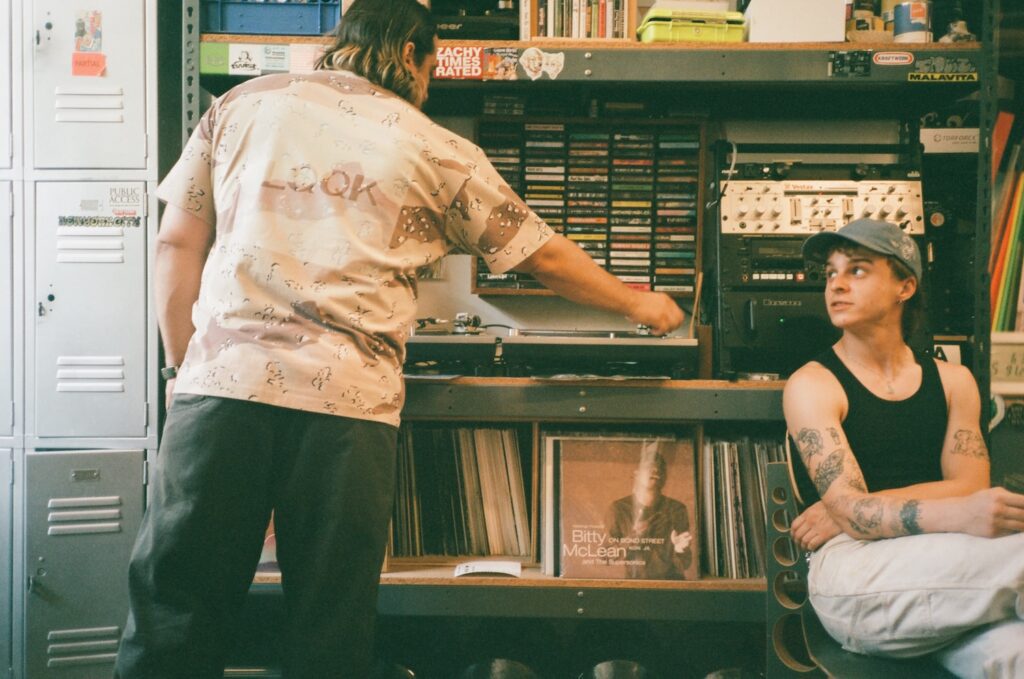
Photo by Atoosa Moinzadeh
I know you’re a big record collector. Do things like album art, liner notes, or other analog formats influence your process?
We’re so deeply rooted in club and dance music, classic rave culture fliers and t-shirts. Liquid Sky is probably my number one influence. I’d say that if I ever feel like I’m hitting a wall with design, I’ll oftentimes just go to a record store and just flip through the records and just let it wash over you, because the typography, the photography, the design, the layout—all of it is such an endless resource, and it’s part of LQQK’s DNA. When I first started screenprinting posters for shows, it was because I just wanted to be in the scene; I just wanted to be involved. So it’s like music and print for me; you can’t separate the two. That analog approach is me at my core. I love the old school, I love the tactile. I know I don’t reject modernity, but at the same time I can’t forget what got me into what I do.
What are some of your favorite collaborations from over the years?
The first one that comes to mind is Vans, because, for me, that was kind of the number one brand I wanted to work with. Next up is this Japanese brand called N. Hollywood, which was also kind of a dream, because when I first moved to New York, menswear was still in a funny stage, where there just weren’t many brands and shops that you could tap into.
I guess the last one would be Sneeze Magazine, I think. Sneeze was another one of these, where it’s such a respectable identity that Sneeze has built, a physical publication that’s skate-adjacent and fashion-adjacent, that’s culturally relevant. So when that opportunity came, it was like a dream come true. We did the cover for one of the issues during COVID, when we first moved into our current space, and we were able to get a ton of the community together to come and just snap a big photo in front of the door. It was a really beautiful moment. Then, we did a clothing capsule with them, and that relationship’s ongoing. We print shirts for them now, and it’s just like an ideal, true collaboration, where you respect each other and both bring something to the table.
What are you most excited about for LQQK’s future?
Beyond a few drops coming up, including another one with N. Hollywood, I think I’m trying to become more disciplined in our brand’s design practice. So, I’m looking forward to getting more honed in. Recently, we threw a party at Good Room. I haven’t promoted a party at a venue in a little while. I used to do it all the time, and I think COVID kind of hit the reset button pretty heavily. It gave me a moment to really sit back and figure out what my lane really was. I still go to Japan twice a year, and we’ll throw parties out there, which is really fun. But it’s nice to bring some energy back to the hometown crowd. I’m gearing up to throw some more parties at the studio, so some of that energy around LQQK being a community space is reinvigorated.
In the 15 or so years you’ve been doing this, the brand has evolved, but I’m sure you have, too. How has running LQQK changed you as a person or helped you grow? What has it taught you?
It was one of those things where I knew I was never going to pursue a traditional career path. It’s about sticking to my guns. Even when I know that financially it’s probably a bit more uphill or difficult than, you know, maybe other careers or job trajectories could be. I think creating this environment and community has ended up being way more rewarding, and it’s taught me a level of responsibility that I don’t think I was expecting when I first started it. People depend on you, and people are looking to you to see that, “I don’t have to march to the beat of the drum that everyone else is.” It’s like, “I can literally forge my own path if I want. If I want to start my own thing, I can do it.”
You have a responsibility to show people that you can achieve anything you want if you’re mindful and respectful to your peers and those people that are going to support you. Realize where those relationships are, and really nurture them. Just share love with the community and try not to have an ego in the process. I think more than anything, I appreciate everyone that comes through these doors.