Photo courtesy of Harper Pictures
The Upstate Horror of Jane Schoenbrun
‘Teenage Sex and Death at Camp Miasma,’ Schoenbrun’s new film, is a gory love letter to a bygone era
Through the Battery Tunnel, up the West Side, across the Hudson River, and out into the Palisades. The lanes narrow, the thruways becoming small highways. Concrete, steel, and glass give way to verdant mountain vistas, jagged rock faces, and tree-lined corridors. Something knotted in my chest I didn’t realize was clenched, and can never seem to remember is always, permanently clenched within city limits, releases, and I know for the next few days that I will breathe freely.
“Upstate” is a catch-all term in New York that technically could encompass anywhere from Yonkers to the far reaches of Western New York and the Canadian border, a seven-hour drive from the George Washington Bridge. But for the most part, colloquially and historically, it’s used to identify the span north of Westchester and south of Albany, two and a half hours by car, running along either side of the Hudson River, a strait straddled by Pennsylvania and Connecticut. For generations, it’s been a haven for people who want proximity to New York without the stress, as well as a place city dwellers can travel to for foliage, to jump into swimming holes, to hike and ski. Or, in my case, to throw some shit on the grill, drink Burgundy, read books that are not for work, and watch Yankee games or old movies on a porch, surrounded by nature, if not exactly in it, with friends and family.
Jane Schoenbrun has been enamored of upstate life and culture for years. The Westchester native’s first narrative film, 2021’s We’re All Going to the World’s Fair, was shot between Saugerties and Middletown in the Hudson Valley. By the time their second feature—2024’s American-film-of-the-decade contender I Saw the TV Glow—was gaining steam, they had joined many New Yorkers, post-COVID, in a decision to buy property and maintain a permanent footprint upstate, splitting their time between Brooklyn and the village of Catskill, New York, 124 miles north of the city. It’s now Schoenbrun’s fourth summer living under this arrangement, which is why over the weekend, for their third feature, Teenage Sex and Death at Camp Miasma, it made sense to bring their work home with a blowout “Upstate Premiere” at the Community Theater in the middle of Catskill, where Schoenbrun has programmed events, will serve as honorary chair for the theater’s Fall Gala, and hangs out for movie marathons when there is downtime between pictures. (The film had its proper premiere in May, at Cannes.)
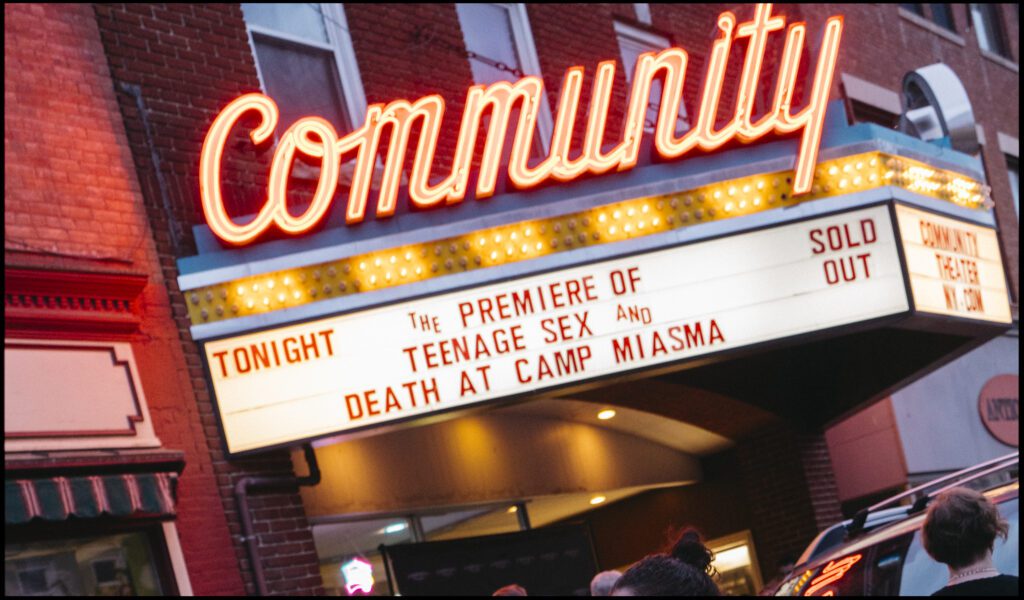
Photo courtesy of Harper Pictures
A little over 3,500 people live in the village of Catskill—approximately two percent of the population of Flatbush—on the west bank of the Hudson River. As you enter the town via two-lane Highway 9W, the mountainous terrain gives way to two-story, faded-vinyl-sided single-family homes crowding the road, with ample green space between and behind them. The town proper is defined by literal Main Street, featuring a banner strung across the road on light poles celebrating the 250th anniversary of America. But as I look for parking, it’s clear today Main Street will be defined by Community Theater and the premiere, as a line stretching several blocks down the street has formed two full hours before the film’s start, the crowd happily braving the heat on the first day of August.
Catskill is one of upstate’s many politically liberal, pocket-crunchy artist communities—stuffed with city expats, old hippies, and all stripes of misfits who’ve found no better-fitting societal container—in a region that has been historically characterized by city folk as a WiFi-less deep-red home for Confederate flags, cow-tipping, and opiate abuse entirely disconnected from the larger world. (It’s a characterization Jane has fun with in Miasma.) The line is clearly “Jane’s crowd,” gender-fluid with vibes more city than country. It’s impossible to know if this is because a progressive contingent of locals have shown out, or because many other film nerd Brooklynites have made the pilgrimage I have, upstate for the weekend. A better point is the aforementioned post-COVID migration and the general global cultural bleed of Brooklyn that has made the idea of a distinct city-country cultural divide harder to parse. The cafes, game shops, Greek restaurants, antique stores, and dog-shitless sidewalks of this well-maintained small town have aggressively tattooed e-girls and “cool” dads in the same per-capita ratio as you might find in Carroll Gardens, at a slightly lower density.
The crowd is emblematic of the highbrow/lowbrow fandom Schoenbrun commands, with Maya Deren shirts, handbags upholstered with The Overlook Hotel carpet fabric, and Friday the 13th merch in equal measure. Schoenbrun currently occupies a rare and arguably unprecedented space in the American cinematic landscape: a queer filmmaker with pop genre sensibilities whose films work for John Waters and Clive Barker fans alike. I see a quartet of women in full-body makeup that makes them appear splattered and stained with blood and viscera, quoting a look from the film, so I ask if they’ve seen the movie before. One tells me this would be their third screening. “I saw it at Cannes, then I saw it at New Fest,” they say. And now they’re seeing it at the Community Theater, which I can’t verify but would imagine is making some kind of obscure history.
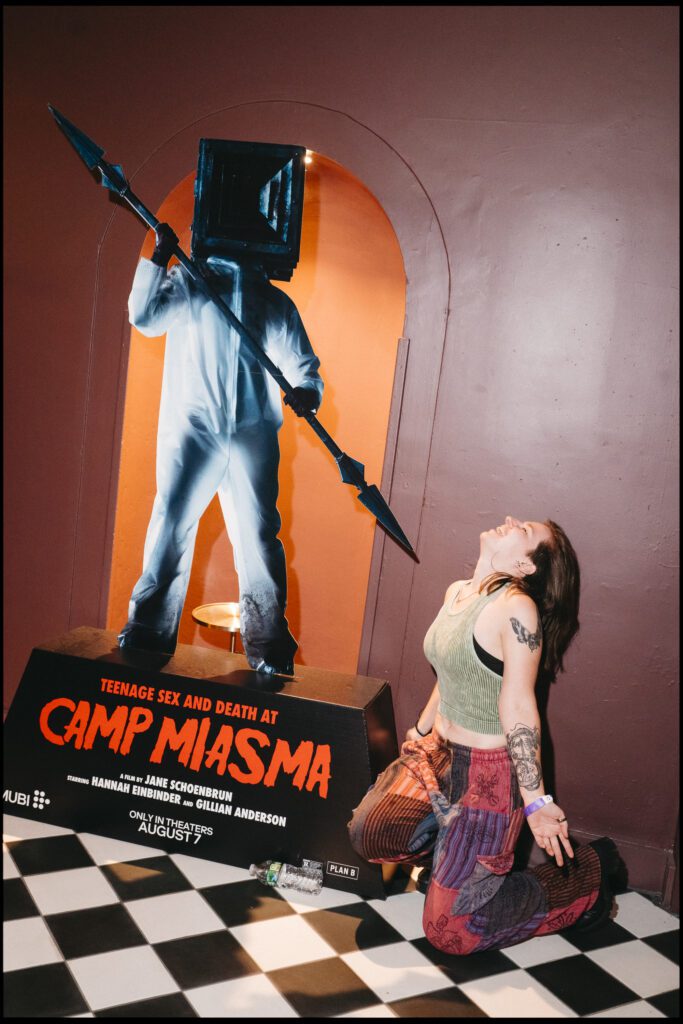
Photo courtesy of Harper Pictures
Schoenbrun is fascinated by the ephemera of ’90s childhood and the bonds we formed—not just to the shows and the toys and the trading cards and the urban legend message board threads—but the ideas of these talismans, the limitless mystic power they held in our imaginations that clash with their pale, cheap reality. In this case, Camp Miasma is an ’80s summer camp slasher franchise that indie filmmaker Kris (Hannah Einbinder), a director focused on “depictions of queerness and cultural monstrosity,” has been tasked with reviving and updating for a Hollywood studio. The film follows Kris’ descent into the wilderness to track down Billy Presley (Gillian Anderson, swinging from her heels), the final girl from the first installment, who has gone offgrid, and the fantasies and truths she finds about herself with Presley in the woods.
The target ephemera here is the siren call of illicit gore and boners each graphic, creepy VHS box promised us as children stalking video rental aisles on Saturday nights like this Saturday night, in small upstate towns like Catskill. It’s a love letter to the saccharine pop we listened to on our way to grab the movie and dinner from a drive-through, the greasy chicken fingers we ate and the Sour Patch Kids and Cherry Coke we chased it with as we fried our brains and libidos with scary movies. The Community Theater makes sense as a home for these interests. A small store abutting the box office sells movie figurines, comic book adaptations, soundtracks on vinyl, and used copies of Goosebumps, as the air conditioner blasts and a John Carpenter synth score thrums for perusers escaping the heat.
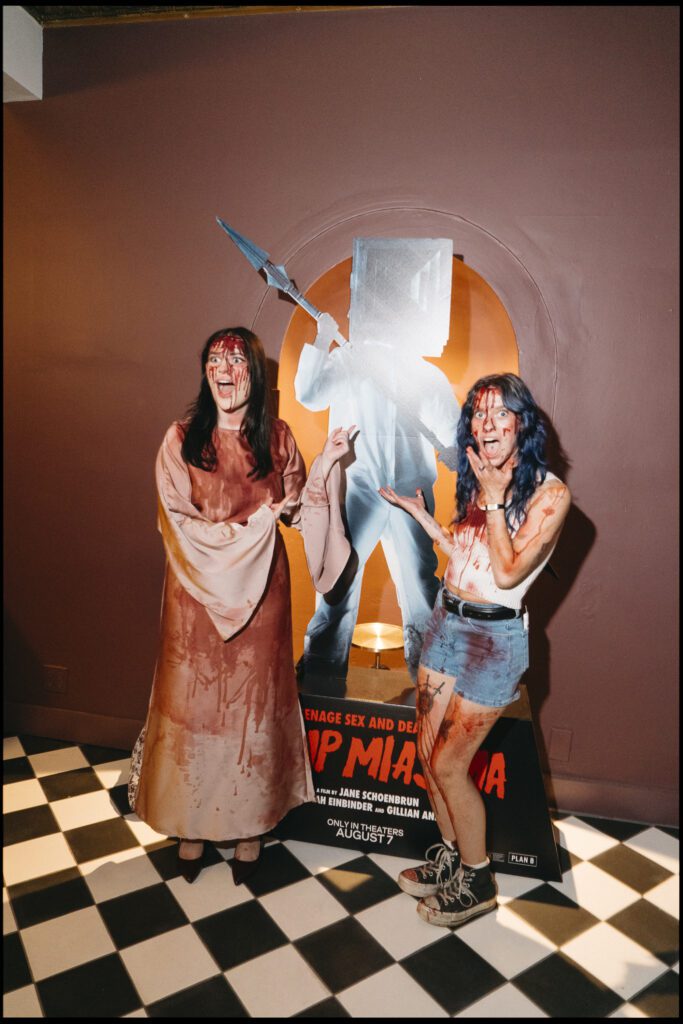
Photo courtesy of Harper Pictures
“This is my living room. I live nearby. My friends and community are here tonight,” Schoenbrun, in a flowing purple skirt and black sleeveless top under a denim jacket, announces to the crowd. They are flanked by surprise guest Einbinder on what they informed us was their six-year HRT anniversary. Community Theater is an immaculately preserved century-old two-screen movie palace I am told has never sold out its 500-red-felt-seat ground-floor theater before; it did so for this event in 12 hours. Einbinder is from Los Angeles, where she had hosted a Miasma screening a few days earlier with Schoenbrun, but is now on Schoenbrun’s home turf, admiring the change of scenery and pace. “When you leave New York City and you enter the space we’re in right now, you feel the peace wash over you,” Einbinder says. To set the mood, Emily A. Sprague, a local ambient electronic musician and friend of Schoenbrun, plays a brief set after the intro and before the film.
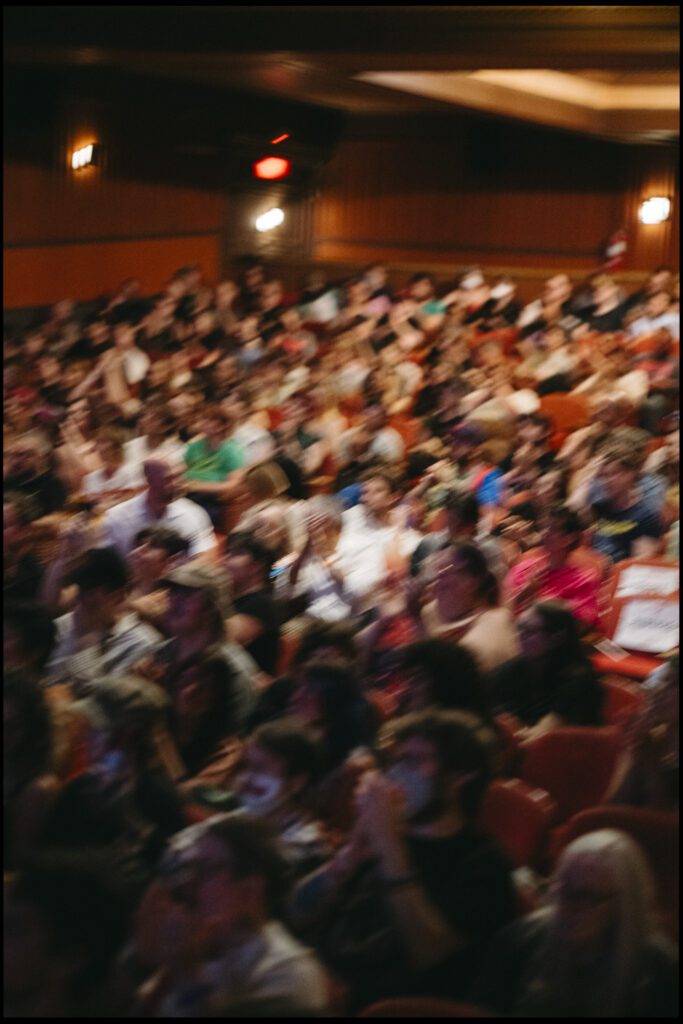
Photo courtesy of Harper Pictures
The lights dim, and the cheers that follow title cards for the film being an official Cannes selection, and one announcing one of its stars, the trans actor Jack Haven, make it clear this viewing experience, for a self-aware future midnight repertory classic, will be very different from the first time I watched it, at 10 a.m. in Midtown, in a small screening room half-full of jaded critics. (I’d recommend, deadline permitting, every critic seek out this film in a raucous, sugar- and booze-drunk house before filing, to see it as Schoenbrun intended.)
Teenage Sex and Death at Camp Miasma is a meditation on how we make movies and, in turn, how the movies make us. It’s about sublimating desire and trauma and working through both in film. It’s escapist tender carnage, a nostalgic, funny, bloody, horny, winking Mini Chewy Sweet Tart orgy that announces its jump scares and is as romantic and sentimental about the flesh and the fluids of traditional horror as it is about its own big ideas.
The film is also an industry satire. Schoenbrun is grappling in real time with their sudden demand in Hollywood and the anxiety that comes with the temptations therein: to sell out, buy into the hype, and become another cog in a machine repackaging problematic “Zombie IP” for a woke contemporary audience. In the movie, a VHS copy of the original Camp Miasma promises, “Now, if it gets too real, you can always turn it off.” At one point, Kris asks Presley why she decided to move to a haunted summer camp in the middle of nowhere. “I bought myself a private alternate universe,” she replies. I couldn’t help but read an element of the film as rationale for why Schoenbrun felt the need to create some distance between work and home, to move upstate in the first place.
After the screening, dozens of cars with kayaks lashed to their roofs make their way to the nearby Hi-Way Drive-In Theater in Athens—a four-screen clearing in a field across the road from a gun range—for a horror movie marathon afterparty programmed by Schoenbrun (an appropriately postmodern slate of Gus Van Sant’s shot-for-shot Psycho remake, A Nightmare on Elm Street 3: Dream Warriors, and 2009’s Rob Zombie-directed Halloween 2). When I get to the drive-in, I’m brought to a back area, half a football field from the rows of parked cars, in a cordoned-off space rich in what can only be described as “adult sleepaway camp vibes,” where revelers play cornhole, drink IPAs, and make campfired, custom-built s’mores fashioned from a picnic table dessert bar strewn with free cookies, crackers, chocolate bars, and marshmallows. Schoenbrun is hanging out with Einbinder and friends, celebrating another rave screening, sitting in a circle on the grass, finishing a late dinner of deep-fried junk food culled from the drive-in commissary.
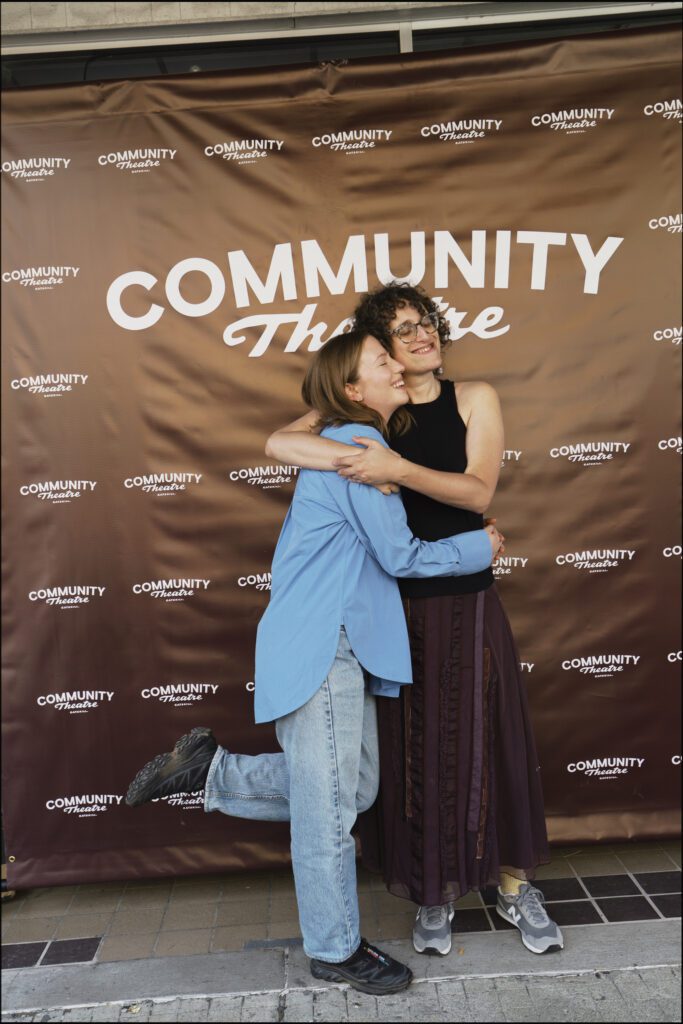
Photo courtesy of Harper Pictures
“I remember somebody asked my friend [Sorry Baby director] Eva Victor what I was up to and they said, ‘I think Jane is just trying to build a good life that can wait for them.’ I’m in a healthy place, and such a huge part of that is having space and community here that feels detached from the film industry. The way people live up here, the queer folks especially, it’s a really nice, caring little family unit,” Schoenbrun tells me. They see Catskill as an opportunity to spend some time outside of the suburban/urban coastal bubble they’d lived in their entire lives and experience a different perspective of this country. “I like being not in a total silo. I’ve been thinking about it in my own work, what it means to be an American filmmaker, which requires being in a space that—you’re not just surrounded by the same things everyone else has in Ridgewood, or whatever.”
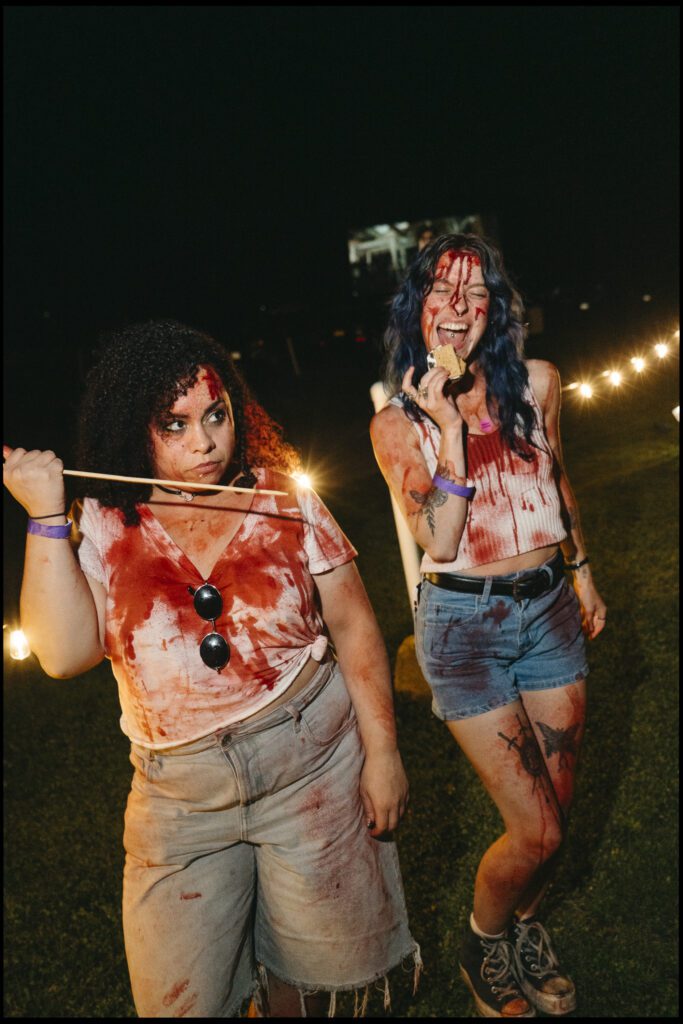
Photo courtesy of Harper Pictures
As I walk back to my car, Vince Vaughan is being projected through the night onto a huge screen, butchering Anne Heche with a long blade as violins squealed under a sky full of visible stars. A chirping chorus emanates from the forest around me, competing with the disjointed surround-sound of one movie being broadcast on 100 car radios simultaneously, carrying on the August-thick humidity. It’s a night for the primal upstate pleasures of warm, shitty beer, sugar and blood, and I think about Schoenbrun’s final words to me, and how they explain so much of what I found interesting and moving about the evening and the evolution displayed in their new film.
“These years up here have definitely coincided with growing. But I think of that as a necessary part of any transition. I decided to change my life, and being here, it’s the life that I always wanted,” Schoenbrun says, equating their move upstate to a form of self-actualization. “I love the folks up here, and I think that my movies are getting less lonely, for sure, because I’m getting less lonely. There’s still loneliness, but I feel like I used to spend a lot more time on the computer.”