Photo by Michael Gonik
Starker is Remixing a Sacred New York Rap Formula
A trip down Fulton Mall and memory lane with the ascendant mixtape rapper
It’s cold enough on a Wednesday evening towards the end of April to get away with a Polo sweater, so I throw one on before heading downtown to get drinks at a steakhouse on Fulton Mall with the rapper Starker, in an attempt to make a good impression. The Brooklynite is a Polo head, sneakerhead, and model who grew up between the Cooper Projects and Boerum Hill, and up until relatively recently, has been known as much for his music as his style.

Photo by Michael Gonik
I pace around in front of a steakhouse waiting for Starker, in the shadow of yet another luxury apartment building going up in a dirt lot, fenced off with a perimeter made of painted plywood between Jay Street and Boerum Hill Place. The honorarium “Fulton Mall” is less ironic than it was a decade ago. There is now an actual mall within the blocks’ long, open-air shopping district between Flatbush and the courthouse.
There are several banks, a Gap, a Banana Republic, and a Starbucks in an area that once resembled an American souk in Downtown Brooklyn, where at independent, all-purpose retail stores the price of everything was negotiable, from Air Forces in colorways that hadn’t properly released yet to fake leathers and bootlegged mixtapes. Traces of this “old” Fulton Mall remain on display—Zumiez, the Foot Locker, beauty supply stores, a Metro PCS, Five Below, Rainbow, a Dollar Tree—but who can say for how long. It makes this stretch of Fulton one of the more overt physical metaphors for the great change that has taken place in Brooklyn over the past 25 years, remnants of what the borough was, shoulder-to-shoulder with what it is and what it will be.
This tension is very much in conversation with Starker’s music, progressive but steeped in a deep reverence for Brooklyn’s cultural history. His new project, LIVING TYPE DANGEROUS VOL. 1, honors the traditions of New York Mixtape Rap, with an emphasis on clever dickhead punchlines, spiked with smirking ad-libs (“I’m smarter than you”), subverted pop culture references (“The gang don’t change like the cast of a Happy Madison production”), and local landmarks immediately recognizable to a certain genus and generation of New Yorker (“Bust a slap on Fulton and St James in the same Coogi Biggie got”). It’s a recipe that defined an era, in which the most romantic thing you could say to a woman is you’d buy her a pair of matching Js on a shopping excursion to Fulton Mall.
But on LTD, Starker raps with a disrespect for pocket that would provoke physical acts of violence from Lloyd Banks or Young Buck if you tried it on a G-Unit Radio installment. He has a taste for production commensurate with the New York rap era in which he was raised, RZA via Conductor Williams’ grimy vocal samples, picking beats with unreliable—at times, entirely absent—drums. His approach to setups and punchlines is abstract and circuitous, an evocation of the era more spiritual than material, saving it from the rote and boring seance/revivalism of a Jurassic 5 or Joey Badass.
Starker walks up cautiously. The one-time Aime Leon Dore model is wearing red Prada sneakers and a matching vintage 1992 Polo rugby with an elastic band cap I find retro replicas of on eBay for $400. The 32-year-old is rail-thin and soft-spoken, eyes darting between slanted lids, with a halting speaking voice that doesn’t contain much of the Pop Smoke-level rasp he achieves on mic. He has a distinct caginess, refusing to divulge his graffiti nom de plume, which is smart, as he is still actively getting up. We can’t get a table at Gage & Tollner, so we head upstairs to the tiki bar speakeasy that lives above the steakhouse. Over french fries and coconut shrimp, we find common ground in his music, the one thing Starker loves to discuss in detail with no reservations.
“I feel like nostalgia’s played out,” Starker says. “But at the same time, there’s this interesting pocket of time that I consider to be very eclectic. I would say between 1998 through maybe 2005.” He’s referring to the first vibrations of rap on the internet, which coincided with the Mixtape Era and pressed up against the dawn of the Blog Era. He was a Limewire kid who, after his days in private school in Maspeth, would download entire libraries of Wu-Tang affiliates and study them exhaustively. I point out that this may just be the moment the nostalgia cycle has landed on, two decades later. Meta references to the heyday of the mixtape, devoid of their former function and mined for pure aesthetics, have been in the ether, so to speak: Tyler the Creator recently got DJ Drama to “host” an album, and Drake used Whoo Kid drops on his Kendrick Lamar diss record “Push Ups,” one of the first shots in rap’s Forever War.
I ask Starker about how the reverence for this era manifests itself in his writing. Going back through his catalog over the last five years, there is a clear progression from a more conventional artist—staying on beat, employing more coherent and direct metaphors—to the current chaotic maelstrom of a rapper whose bars are packed so densely they force the listener to lean in and rewind (and they’ll have to, as the majority of the lyrics on LTD aren’t available on Genius, presumably because AI can’t decipher his machine gun cadence, and the days of pen and paper, flesh and blood OHHLA transcribers are long gone). Starker references Shea Davis, a South Bronx rapper he looked up to as a kid, an exemplar of a more traditional style he grew up emulating. “Thing is, rappers become bored. So I have to try to find ways to make it fun again; experiment with a beat, try to approach it with a different rhythm in a new way, sonically,” Starker tells me. He’s making formally stylized, rambling, and “experimental” music that may bring to mind, say, a Mach-Hommy, but differentiates himself by keeping it loose, not restrictively formulaic. It’s like using quantum mathematics to solve simple algebra. “I like making introspective music, that’s actually my comfort space. But right now I’m into making music to ride to while being more unpredictable with where I land with my words.”
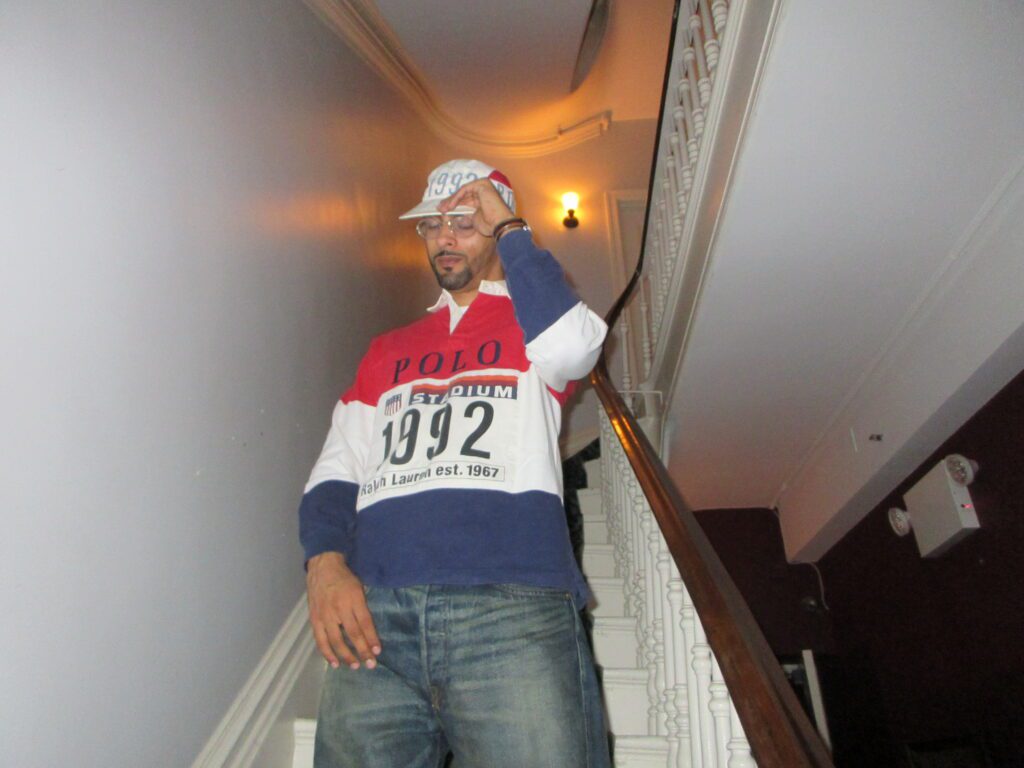
Photo by Michael Gonik
The cover of Starker’s album is a loud reference to the design of a specific Ghostface Killah mixtape from the mid-aughts (Ghost is Starker’s favorite rapper, and he cites Supreme Clientele as particularly influential to his style), but it refracts the greater aesthetic of that era: a grainy, scanned digital picture reprinted on Xerox paper for an “album cover,” composed with an amateur Photoshop header and tracklist running down the side, chopped into squares with a guillotine paper cutter, and slid into a blank jewel case. The disc inside would be a shiny CD-R, possibly affixed with another Photoshop job white sticker label or simply identified with a Sharpie on the reflective surface.
These “tapes” were currency, mostly downloaded and home-burnt by the time Starker came of age, but he remembers the dying days of their blackmarket, when they could be purchased or bartered for in barbershops or off folding tables on Fulton, not far from where we’re speaking. “We would come over here, and there would be people with a table or people on the corner. There would be little corner stores that would sell hats and t-shirts, bootleg stuff. They wouldn’t sell them publicly because artists might come on the ave and catch them,” he recalls. “I spent a lot of time growing up listening to these mixtapes. This is just what I’m used to, but I know that there’s people today that never had a mixtape, so I wanted to bring that to them the way it was brought to me.” He does just that, selling physical mixtapes of LTD produced in the fashion described here, direct to consumers off his Bandcamp page.
Aesthetics have always played a large role informing Starker’s projects. References in his discography run from Tollywood to Kaiju to classic lit, but ultimately he sees his work as a reflection of his immediate environment. For instance, 2021’s The Greenest Block takes its cover art from Jonathan Lethem’s Fortress of Solitude. “I grew up where the novel is set, in the heart of it. I got into it because Jonathan Lethem’s brother is a very well-known graffiti artist named K-E-O X-Men. It’s an awesome book, and my block looks like that. The crowns of the buildings—when I’m on my block and I look up, same crowns.” I ask if he can draw a thematic link between Fortress of Solitude and a Ghostface mixtape. “Geographically, yes. If you were to walk up two blocks from Boerum Hill back then, and you found yourself on Fulton Street mall, you’d find people selling mixtapes. Mixtapes full of New York shit; places and people that we know, little signals just for us. We learned about new music, about the world, through mixtapes. So it’s really just me interpreting my hood.”
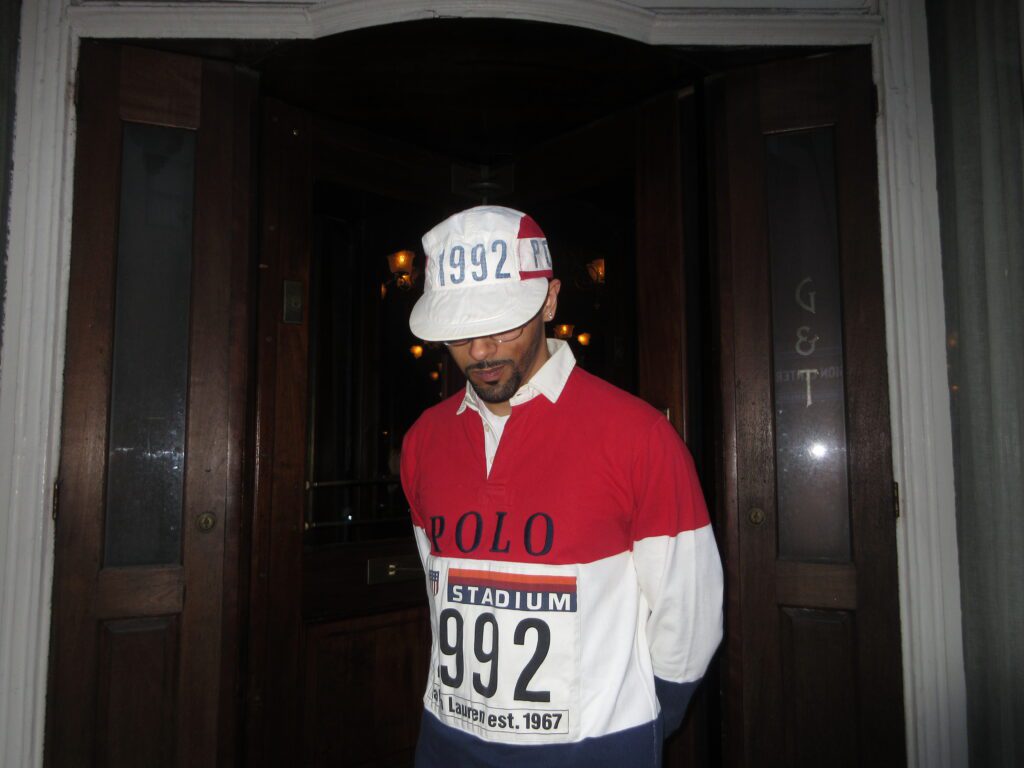
Photo by Michael Gonik
There’s a line on the project’s dreamy, drumless, standout “Pignoli”—the pine nut-studded almond paste cookie ubiquitous in any old school Italian bakery a few blocks west of here, in Carroll Gardens—that had lodged in my brain: “I used to dream about getting out my neighborhood/Now I’m never on the block enough.” It made me think about the aching sense of loss, the desire to preserve history, in Starker’s supposedly frivolous lyrical exercises, written by a 90s kid whose relationship to the city has shifted radically over the course of his life, growing up a few blocks from Jay-Z’s onetime stash spot, where Jimmy Jazz outlets have given way to flagship stores for national brands and luxury residences for people who would’ve been scared to walk down Fulton Mall, let alone shop here, 20 years ago.
As the check landed, Starker broke down the bar for me.
“I grew up in an area that was very traditional in the sense that I would go outside and there would be a lot of people on my stoop, people on crates playing chess or dominoes, and I didn’t really appreciate that back then. Now all those things no longer exist; the city suddenly started pushing those people out. And now that I have the ability to go somewhere, I’d like to be there, but I don’t want to necessarily go back unless I have to, because now that’s gone.”