Photos by Matthew Ritchie
A Glorious Afternoon at the Great Baseball Oasis in Coney Island
The worthwhile schlep to see the Brooklyn Cyclones play ball, without pretense or the noisy onslaught of a Major League-level event
What is painfully apparent for those residing in Brooklyn’s northeast corner is how long it takes to get to Maimonides Park in Coney Island, the home of the High-A Brooklyn Cyclones, the only professional baseball team within the borough’s borders. It’s a full-day trip to see the Mets’ local Minor League affiliate, one of Brooklyn’s few affordable family-friendly entertainment offerings. Tickets recently dropped to as low as $10 for all 120 Minor League teams (for a limited time and select games). Still, even without the deal, the cheapest ticket often hovers around $15, which constitutes an increasingly rare low barrier of entry in the city.
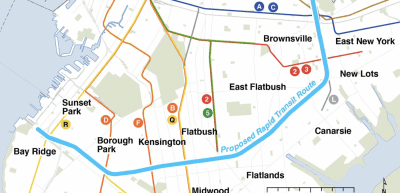
Maimonides is 11 miles from the top of Brooklyn as the crow flies, a labor of love that could mean taking two to three trains, or biking for hours, or sitting in a parade of traffic. Parents make sure that sunscreen is packed, baseball gloves are in hand, and the tickets are beamed onto their phones to enter through the gates prepared. On the way, the baseball fanatic may be tempted by public diamonds, watching as the alphabet of avenues crossing Ocean Parkway cede space to delightfully nautical-themed streets, wondering, Why don’t we just have a catch over there? Yet in a rare flip of an old adage, the destination is the only thing that matters at a place like this.
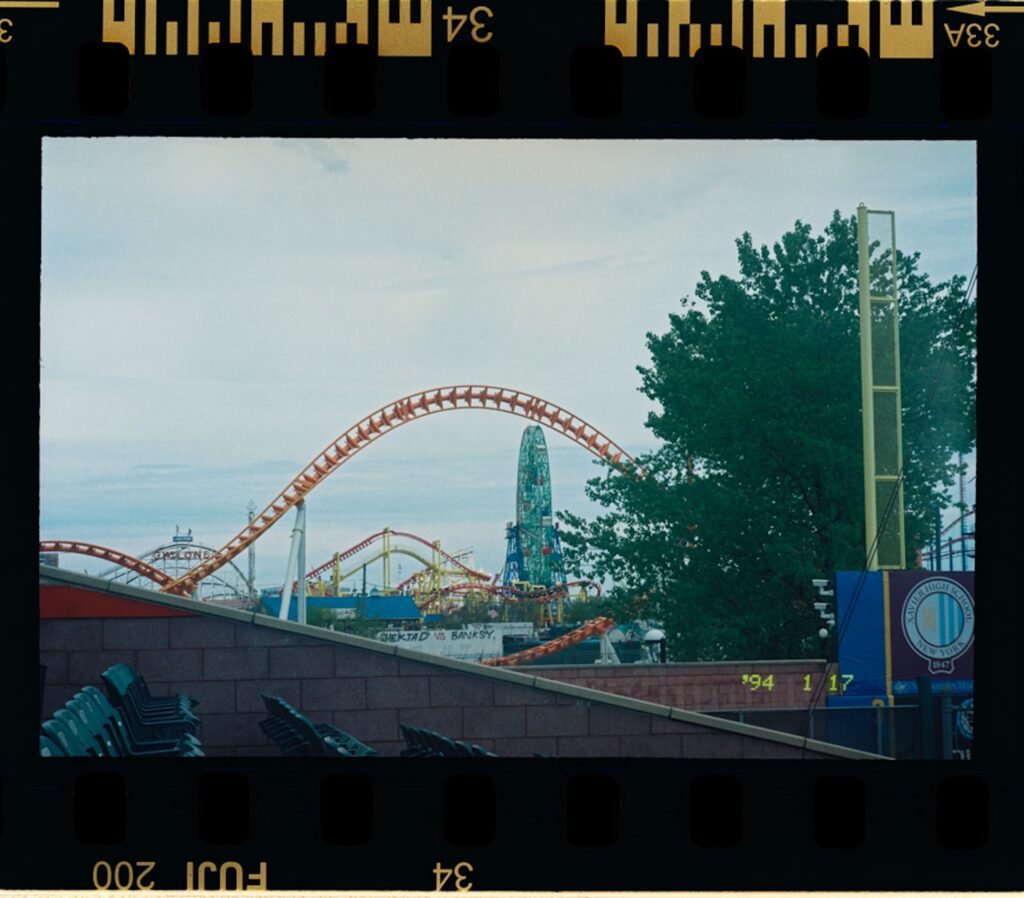
Photo by Matthew Ritchie
Even in the early days of May, where spring is still fighting the good fight to make its debut in the city and threatening to get the temperature above 60 degrees, Maimonides Park is quite the oasis on Coney Island’s boardwalk. A fan’s attention is liable to wander—which tends to happen more than a few times over the course of a game, due to baseball’s lackadaisical nature—and is combated by youth-focused fan engagement like hot dog mascot races and running the bases between every inning. Your thoughts may drift to toes in the surf lapping just behind the outfield wall, or scraping the sky on the actual Cyclone clacking on wooden slats just off in the horizon before being snapped back into focus by the crack of the bat.
The fan’s odyssey to a Cyclones game runs in almost direct opposition to that of the Minor League players on the field—those of the Brooklyn “Jefes” and the Baltimore Orioles’ affiliate Frederick Keys on this calming, partly cloudy Saturday—despite everyone breathing the same salt air. (The Cyclones occasionally don the “Jefes” moniker and alternate bright yellow jerseys to show love to local Hispanic communities, as part of Minor League baseball’s “Copa de la Diversión” series.) Most of the players, often under the age of 23 or 24, have a long way to go in their baseball lives. That distance between them and places like Citi Field and Yankee Stadium on opposite ends of town motivates every move that these young players make at Maimonides Park.
Only 10% of players that are signed or drafted make it to the Major Leagues, and even fewer grow into stars. Since 2001, just 119 former Cyclones have reached the big leagues, with names like Pete Alonso and Nolan McLean posited as modern success stories to make it out of Coney Island. It’s what makes the Cyclones’ home dugout explode with joy when pitcher Juan Arnaud escapes a jam with runners on and threatening to score in the fifth inning, what prompts catcher Ronald Hernandez to shout and point to the sky as he rounds the bases on his tie-breaking home run in the sixth inning of their eventual 2-0 win.
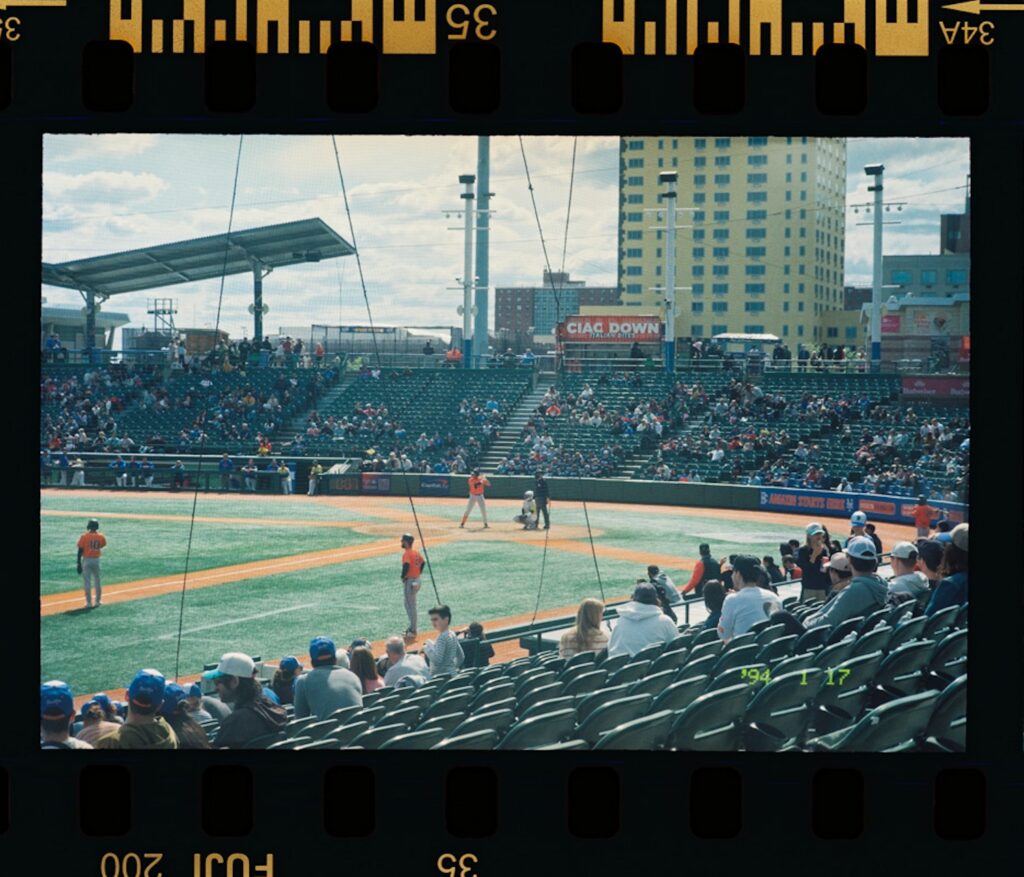
Photo by Matthew Ritchie
There’s an imperfect, yet beautiful, marriage between the fans at the 7,000-seat, half-capacity stadium and the players on a Saturday like this in Coney Island, rooted in the mutual understanding of what it means to finally be here. When the gates open at 1 P.M., families, youth baseball teams, and autograph hounds flood towards the barriers of the field, trying to get as close as they can to the future of the game. The Keys players, out early and warming up slowly with intent, oscillate between gracious and teasing, interacting with the fans, signing autographs, and pretending to toss balls into the stands before relenting.
Children in barely-fitting uniforms and cartoonishly oversized gloves shriek with excitement when they get their hands on a baseball for the first time, either by fortune from a foul or the kindness of a player or nearby fan, locking a core memory into a small leather sphere adorned with red stitching.
Once the game begins, a sort of calm takes over the crowd, littered with families of all races, small groups of thirtysomethings double-fisting tall boys of Michelob Ultras, and older folks clutching their scorebooks. As a former player, I spot my community, look upon them with love and frustration, in the small pocket of people for whom the game has passed. The over-explainers who let the knowledge of the game leak out of them in fits of excitement; the guardians who try to transfer their passion to younger folks who barely know what’s going on. They fill in the gaps of on-field action with in-stands adoration, which has fewer and fewer outlets as their distance from the field grows, and often lament the fact.
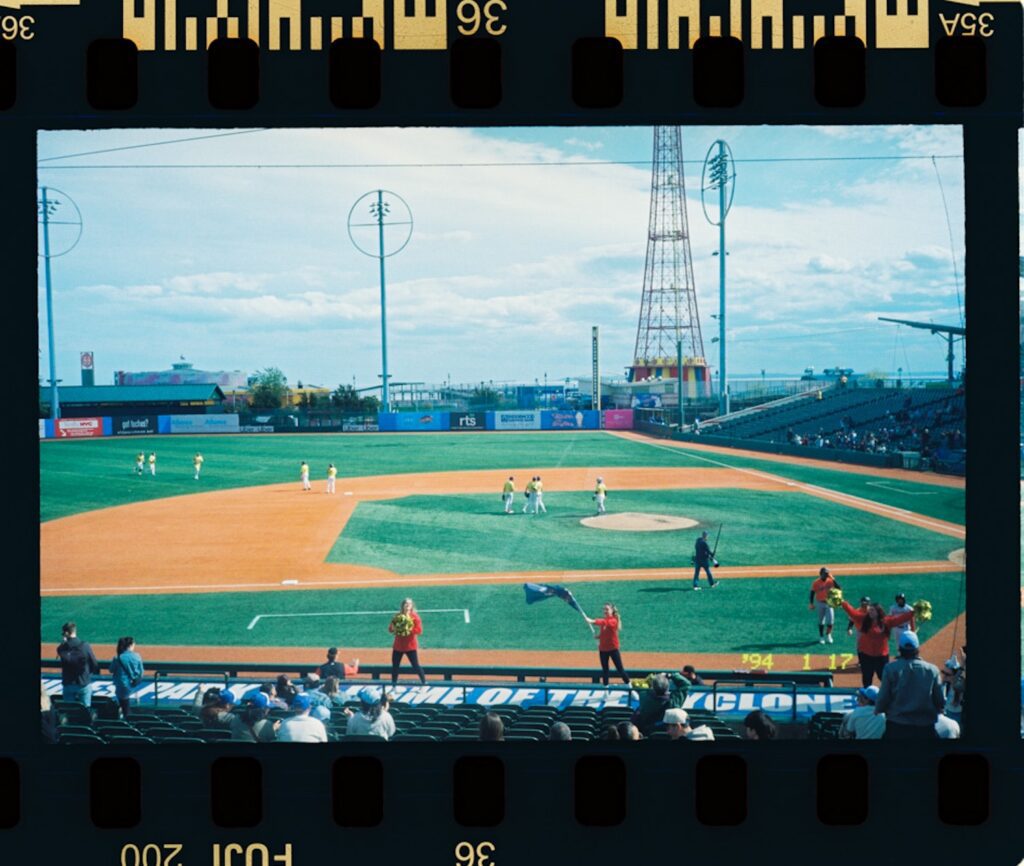
Photo by Matthew Ritchie
The game didn’t have a pulse until about the sixth inning—with only six hits total between the teams—but the atmosphere is devoid of the noisy onslaught of a Major League-level event. It’s encased by its own kind of ambience, the slow mechanical churn of amusement park rides a few blocks down Surf Avenue, and every conversation in the green stadium seats and fan sections along the concourse rolling on without interruption as pitches blow by the batters.
It’s been posited by philosophers and thinkers for decades that baseball is the best live sporting event on American soil, partly because it doesn’t ask much of its attendees. It’s a sport whose pace has always been akin to a lazy river, only requesting a sliver of your attention when there is a bend in the current. Even for the adults who treat Maimonides as little more than a setting for casual linkups, filling up on beer and Nathan’s before spilling out into the boardwalk’s embrace, there’s a respect for the game, a tacit understanding this glorious diversion wouldn’t exist without the players on the field.
If there’s a reason certain Brooklynites will repeat, like religious converts, “You gotta go to a Cyclones game,” it’s because here we’re granted a little slice of heaven, a day in the sun, sitting peacefully while young men chase their childhood dreams with the bravery that’s left the rest of us. The least one can do is cheer when the ball goes over the fence, dance when Philip Bailey’s “Easy Lover” blares through the speaker at the final out, and pick up the slack for the empty seats on either side. Holding up your end of the bargain before you take the long journey home is an act of love when it gets down to it.