Photo by Francisco Hernandez
Last Night in Fort Greene with Xochitl Gonzalez
The Pulitzer-nominated author unpacks her new book, 'Last Night in Brooklyn,' and a nuanced theory of gentrification, over drinks at a DeKalb Avenue dive
The best joke I’ve ever come up with, though I’m quite sure versions of it have existed for as long as this city has, goes like this: The first “Real New Yorker” was a 17th-century Dutch colonizer, who, within a few weeks of arriving on Manhattan’s shore, looked around at their developing settlement and complained that the city they loved had been ruined and made lame by all the new people and places. It’s a dumb joke, but one that captures an eternal mentality recognizable to anyone who has lived here for more than a year or two.
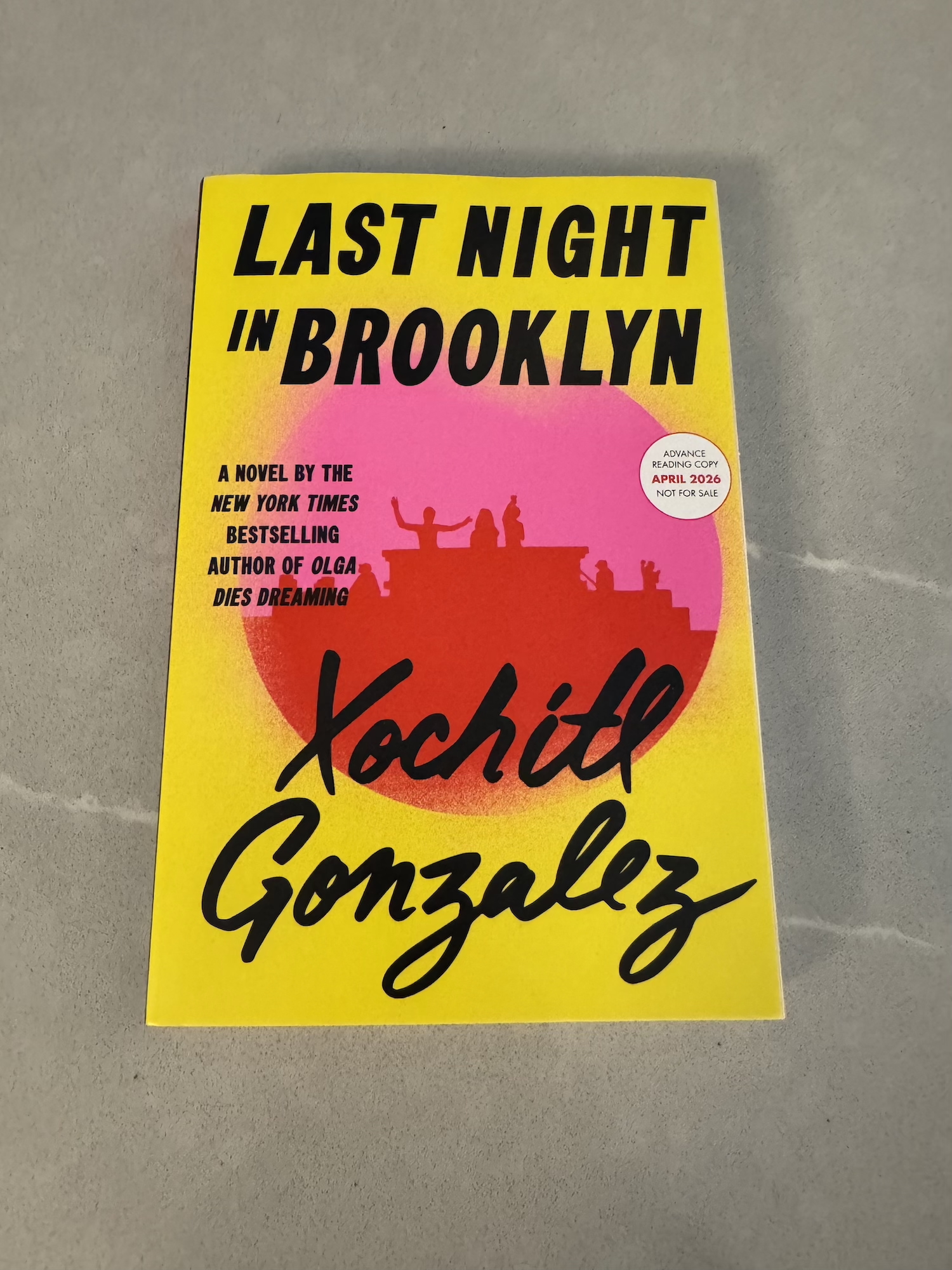
Photo by Abe Beame
I bring this up because recently, the author Xochitl Gonzalez has rendered this joke in novel form and explained how that jadedness has caught up with my generation of New Yorkers. Her breathless, alternately irritable and nostalgic joyride Last Night in Brooklyn is a “spot” glossary from a great period of our shared youths in downtown Brooklyn, as well as an exploration of the socioeconomic and spiritual gentrification of Fort Greene, disguised as a beach read. The novel holds back the years for locals of a certain age, who lived here during the aughts, had a friend who tended bar at Night of the Cookers, a friend who DJ’d at Southpaw, and a friend who threw monthly rent parties in a quasi-residential Gowanus loft.
It’s the story of her protagonist, Alicia Fonten—an Alice B. Toklas/Nick Carraway/Jay McInerny/Carrie Bradshaw from Gravesend with a Nuyorican accent—who goes to Yale, then moves “home” to an apartment in the Navy Yards and a copywriting job at an ad agency. She flips a fairytale turn-of-the-century Fort Greene into her personal Pleasure Island, with a fast-friends creative class crew of young gentrifiers of color who, when they’re not complaining about gentrification and the less cool gentrifiers destroying the culture and community they love, are having the day-drunk time of their lives.
Gentrification is a thematic thread that has occupied Gonzalez’s life, from her childhood in the borderlands between Sunset Park and Borough Park to her undergrad education at Brown to her years as a high-end event planner and Fort Greene resident through today, as a prolific writer (recently nominated for a Pulitzer Prize for her regular writing in The Atlantic), now based in Brooklyn Heights and on her third novel in four years. Last Night in Brooklyn occurs at the exact moment in history when Brooklyn’s cycle of change revved from New York’s historic, “organic” breakneck pace to its current, terrifying, late-capitalist speed, taking a wrecking ball to the borough, neighborhood by neighborhood. Because her book spoke to me so directly, I wanted to sit down with Gonzalez to go over our shared history and the impact her very nuanced depiction of gentrification has wrought on a place and time we loved.
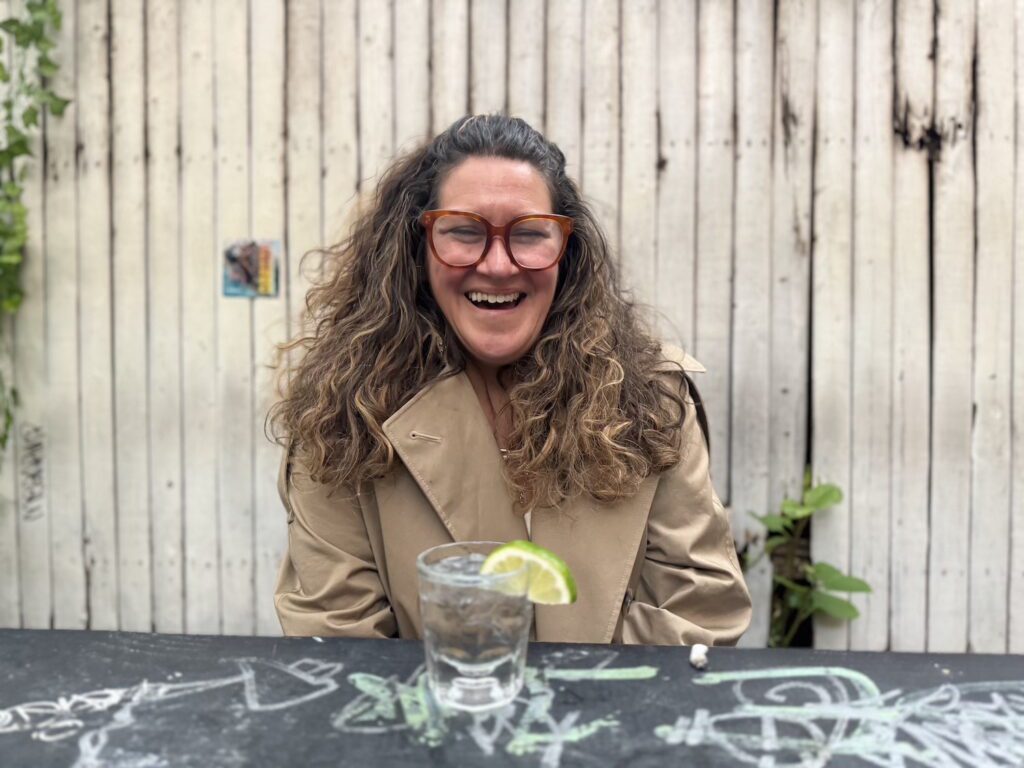
Photo by Abe Beame
I meet Gonzalez at 4 p.m. on a Friday afternoon at Alibi, a cash-only watering hole I picked specifically for its decades-old roots on DeKalb’s prime strip. The institution smells specific to Alibi, yet universal to all dive bars; both bad and good, dank but not unpleasant, the backwash of every alcohol on earth puddled in the bar’s pits and depressions, into the pool table’s felt, settled into the very foundation of its sunken ground floor that gets little natural light regardless of time of day. It’s an ancient, durational essence that has been earned over the course of generations paying rent in shots served to regulars and tourists passing through.
The bar is one of many Fort Greene legends that get a shout in Last Night, and Gonzalez appears excited to return in person. She is smaller than her personality, but her mane of brunette curls, underlit blonde, with outsized tortoiseshell catseye glasses, are expressions of an extrovert. Gonzalez immediately begins chatting up our note-perfect, surly, middle-aged, white, and bald bartender, who is quickly disarmed by Xochitl and apologizes for his initial surliness. He was just in Puerto Rico, he explains, working on a mural in Isabela and stepped off the plane directly into this 14-hour shift. I order a Guinness and Gonzalez a Tito’s on the rocks. He pours a flawless pint, and we head into Alibi’s partially covered backyard to talk.
“Listen, don’t get me wrong. The story of New York—the story of Brooklyn—is the story of people moving themselves here and trying to make it. The only peeps who didn’t are the Lenape,” Gonzalez writes in a passage in the middle of her novel, largely expressing its anxieties and concerns. “But the difference, I could suddenly see, is that these people around me now were not mere transplants; they were replacements.”
The concept is hardly novel. “Gentrification” was coined as a term in 1964 by the sociologist Ruth Glass to account for upper and middle classes infiltrating working-class areas in London and displacing the existent communities. As Willy Staley explained in 2018, the term has mutated into a catchall that accounts for cultural appropriations that have nothing to do with real estate. It is often used to describe the whitewashing of everything from ethnic foodstuffs to climbing gyms, but its impossibly broad use dissolves any fixed meaning, now essentially referring to any added amenity that can be used to justify raising the cost of living.
In a city of hard, fast, unceasing change, this means any and everything technically qualifies as gentrification. A Price Chopper in a food desert is gentrification; a new taco truck in a Mexican neighborhood is gentrification; a working-class kid from Fort Greene, who goes to college, gets a job in finance, then moves back into an expensive apartment across the street from the building they grew up in, is gentrification. In his essay, Staley presents a history of thinking on the term and outlines its five distinct waves. It begins with young creatives inhabiting more affordable areas in a city and ends as a hollowed-out wasteland where landlords hold eternally empty storefronts they can write off for unsustainable rents and billionaires hold multi-million dollar penthouses they rarely visit. Fort Greene is arguably between its second and third stages, when the middle class follows the creative class into a community, just before the tipping point, when the existing community and its culture are wholly displaced. “First people come, and they make a vibe. And then the vibe looks attractive, and people then want to own it and turn it into a brand,” Gonzalez says, attempting to put a fine point on an incredibly complicated modern urban phenomenon. But it’s the callousness with which this invasion takes place that Gonzalez’s passage pins down.
“When I was revising that passage about ‘the replacers,’ I had been really interested in thinking about how Brooklyn has changed. According to a census, when my mom left me with her parents in 1980, 10% of Brooklynites had gone to college. And now it’s something like 44-45%, with the numbers between white people and Black and Latino people very skewed,” Gonzalez says. “But what I think is really interesting is that college mainly prioritizes things like individualism. So this cultural replacement, in a weird way, represents this kind of collectivism of need.” Gonzalez suggests this need for self-expression manifests itself in class-signifying amenities, like cheese shops that replace bodegas, an artisanal sandwich shop that replaces a roti takeout counter, or, in the novel, a wine shop that directly competes with a beloved liquor store. In most cases this is less nefarious vulturism than case-by-case opportunism that comes from reading tea leaves and having the vision and timing to capitalize on demand in a market. It can be a “felon-less” crime in most instances, so to speak, yet it keeps happening, and most New Yorkers, including the gentrifiers themselves, at least suggest they are unhappy about it.
So, I asked Gonzalez if she believes a more ethical gentrification is possible. Her answer demands a degree of awareness and sensitivity on the behalf of those moving into working-class communities and ethnic enclaves. “The characters in Last Night enter the scene at this weird tipping point where they’re gentrifiers, but they’re money gentrifiers, not cultural gentrifiers. They’re saying, ‘I love Night of the Cookers,’ or, ‘I’m just gonna join your Baptist church instead of commuting to my own, or starting my own,'” Gonzalez says. “Whereas the cultural gentrifiers in the book approach the neighborhood like, ‘This place would be great if we could have that.’ So it’s looking at your community as lacking versus being like, this is amazing. Because you can’t create something without destroying something else.”
This solution isn’t as simple as broad acceptance of community. Issues of awareness when it comes to cultural sensitivity are higher than they’ve ever been, but so are the invisible forces of modern life that keep us from developing relationships with our neighbors that would allow a newly minted Brooklyn resident to discover a beloved, decades-old coffee shop, rather than running to the nearest Blank Street. “We’ve never had more information, and yet, all we want is answers. And we don’t actually want understanding. I think ethical gentrification requires a pushback on this top-down demand by technology to eliminate humans from your life, because community starts with actually knowing the fucking people that live and work in your neighborhood,” Gonzales says. “The more that we keep outsourcing shit, the more that we don’t know anybody. Before you move anywhere, but particularly into communities in Brooklyn, ask yourself if you really want to live in a neighborhood, or just occupy the aesthetics of a place?”
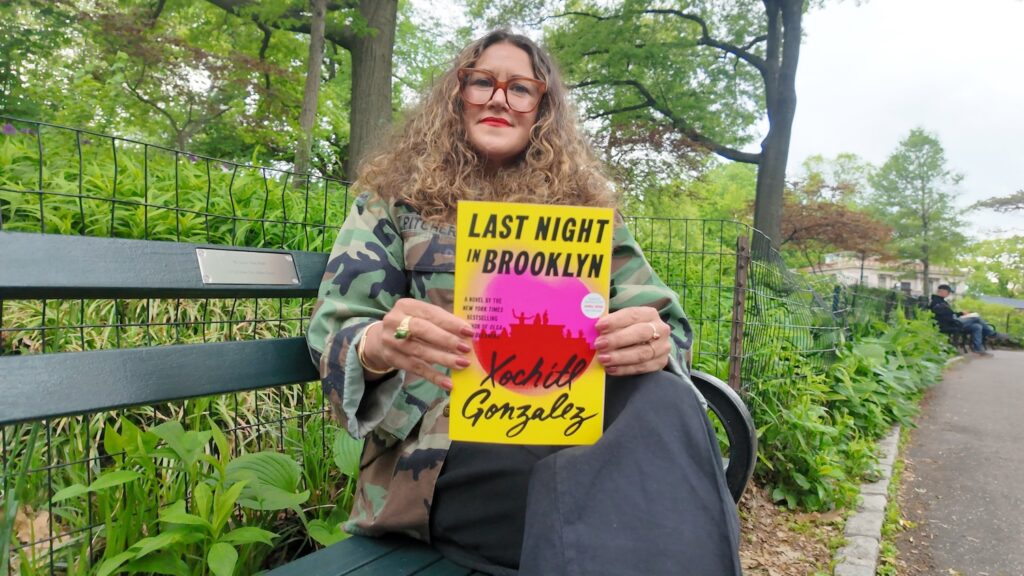
Photo by Francisco Hernandez
Gonzalez’s personal answer to ethical gentrification has proved complicated. She no longer lives in Fort Greene. She got an MFA from the Iowa Writers Workshop, and when she returned post-pandemic, the neighborhood no longer felt like home. It is hard for the Brooklyn native to feel comfortable anywhere in a borough she has a harder and harder time recognizing. “I’ve been asked, ‘Why don’t you just move back to Sunset Park?’ And the answer is I feel so weird about it, because I’d be gentrifying my own neighborhood, then I’m the fucking asshole,” Gonzalez says. “Then in Fort Greene, or Bed Stuy, I get annoyed by all the changes, all the people leaving. It makes you grumpy. There’s a certain acceptance, and part of why I wrote the book is it’s almost like I don’t know how to be here anymore. I moved to Brooklyn Heights because it was like, everybody here is kind of a douche. There’s a cat cafe. You know?” It’s a privileged decision, simply moving to a more expensive and comparatively cultureless neighborhood, but it speaks to the impossibility of an “authentic” experience in the borough as presently constituted.
There’s a specific type of conversation two people who have lived in Brooklyn for decades will inevitably drift to if left to their own devices. It’s a play on David Roth’s famous “Remembering Some Guys,” but for dearly departed bars and restaurants. We go through our old haunts, then move to the also mandatory litany of jaded middle-aged New Yorker complaints: Everything closes early, no one drinks anymore, no one makes friends anymore, Resy killing spontaneous dinners, how our phones rob us of those magic random encounters on a night out, the steel and glass eyesores breaking up the aesthetic of the neighborhood’s cross streets lined with gorgeous old brownstones, the dearth of third places.
In the New York of our shared material realities, it is essential we keep up the fight against the systemic factors pushing communities and cultures out of it. But Gonzalez believes it’s equally important we do our parts to celebrate and preserve the communities that remain. That we continue to educate the next generation of New Yorkers—our young neighbors, our kids, and their friends—on how to make eye contact, say hello in the elevator, hold the door for your elderly neighbor, and ask how she’s doing; basic manners that amount to the small gestures that make relationships, cross-cultural dialogue, awareness, sensitivity, and humanity possible.
Before I knew it, we’d been sitting in the back of Alibi for an hour and a half and it was time to head out. As we waved to the bartender and headed out to DeKalb, I inhaled Alibi’s history, and tried to hold it in.