Photo by MC Alexander Ciceron
This Haitian Couple Wants Rogers Burgers to Be a Flatbush Staple
"I want people to get a bite of Flatbush anywhere in New York."
On a humid March evening, strolling down Rogers Avenue looking for a place to conduct our interview, Haiti-born couple Josue Pierre and Jonathan Pierre-Lafleur greet a gangly pre-teen. Josue recites the boy’s customary order from memory. “Two bacon cheeseburgers, a Burger Créole, and two Sprites,” the 43-year-old says without a moment’s pause. It’s a lot for a little kid, but Josue says the boy orders for himself and his family. He’s been doing so since around the time their restaurant, Rogers Burgers, opened last July in Flatbush. “You’re literally watching these kids grow,” Josue tells me.
Rogers Burgers has been growing, too. Located on a quiet strip on its namesake avenue, the Caribbean burger spot has already earned enough acclaim to be covered by The New York Times, and judging by the small boy and the 20-something that says what’s up to Josue and Jonathan, the locals also seem to know them pretty well. The shop carries all the aesthetic cues of a traditional Mom-&-Pop, its name painted in royal blue lettering on a white banner hovering above the entrance. Inside, there’s a small counter and about five seats. If it’s not too crowded, you can eat there, but the grub comes fast enough to qualify as another one of the neighborhood’s incomparable takeout options. “It’s very Flatbush,” Josue says, nodding to the menu’s Caribbean DNA.
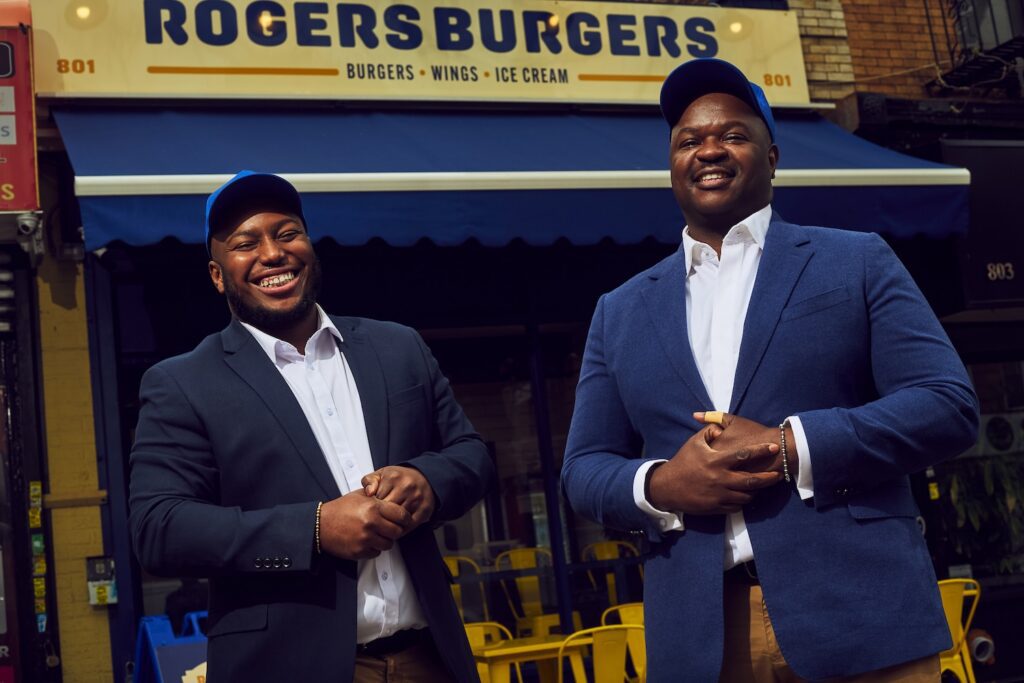
Photo by MC Alexander Ciceron
Long before he had burger joint ambitions, Jonathan recalls waking up at two in the morning to help prepare food for his mother, who ran a local food stand in his native Port-au-Prince. When she worked overnight, he’d cook meals for his brothers; washing his hands before clinching a fist full of raw meat, marinating it in a green spice called epice, and covering the meatball in flour to fry it up in a pan. “That was my immediate introduction to the patty,” he tells me.
Jonathan entered the hospitality scene following the catastrophic 2010 earthquake in Haiti, when he picked up the pieces working at a Belgian-owned Brazilian restaurant. He moved on to work at the restaurant’s New York location, bouncing around various fine dining establishments from there, mastering the nuances of the service industry. But his plans were bigger still. “I knew from my mom,” he notes, “I wanted to own my own business,”
As Jonathan worked his way through the rigors of restaurant management, Josue, his partner and now husband, oscillated between the worlds of finance, politics, and entrepreneurship. He ran for City Council in 2020, and currently works at Empire State Development now, but before that, he served as Brooklyn Borough Director at the Bureau of Public Affairs. “It was [about] how do you connect [the] community with government resources?” While connecting communities with needed resources was his day job, more immediately, he was looking to connect with the right boyfriend. After engaging in the masochistic exercise of trying his luck with dating apps, Josue found Jonathan about five years ago.
“He just had this different worldview and a different energy that also appealed to me,” he remembers. The Haitian connection helped, too; Josue appreciated that, unlike himself, who had moved from the island to Flatbush as a small child, Jonathan had been raised in Haiti. For his part, Jonathan’s attraction was based in both cultural novelty and Josue’s own self-acceptance. “Josue was the first openly Haitian American gay man [I saw], so that was something that was very attractive to me,” Jonathan remembers. “The fact that he can be himself.” Once they moved in together, they gradually developed an entrepreneurial synchronicity.
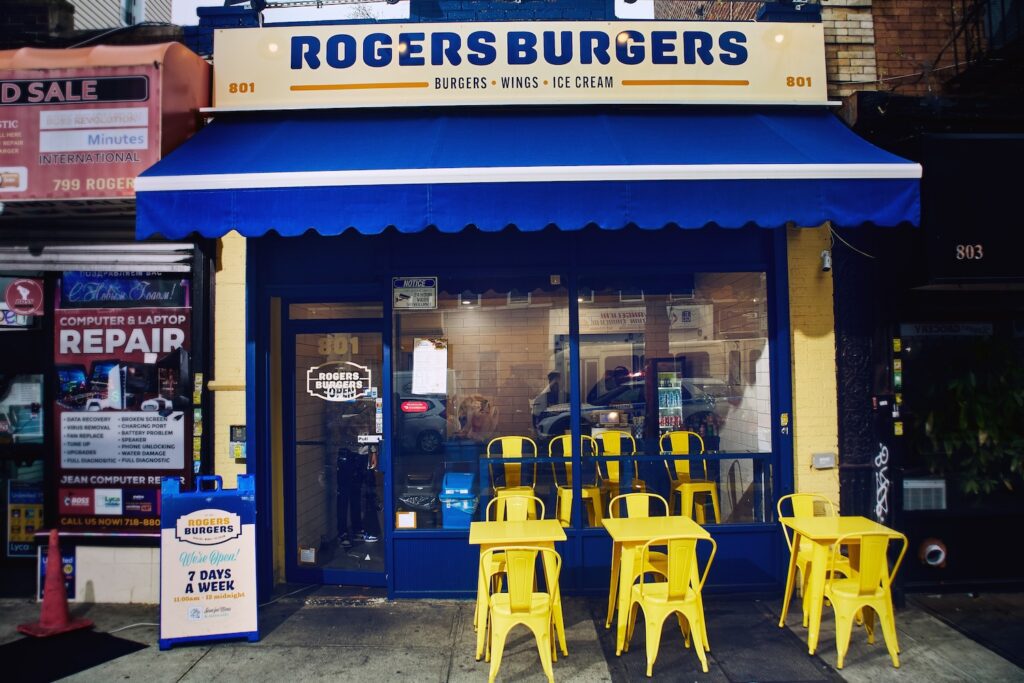
Photo by MC Alexander Ciceron
“We didn’t want to use any frozen patties,” says Josue. And so they didn’t; instead, they experimented with six different meats before deciding on a particular brand that was both high quality and affordable enough that they could charge customers no more than around $10. They eschewed plain buns, opting instead for soft brioche buns that wouldn’t soak and disintegrate beneath the weight of a burger. Then, there was the task of making sure the spot reflected home; Haiti and Flatbush.
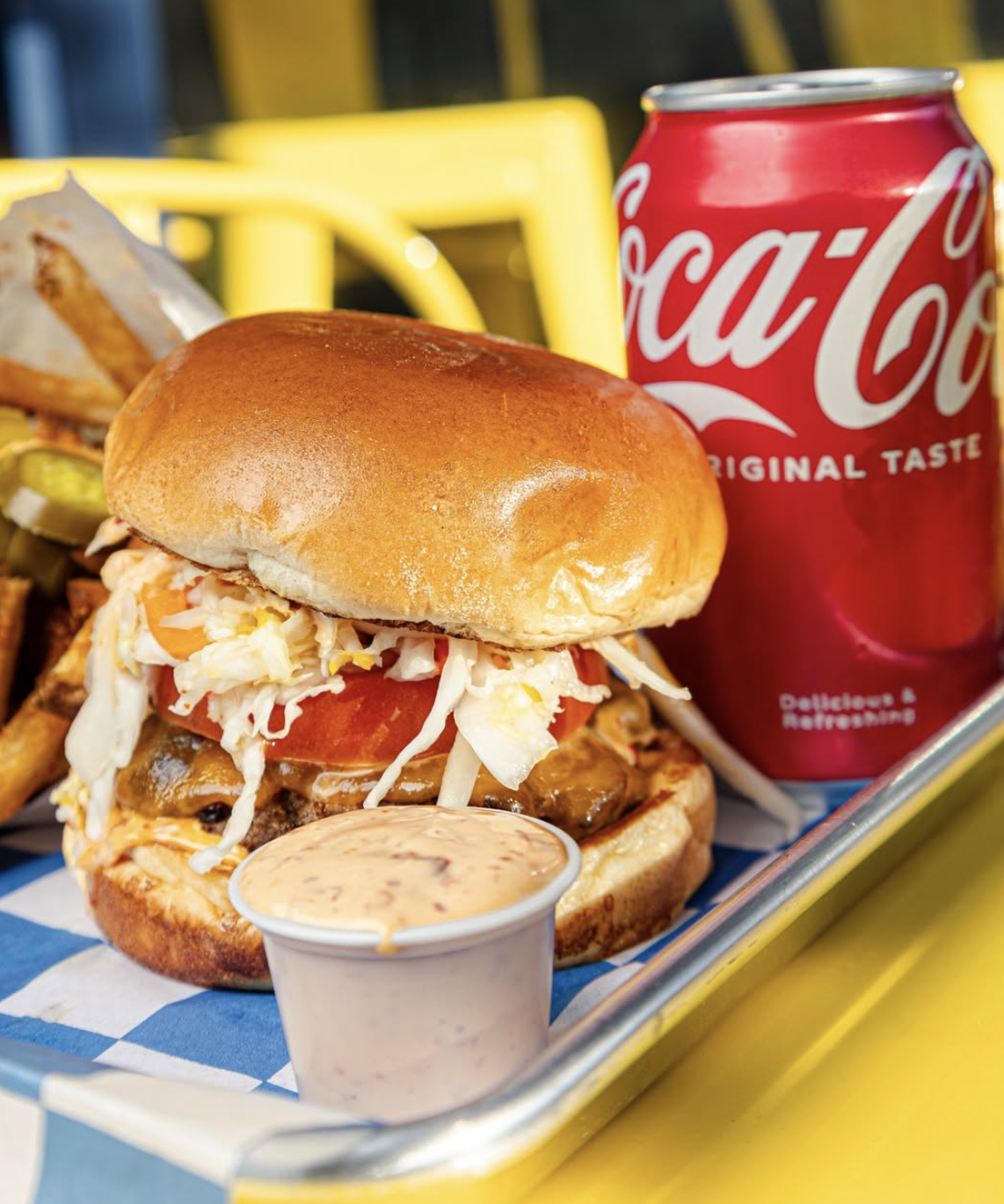
The Burger Creole (Photo by MC Alexander Ciceron)
In Brooklyn, jerk-flavoring is as ubiquitous as loud music. And so, their Yard Burger features jerk-flavored aioli, cheddar cheese, and jalapeño peppers. Less common is their Burger Créole, a Haitian-inspired sandwich that includes spicy pikliz, pikliz-infused aioli, cheddar cheese, and tomato. Josue’s dad doesn’t eat beef—let alone fast food—but that didn’t stop Josue from giving him a taste test. “We made a Burger Créole version of our chicken sandwich,” Josue tells me. “And he was like, ‘I don’t eat this stuff, but this really hit.'”
From the outset, the same was true for Rogers. One day while leaving his day job to work an evening shift at Rogers, Josue was rounding the corner at Church Avenue when he saw a line of seven people waiting outside the shop. He suspected there had been a gas fire, but after entering the restaurant, he found that it was just as crowded inside. “I see this frantic look on the cashier’s face and she looked like, Hurry up and come help us back here.”
From his experience managing money, Josue knows generating revenue isn’t easy. And yet, that September, Rogers Burgers broke even.
But expansion is the endgame. “When folks go to Harlem, they’re like, ‘Oh, I’m going to stop by Sylvia’s. I’m going to stop by Red Rooster,'” Josue says. “When they come to Brooklyn, and they think about Flatbush, I want them to say, ‘I’m going to stop by Rogers.'”
“We want to see Rogers Burgers in the Barclays and Madison Square Garden,” Jonathan adds. “I want people to get a bite of Flatbush anywhere in New York.” Embodying that local touch feels especially important to Josue, who still remembers growing up just around the block from where Rogers sits today.
“We can’t afford to do gourmet, but that wasn’t what we were aiming for,” Josue says, outlining the mission. “Dumping poor quality ground beef onto neighborhoods like Flatbush, Crown Heights, and East New York; I don’t like that, because I am that. I am that community.”