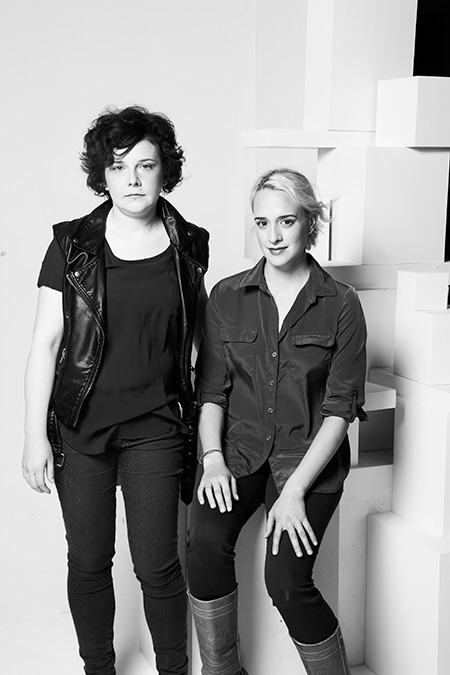
Emily Books, founded by Emily Gould and Ruth Curry in 2011, is an independent e-bookstore that offers consumers a chance to take advantage of the ease of online purchasing without having to sacrifice the interactive and community-oriented aspect of visiting a local bookstore. So, basically, you can not only say fuck you to Amazon but can also stay connected to an actual lit scene while still getting to read on your iPad. It's kind of a brilliant way to not compromise, and what are we all trying to do each day but not compromise? But who would have suspected that there was room in the online bookstore world for a David to Amazon's Goliath? Not me. Or, at least, I guess that's what separates entrepreneurs from the rest of us. They have ideas, then they make those ideas real, and, finally, everyone else gets to benefit. I'm super into this model of business, especially when it means getting to flip off Amazon, which, more on that later.
I spoke with Emily Gould not long ago about her experience as a Brooklyn entrepreneur and how she sees Emily Books developing in the future.
When did you and Ruth start Emily Books?
We had the idea in the summer of 2011, but it was a very vague idea — basically, we wanted to start an online bookstore that sold ebooks truly idependently, without Google or iBooks or Amazon as a middleman. All we knew was that our appeal would have to be expert curation. So we just thought we'd pick books we loved that not enough people knew about. We didn't know our project would have a radical, activist, feminist streak until we'd been in business a few months, when it became clear that we were building a utopian alternate-universe bestseller list — a a syllabus for readers who are curious about the best transgressive, funny, gripping memoir and fiction written by every kind of person other than heterosexual men.
What was behind your decision to start an ebook store? And, also, please explain what makes Emily Books so singular in its mission and practice.
We decided to start an ebookstore because we had both, after what seemed to us like a long period of resistance, just started reading ebooks. We loved the instant gratification of downloading the book you need THAT SECOND and having it available anyplace, but we actually weren't that impressed by the selection that Amazon and Google books and the iBookstore had. It was hard to find some of the books we wanted to read — they either weren't available as ebooks, or there wasn't a centralized place to buy them. And we didn't like that we had basically no choice but to support big behemoths instead of our neighborhood bookstores.
Now, a year later, that situation is improving slightly, and it looks like there are more innovations on the way, thanks to Kobo partnering with independent bookstores. But we're still the only e-indie that offers a subscription model — a way for readers to automatically receive monthly ebook picks, via email. And we flatter ourselves, of course, that we are able to offer a really singular selection. Ruth and I are constantly reading. We probably each read between two and five books per week that we're considering for the store (in addition to whatever else we're reading!) We tell our customers that "we read a lot of books so you get to only read great books."
What had been your experience in publishing up until the point you started Emily Books?
Ruth and I met working for Hyperion, a big commercial publishing house, in the early 00s. She later went on to work on the agency side, and currently works in the contracts department of a university press. She's an expert on rights and contracts, as well as the tech side of our business, not to mention the accounting side. She's also a very talented writer — she wrote an essay for our site that I absolutely love, about our pick Glory Goes and Gets Some.
How do you feel supported by the Brooklyn lit community? (both the people who work in lit and the people who participate as consumers)
WORD bookstore in Greenpoint has been wonderful about hosting some of our best events — I made a joke at the last one, our 1-year anniversary party, that it's nice of them to host us considering that we're the competition! And it actually is really generous of them. I personally buy paper and electronic editions of most books that I love, so I don't think it's really an either-or proposition.
We do have a lot of Brooklyn based customers, but we also have customers from all over the country and all over the world, which surprised me at first. But people in Brooklyn are kind of overwhelmed by books and culture, and they maybe don't need us in the same way that someone who lives in, say, Virginia Beach needs us.
What has been the most rewarding aspect of running Emily Books?
I really look forward to the moment at the end of each quarter when we send the checks to the small publishers and authors we work with. It's amazing to be able to send a letter to a writer you admire that says "We are pleased to inform you that we sold X copies of your book, and here's a check." It's a really good way of writing fan mail. I recommend it to everyone.
What have some of your favorite titles been? How do you choose the monthly books?
We keep a running list of books that have been recommended to us and we go through catalogues and used bookstores, and we also have had a few intial readers — Kaitlin Phillips and Alex Ronan have both been enormously helpful — who give us a heads-up when they encounter something great. We also get recommendations from authors we admire, which is hugely useful. Chris Kraus, Minna Proctor, Curtis Sittenfeld and Elisa Albert have all recommended books that we either have featured or will feature in the future.
Re: favorite it's really hard to pick. Two of our bestselling books are Glory Goes and Gets Some by Emily Carter and Making Scenes by Adrienne Eisen, which is the pen name of a blogger called Penelope Trunk. Those are the books I have the hardest time describing. They are both completely sui generis, miracle books. They're also both autobiographical fiction, which is a genre I've always been drawn to. It's weird, for a while people wrote fiction because memoirs were considered less saleable, and even though that's obviously not the case anymore there's still a taint associated with memoir, especially by women. I won't stay on my soapbox about this for very long, but you still often see reviews that say, essentially, "What important thing has happened to her? What could she possibly have to say?" It's strange how many people who profess to love books and reading don't seem to understand that the entire point of reading is to inhabit someone else's subjectivity, and that the entire point of writing is to allow other people to inhabit yours. First-person writing is one of the simplest and best tools we have for this, and it continually amazes me when people think writing "I" stories or books is self-centered. It can actually be one of the most generous ways of writing.
Where do you see the company heading in the next few years?
We are very, very close to launching our app, which will allow readers access to our books and the associated content available on our blog in-app on their iPads and iPhones. Since I love reading on my phone this is a really exciting thing for me personally! I hope other people will love it too.
In the next few years ... it's funny, as recently as a few months ago I was so worried that we would run out of books. But I've read so many great books in the last two — just in the last couple of weeks, I've read three absolutely amazing books. Now I don't feel like we'll ever run out of books, which is great, because we plan to keep this up forever.
Follow Kristin Iversen on twitter @kmiversen