Congratulations, Brooklyn—you are officially the white hot center of New York City’s labor market.
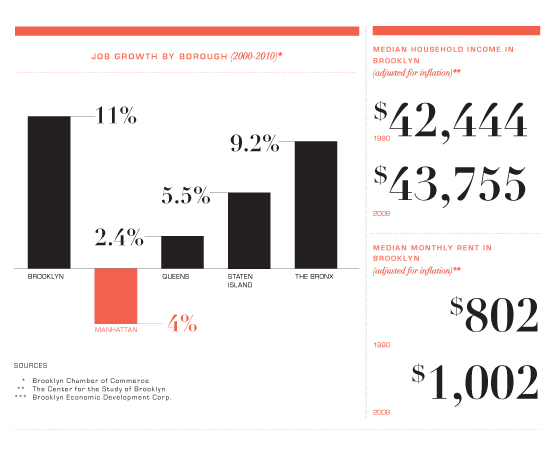
From 2000 to 2010, the borough’s employment rolls grew by 11 percent as more than 50,000 jobs were created. Manhattan, by contrast, saw its job count fall by 100,000, or just over 4 percent. Queens and Staten Island, meanwhile, were up 2.4 percent and 5.5 percent, respectively. The only borough to approach Brooklyn’s growth was the Bronx, which over the decade gained 19,600 new jobs, up 9.2 percent.
To regular readers of the New York Times Styles section (and, well, magazines like this one) this should come as little surprise. Brooklyn has become in recent years the epicenter of a certain small-scale, locally focused but widely heralded economic scene. This is perhaps most evident in DUMBO, where a growing collection of internet firms like Etsy and Small Planet, along with digital creative agencies like Huge and Big Spaceship, have led local real estate agents to dub the area “Silicon Beach.” The trend, though, extends borough-wide: jewelry-makers in Williamsburg, whiskey distillers in the Navy Yard, letterpress printers in Sunset Park, bars upon restaurants upon restaurants upon bars—new Brooklyn businesses abound like beards at a Bon Iver show.
It’s impossible, of course, to fairly characterize this activity in just a few sentences. But were you to describe the “New” Brooklyn Economy (as we’ve decided to call it), a few themes would emerge: it’s entrepreneurial and improvisational. It’s obsessive and passion-driven. It’s tech savvy but ploddingly (some might say annoyingly) deliberate. It values quality over efficiency and productive surprises over standardization. It’s the realm of autodidacts, fanatics, mad scientists, and geeks; a world of vintage coffee roasters, hand-made bicycle frames, and nine-dollar chocolate bars.
A person might argue—and certainly some have—that this is something of a sideshow, a game of make-believe put on by and for affluent brownstone-dwellers while the rest of the city, and country, go on making and spending their money the old-fashioned way—as entrenched members of the largely corporate, increasingly globalized order. And yet, over the last 10 years, more than 10,000 new firms have opened for business in Brooklyn. Which raises the question: can an economy of 2.5 million people run on iPhone apps and artisanal pickles?
We put the matter to a group of Brooklyn academics, activists, authors, politicians, and businesspeople to hear what they thought. The short answer? Probably not. The slightly longer but perhaps more to the point answer? Probably not... but have you got a better idea?
“Brooklyn is a blueprint for the country,” wrote Sara Horowitz, founder and director of the DUMBO-based Freelancers Union. The borough, she noted, has been at the forefront of a shift toward independent work—“freelancing, part-time, consulting, temping, self-employment”—that’s recently emerged nationwide.
The question, though, Horowitz pointed out, is just how well positioned are workers to ride this trend?
“Just because the future-economy is here today doesn’t mean our support system has caught up,” she said. “Freelancers still struggle with challenges that ‘traditional’ workers don’t have to: unpaid wages, a lack of unemployment insurance, finding affordable health care, and unfair taxation.”
Then there’s the simple fact that being a successful entrepreneur—or an unsuccessful one—involves a significant amount of risk and a ridiculous amount of work. Likewise, the notion of a small-scale, localist economy no doubt has its appeal, but it’s tough to beat the salaries and benefits offered by corporate and union jobs.
Indeed, despite Brooklyn’s relatively rosy employment figures, incomes have been basically stagnant for the last two decades. According to numbers from the Center for the Study of Brooklyn’s 2012 Brooklyn Neighborhood Report, the borough’s median household income in 1990, adjusted for inflation, was $42,444. In 2009 it was $43,755—a three-percent bump spread over nearly 20 years. Meanwhile, median monthly rents have spiked 25 percent, to $1,002 in 2009 from $802 in 1990, and the percentage of the borough’s residents paying more than 30 percent of their income in rent has jumped to 52 percent in 2009 from 42 percent in 1990.
“At best, the news is marginally non-negative—for some,” said Neil Smith, an anthropologist at CUNY. “There are still lots of jobs in stores and offices and garages and restaurants and small manufactories... but a lot of jobs have also vanished and a lot of people are out of work.”
Independent, artisanal, small-batch Brooklyn has done relatively little to mitigate these trends. Of the 50,000 jobs the borough netted in the last 10 years, more than 30,000 were in health care and social assistance. Another 9,000 came from hotels and food service, while another 8,000 came from education. The borough lost in that time more than 23,000 manufacturing jobs, as well as 1,400 construction jobs. The story of Brooklyn’s labor market over the last decade is largely the story of those sectors, none of which figure prominently in typical celebrations of the area’s boom.
Nonetheless, the idea of Brooklyn as test kitchen for an exciting new economic model has taken root in the public’s and—perhaps more importantly—the media’s imaginations.
As Brownstoner and Brooklyn Flea founder Jonathan Butler put it, “Brooklyn, along with like-minded cities around the world like Berlin and Portland, is leading the way in reinventing a new kind of entrepreneurial economy. The values and economic power of this movement are very real and, like it or not, Brooklyn has become a global brand synonymous with these qualities.”
In part, the excitement is probably because, all hype aside, there are, in fact, any number of ambitious, creative people out there in Brooklyn doing something great. EnergyHub’s smart meters are ingenious inventions. n+1 is an excellent magazine. Etsy has completely changed DIY.
In part, the notion has probably caught on simply because it’s such a lovely idea. A local, sustainable, entrepreneurial economy in which we each participate according to our passions and our values? It’s hard not to root for something like that. Particularly when every so often something suggests it could actually work.
And, in part, it’s probably because, well, the old economic order—the one that offered things like pensions and health insurance and job security and linear career paths—looks like it might be crumbling around us; and, given that, it seems only prudent that a person should start trying to figure out what, exactly, is going to come next.
This spring, the Strand bookstore went through one of its periodic labor disputes, with the store’s owners and union wrangling over a new contract. At some point during the negotiations, one of the workers drew a comic strip laying out the basic argument for the union’s position. The comic was linked to by The Awl—a website that, though not technically Brooklyn-based, is, in terms of its founding, its business model, its writers and readers, about as “New Brooklyn” as it gets—and was subjected to the broadly sympathetic but gently mocking treatment the site doles out so well.
Given the general tendencies of The Awl’s readership—big-hearted, liberal, community-minded—you might have expected them to side with the Strand’s union. But you would have been wrong. They were almost entirely unsympathetic to workers’ argument—unsympathetic and amused, like people who’d just seen their cat fall off a counter leaping for the fish they’d brought home for dinner.
This isn’t because Awl readers are secretly a bunch of union-busting Pinkertons or rapacious private equity types. It’s just that, in this day and age, in this time of Amazon and iBooks and the brick-and-mortar death spiral, they simply couldn’t pretend that a battle between a union and a local bookstore could be anything but absurd.
“Take care not to keep all your eggs in the ‘unionized independent bookstore’ basket,” one commenter wrote. And this was sound advice. A person shouldn’t keep all their eggs in the unionized independent bookstore basket because, quite frankly, all signs point to that particular basket being screwed.
But still, the question remains. Where then with the eggs? Some people in Brooklyn have some ideas. Maybe a few will work out…
Neil Smith
CUNY Graduate Center, Anthropology and Geography
It is not clear to me that there is a “new Brooklyn economy,” if that is taken to mean some kind of economic renaissance specific to Brooklyn. At best, the news is marginally non-negative—for some. There are still lots of jobs in stores and offices and garages and restaurants and small manufactories, along this or that street or highway, but a lot of jobs have also vanished and a lot of people are out of work. Most renters in the borough have not seen any decline in rents, despite the economic depression—rather the opposite. Although the gentrification frenzy has chilled with the economic crisis since 2007, it has not ended: working and non-working people on the edge are still being evicted. For those who think the hipster moment of the 1990s and beyond will continue unabated, whether in old-hat Williamsburg or Bed-Stuy or Sunset Park, it’s fairly clear the cultural geography of hip will continue to follow the real-estate market outward. New restaurants will still open even as the number of homeless people begging outside their doors increases. Hipsters aren’t the cause—but all too often are the willing if sometimes unwitting tools—of gentrification, and they become its second or third phase victims along with Brooklyn’s working class. Brooklyn 2020 looks like the new inner city—global, gentrified, ghetto.
Morris Levy
The Yard
Brooklyn’s proximity to Manhattan—along with being a more affordable option—is why the borough is becoming a major hub for brilliant young minds to cultivate the next round of technology. We opened The Yard, a coworking office space for creative professionals at the border of Williamsburg and Greenpoint, this past November. My partner and I saw the need for office space in the area. The surprise was the talent and creativity that actually came through the door: there are people here from all over the country working on the most amazing projects, products and intellectual properties. They are not all born and raised in Brooklyn, but they have come to the greatest city to cultivate and grow their projects. They could have gone anywhere with a laptop and cell phone but chose to be here in Brooklyn.
Ashley Zelinskie
The Active Space
Lichens are moss-like organisms that flourish in harsh, bare environments. They are a type of fungi that grow where no other life forms can survive. Lichens are the first to inhabit an environment, and from the second they arrive, lichens begin to change the surrounding landscape. They break apart rock and stone and produce soil capable of supporting life. Grass, trees, and flowers eventually grow in a once-hostile environment.
Artists are lichens. They search out run-down neighborhoods where the rent is cheap. They survive and flourish. They change the landscape with their creative effort. Slowly, businesses start moving in. Coffee shops, bars, and vintage stores arrive in the area. The neighborhood becomes hip. The hip culture draws more people, who have more money. These people with more money spend more money on local businesses. The area grows and grows until the landscape looks nothing like it did when the lichens arrived. And we forget that, underneath the trees and flowers, the previous environment was broken down. The rocks have been pulverized and blown away. Soon the lichens are overtaken as well, and their spores blow in the wind, looking for another barren neighborhood in which to take root.
Sharon Zukin
Author; Brooklyn College, Sociology
Indie rockers, artisanal butchers and aspiring writers are only the tip of Brooklyn’s emerging service economy. But they are the most visible, bloggable part of the borough’s work force. The other 90 percent of Brooklynites work in hospitals, colleges and offices, as well as in retail stores and people’s homes. This silent majority of service workers does not support the romantic image of Brooklyn as a bohemia of the self-employed. It does suggest that most Brooklyn residents either depend on a regular paycheck from a large organization or hold informal jobs where they are paid off the books.
Having made the transition from Brooklyn industry to Brooklyn Industries, we should now try to nurture economic diversity by expanding urban farms, small factories, cultural workspaces, all forms of healing centers, universities and locally owned shops.
Lincoln Restler
District Leader and State Committeeman
Every time I enter a coffee shop in North Brooklyn at 11am on a Wednesday, I am taken aback by the packed houses of lit-up laptops. Most of these coffee-shop squatters, doggedly plugging away on their keyboards, are part of a swiftly growing cohort of independent workers that have made Brooklyn the capital of a new creative class. Every couple months, a new co-working space, like Greenpoint Co-Working on North Henry or The Yard on Nassau, pops up, demonstrating the significant demand for workspace. These graphic designers and web designers and writers and editors are successfully hustling to find work and are establishing new career trajectories.
For well over a decade, Brooklyn has been the choice destination for liberal arts graduates from around the country. These new Brooklynites have transformed East Williamsburg into an artists’ colony and DUMBO into the city’s tech epicenter. But to support and grow this creative and collaborative community, we need real commitment from the leadership of our city. The public and nonprofit sectors must proactively implement policies that can help grow and sustain the creative class. Independent workers need access to essential work supports, such as the affordable healthcare offered by the Freelancers Union and the low-cost tax assistance for self-employed workers made available by Brooklyn Cooperative Federal Credit Union. With the right technical assistance, we can create sustainable business plans that will transform freelancers into entrepreneurs.
To achieve more supportive policies and expanded services, the creative class needs to get organized politically. The Freelancers Union has been smartly advocating for a 21st-century social safety net, and every creative worker in Brooklyn should join the effort.
Dennis Farr
Community Activist
All economy is “creative” insofar capitalism is systematic appropriation of imagination, so “creative economy” euphemizes Williamsburg’s gentrification. The monopoly on perspectives of “creative economy” and “its value” by agents of gentrification perverts sense.
Hands down, Real Estate is the most “creative” of economies in Williamsburg since 1979. Its artifice is not easily measured. Real estate holdings, not any particular or general production, valuate Williamsburg’s “self-employed.” Gentrification apologists improperly ignore the distinction. The Internet and mobile connectivity have altered if negated producers and managers inhabiting the same physical space in “creative economy.” Thus, labor erodes from social production centers into belts of professional and semi-professional satellites—not factoring that labor’s transaction further removes from Williamsburg. Apologists likewise improperly conflate design conceptualization set outside Williamsburg with design labor in her new satellite belts. Whereas no significant agencies house facilities here, it is ludicrously believed “Design” as a whole orbits Williamsburg. All in all, manufacturing and jobs decline while financial values rise. “Creative economy” is lost on three decades of Real Estate’s hyper-valuation and hypertrophy.
The nitty-gritty is that gentrification’s disposable income generated in the “creative economy” outside of Williamsburg circulates, and only in part, through her “tavern economy.” It does not circulate through significant large-scale cultural and public institutions, unlike brownstone Brooklyn with her Brooklyn Museum, Pratt Institute, and Prospect Park, among many others. Other than “tavern economy,” income disposes outside of Williamsburg and poses no meaningful employment, production or education for community residents, especially Williamsburg youth.
Serious steps toward genuine creative economy can be taken if recent and multiple calls for a technology valley in Williamsburg unite with previous proposals for a civic engineering and environmental science university atop the Domino Sugar site.
Marty Markowitz
Brooklyn Borough President
Brooklyn was once a manufacturing powerhouse, but sadly most of those businesses closed up shop, taking jobs with them. And because not everyone can have a master’s degree and land a high-paying job, it’s important that we make every effort to revive Brooklyn’s manufacturing and light industry base—making things by hand again and creating the jobs of today. We are seeing forward-thinking entrepreneurs filling that gap and supporting our borough’s local economy by using locally sourced materials to make everything from artisanal pickles and mayonnaise to solar-powered street lights manufactured at the Navy Yard and fresh produce grown on rooftop farms.
Sunset Park’s Federal Building #2—renamed Liberty View Industrial Plaza—is a great example of repurposing old space for a new economy. It will be a place that creates jobs and nurtures Brooklyn’s creative economy, attracting the artisans and crafts-people whose unique vision makes Brooklyn the creative epicenter of New York City. Smaller firms are increasingly threatened by displacement in Brooklyn, and the best thing we can do for them is provide them a home so that they can concentrate on doing what they do best. At the old Pfizer plant, Kombucha Brooklyn, Brooklyn Soda Works, People’s Pops and Steve’s Ice Cream are tapping into this growing movement as well.
Another example is that of the business incubators popping up in Brooklyn—incubators, for example, that take advantage of Brooklyn’s thriving food and culinary industry, help bring light manufacturing and production back to Brooklyn, and support growth of small businesses and entrepreneurs. Central Brooklyn represents one of the most economically challenged areas of the city, so I was proud to fund the 3rd Ward incubator that will help create much-needed jobs by providing affordable space, business acumen, as well as the equipment necessary to help a small business get off the ground. Entrepreneurship doesn’t know income levels, and I know that great ideas can come from anywhere. This incubator will help provide the “tender loving care” today that will grow into the Brooklyn businesses of tomorrow.
Over in DUMBO, we are witnessing Brooklyn’s exploding high-tech economy, and I have no doubt that one day Brooklyn will rival Silicon Valley in terms of high-tech ingenuity and the creation of technology sector jobs. And just recently we were proud to announce that an NYU-Poly applied science campus is coming to 370 Jay Street in Downtown Brooklyn, further solidifying Brooklyn as a center for innovation and higher education—“College Town, USA.”
Only time will tell if Brooklyn’s “new” economy can be sustained and how many of today’s startups can survive over the long haul. But history has shown that many Brooklyn small businesses grow into big businesses—Domino Sugar, Brillo, Alpo, Sbarro Pizza and PC Richard & Son, to name a few.
Sara Horowitz
Freelancers Union
Brooklyn is a blueprint for the country. Independent work—freelancing, part-time, consulting, temping, self-employment—has now surged to almost one-third of the jobs in the US. People are venturing out on their own, either out of necessity or by choice, into accounting, design, law, child care, financial planning, and everything in between. And our state is leading the way: Freelancers Union’s membership has grown to 170,000 nationwide and 35,000 in Brooklyn alone. New York—and in particular Brooklyn—has become the hotbed for this creative growth. Freelancers Union is based in DUMBO, alongside Etsy, Neighborhoodies, Loosecubes, Gothamist, New York Foundation for the Arts, and a slew of galleries and art studios.
Unfortunately, just because the future-economy is here today doesn’t mean our support system has caught up. Freelancers still struggle with challenges that “traditional” workers don’t have to: unpaid wages, a lack of unemployment insurance, finding affordable health care, and unfair taxation. Because this workforce is by definition independent and diverse, it’s also challenging to organize freelancers to create a powerful, unified voice.
In New York, we’re starting to see independent workers come together to create real change. In fact, New York State is currently the best place in the country to be a freelancer: Freelancers Union and our members helped repeal the Unincorporated Business Tax in 2009, an unfair double-tax on the self-employed; we’re nearing passage of the Freelancer Payment Protection Act, which would help freelancers collect unpaid wages; our social-purpose insurance company is already serving over 23,000 New York freelancers and their families.
The only way to continue achieving success is to corral the power of the collective. Only by coming together, exchanging, sharing, networking, and organizing can we make our voices heard—in politics (legislation) as well as in markets (supporting freelancer-friendly businesses). We call this New Mutualism, and it’s at the root of our work. It’s how we created tools to help freelancers, like Client Scorecard and Contract Creator, and why we hold monthly meetings with our members.
Brooklyn is at the forefront of creating a system of mutual support that offers its residents the freedom to build meaningful, connected and independent lives.
Allison Robicelli
Robicelli’s
I don’t think it’s a new Brooklyn economy. I think this country is realizing how great the old Brooklyn economy used to be. The economy that was built by the front lines of people seeking the American dream. And maybe that’s what the rest of the country needs to see right now—that in Brooklyn, everything is possible, just as it has always been.
We never started out to be a part of some sort of “economic movement.” We set out to be small-business owners. That’s always been the Brooklyn way. We’ve been a city of immigrants for hundreds of years, setting up here with next to nothing and finding a way to survive—reinventing the traditions of their homelands and in the process creating a distinctly new culture.
The notion that we’re “food artisans” is a little ridiculous to me. We wanted to be like Alba’s, or Ebinger’s, or Rispoli’s, or Junior’s. We were lucky enough to grow up in a town with the most amazing culinary traditions in America, and all we ever wanted was to follow in their footsteps.
This is a unique time for us. In the past 10 years, I have seen national chains popping up all over my hometown, raising the rents, forcing businesses that had been around for generations to close—and, most importantly, changing the buying patterns of Brooklynites. It’s that last part that makes me think that perhaps we’re stupid for clinging to the old ways of business, the ways that made us feel like we were a part of a real community instead of merely consumers and inhabitants.
We’ve also seen, in the past 10 years, immigration not from overseas but rather other parts of America. Brooklyn was always a place we all dreamed of escaping from, and now people are fighting to get in. Some have claimed that they were the ones who brought this spirit of creativity, innovation, and economic change to our borough, but nothing could be further from the truth. This was a borough built by little old women working as seamstresses and hairdressers from their basements; by entire families living in the backs of stores and restaurants; by inventors, scrappers and hustlers.
Nikil Saval
n+1
Some better-off residents of Fort Greene may be surprised to hear that they live near the second-poorest census tract in New York, the one that covers the Ingersoll and Whitman housing projects. The average income there is $9,001—more than a thousand dollars below the federal poverty line for a single person. A mere two tracts away, in the same neighborhood, the average income rises to $83,105. Sustainable or not, this fact of the “new” Brooklyn economy is grotesque. The question for white-collar Brooklynites, as for white-collar workers in cities everywhere—severely battered by the crisis some of us helped engineer—is whether we persist in aiding the gentrification that allows such disparities to fester and grow, or whether we fashion a politics that levels the distance between the poor and ourselves—the very distance that allows us to feel so creative and new.
Halimah Marcus
Electric Literature
I’m not sure what’s new or exclusive to Brooklyn about creative self-employment. I moved to Brooklyn two years ago from West Philadelphia, where there is something of an economy of a young, creative class. Many people have part-time jobs to accommodate artistic pursuits. But the difference between Philadelphia and Brooklyn is that the cost of living in Philadelphia is much cheaper. (I know people who have studios in their palatial bedrooms and pay under $300 a month.) Brooklyn is another beast entirely. If your artistic pursuit hasn’t turned into a full-time job—or, even if it has—you probably have another full-time job on top of that.
At Electric Literature, we’ve been able to sustain our business and, depending on which way the winds are blowing, pay a couple employees. Within this “new” Brooklyn economy there’s another economy—let’s call it “the reading economy”—that Electric Literature is very deliberately working to grow and support. Independent and DIY publishers are never going to sustain our borough’s economy—no one starts a magazine or an indie press expecting to have health insurance—but they do fulfill a need for a certain creative product. Their value is in the diversity and passion that they bring to the marketplace.
Electric Literature has always been committed to paying writers. Our new publication, Recommended Reading, expands our mission to support and grow the readership of independent publishers by partnering with indie journals and presses. Still, the writers we publish have other jobs. Many of the editors we work with do, too. But ultimately, building a supportive network of independent publishers will be more sustainable than if we go it alone, and one of the best places to build such a network is Brooklyn. •
Showing 1-3 of 3