Photos by Matthew Ritchie
Aint Wet Can’t Be Erased
After the devastating loss of their studio in the Red Hook warehouse fire last year, the hyperlocal designers and screenprinters are putting the pieces back together one drop at a time
On an oppressive summer afternoon walk through Red Hook to a modern bougie coffee shop, Abe El Makawy and Mikey Saunders—the duo behind the New York-born and raised fashion brand Aint Wet—take note of the constant spectre of change around them. “The irony here, is that Red Hook was never like this,” El Makawy said. “You’d be in Red Hook because it was a space where you could slow down. And it’s not just Red Hook, it’s the commodification of each neighborhood.”
“I think that’s maybe the worst part. It’s that you go, ‘I’m living somewhere within my means, and it’s chill here. I’m not trying to be in the hottest place,’” Saunders says in a light green three-quarters shirt, picking up where El Makawy left off.
Faithful fans of Aint Wet already have a sense of how Abe and Mikey’s hyperlocal brand, rooted in singularly New York symbolism, has been shaped by that awareness of disappearing cultures. The pair are drawn to remnants of an ever-changing city in their work: “P AINT S” and “Sherita’s Law,” are riffs on old Lower East Side and Atlantic Avenue signs and billboards. The day after they dropped that collection, the building that used to display the “Sherita’s Law” sign was torn down. “I want to think I have a target on my back,” El Makway says. “[Gentrification] just kind of comes to you. … It moves, it’s like it follows you,” his partner echoes.
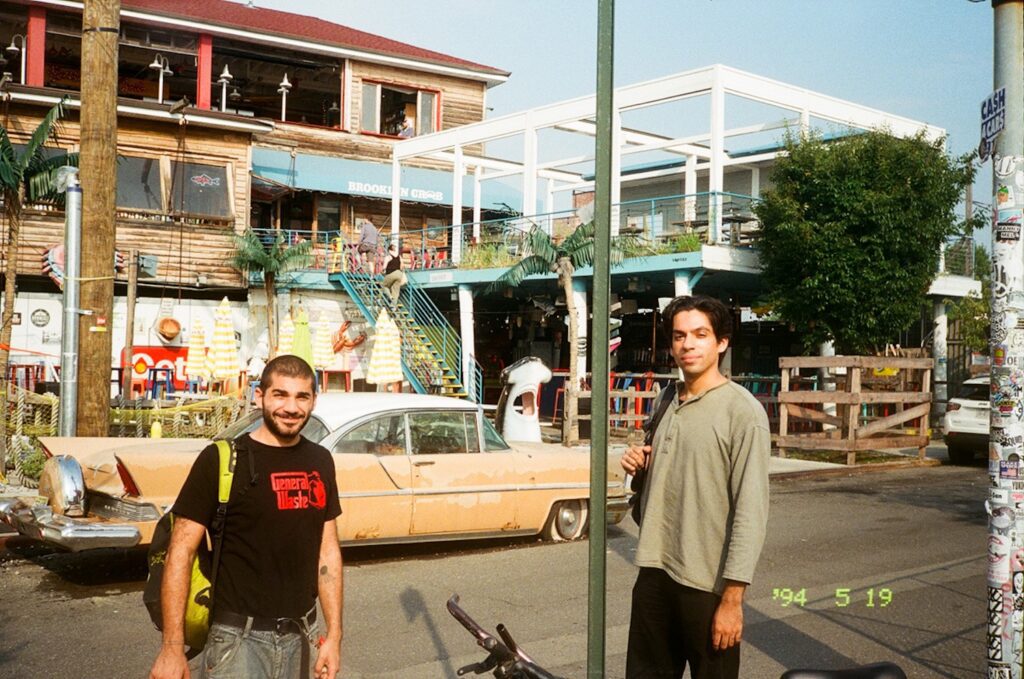
Abe El Makawy (left) and Mikey Saunders (right), co-founders of Aint Wet (Photo by Matthew Ritchie)
Before the brand, El Makawy and Saunders started as friends growing up in Carroll Gardens, pushed together because their moms were (and still are) close friends. The “arranged marriage” resulted in decades of hanging out over Legos in each others’ living rooms. As the mid-2000s arrived, Abe would trek to Mikey’s house to use an eBay account that he created on the Saunders’ family desktop, because his family didn’t keep a computer in the house. “I was doing the same shit I do now, just researching things… I’ve always been obsessed with the past,” El Makawy states. Abe credits Mikey as his best friend in the physical, digital, and professional worlds. When it came time to get first jobs, Mikey worked at Saunders’ family print shop, NY Printing & Graphics, which was based in Tribeca, before moving to 481 Van Brunt St. in Red Hook.
In many ways, the print shop was the catalyst for Aint Wet. It’s where El Makawy and Saunders’ self-described “factory mentality” mixed with a love for art and provided an outlet to express themselves creatively. The brand—the name an inversion of the “WET PAINT” signs that adorn a city in constant renovation—was partly born out of Hurricane Sandy destroying NY Printing in 2012, allowing them to acquire a real screenprinting machine after a donation, which they toyed with as an extracurricular in high school.
Since getting off the ground more than 13 years ago, Aint Wet has morphed into a go-to collaborator for New York’s underground music scene. They’ve been involved with post-hardcore band Show Me The Body since 2016, with El Makawy loving and sharing their music with Saunders back in high school. They’ve been designing the band’s rollouts for more than a decade now. They’ve been locked in with 10k Global rapper MIKE and label co-founder Naavin Karimbux since 2016, handling art direction on numerous vinyl releases, tour shirts, and their annual Young World Festival at Bed-Stuy’s Herbert Von King Park. “It’s great because we walk around and kind of just put thoughts in our pockets everywhere we go, just from observing,” El Makawy says. “When they inevitably do end up in some album campaign … I actually think it’s really amazing because it becomes a step removed.”
From Karimbux’s viewpoint, though, Aint Wet’s process for bringing their memories to life on T-shirts and merch drops makes every piece feel far more intentional, grounded in something real. Karimbux first met El Makawy through mutual friends around the same time he started working with MIKE. He believes that wearing one of their shirts feels like wearing New York City itself. El Makawy and Saunders are products of Egyptian-Italian and Puerto Rican-Italian households, respectively. It’s from this brackish mix of immigrant experiences, the very foundation of the city’s culture, that they are able to pick up little tidbits of distinct images as a way of scavenging together a unique identity.
“I remember they did a shirt that was like a subway platform, the yellow part with the raised bumps,” Karimbux tells me over the phone. “Abe did it in a way where there was yellow underbase, but with this thing called puff printing, which is where the ink’s raised and coming out, and he used that to do the bumps on it. Just super unique things where he’s mixing experience and design sensibilities, New York City, and then this crazy print knowledge. I think that’s what really separates them from other brands.” The fact that El Makawy and Saunders are in complete control of their creative journey, from designing to screenprinting, grants them another level of execution that few brands are able to reach. There’s a clinical, methodical nature to their screenprinting knowledge that fuses with a sprawling artistic lens. Karimbux likens their dual capability to how Kanye West could engineer a beat and then rap on it, knowing every nook and cranny in the production to find the right pocket.
In 2023, Aint Wet headquarters shifted from Gowanus to the same Red Hook warehouse, 481 Van Brunt St., as Mikey’s family print shop. The warehouse had morphed into an artisan’s haven in the 1990s, with studios and small businesses held together by bohemian spirit and passion. Aint Wet’s new space was dubbed “General Waste,” a perfect symbol for the creative chaos that existed in every corner, tools strewn among old signs and discarded prints that still had the latent potential to be built into something new. It became their cove to pump out physical media gems and merch capsules. It also gave them a real reason to see their family almost every day, the aspect that Saunders viewed as the studio’s best feature. “The space, in the way it existed, was kind of utopic. It was everything that we could have asked for. But it was still incredibly dysfunctional,” El Makawy says, taking a moment to picture the space while rubbing the top of his buzzed head.
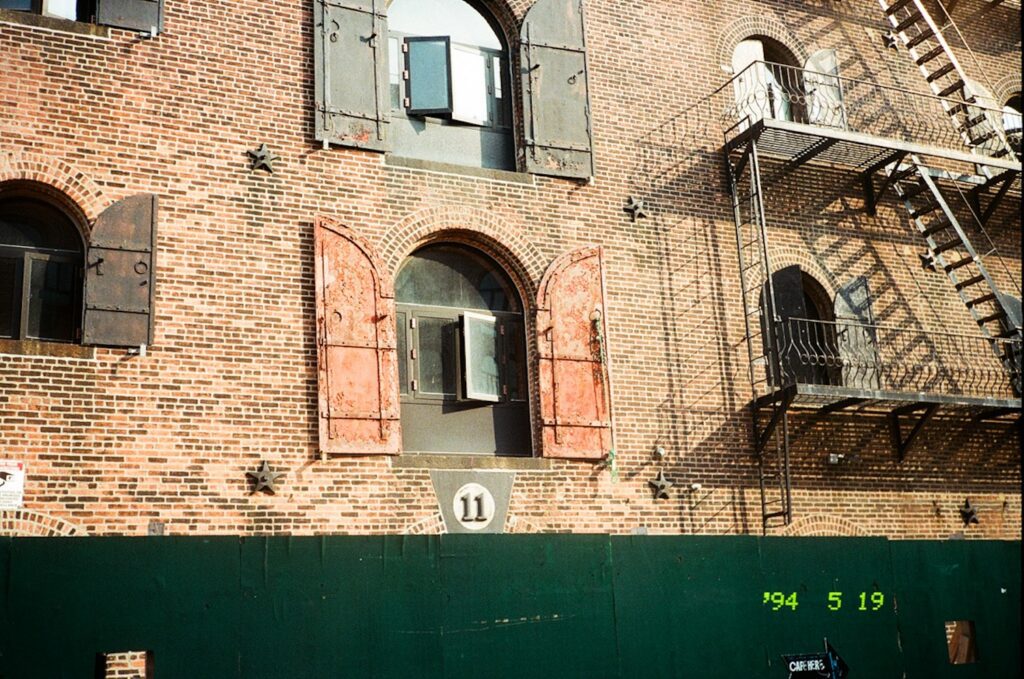
Photo by Matthew Ritchie
On September 17th, 2025, El Makawy was starting his Wednesday morning like any other before it when he received a phone call from a neighboring business owner in the building. The call was about a five-alarm fire that started a little after midnight in the warehouse and had ripped through hundreds of businesses by the time morning light rose over the pier. When El Makawy and other artists and business owners arrived at the warehouse, they could only watch as firefighters tried to contain the blaze, which would smolder for a couple days.
El Makawy and Saunders joke that they had 13 years to prepare for a cataclysmic event at their studio space on the pier—armed with a knowledge born from Hurricane Sandy destroying the Saunders’ print shop back in 2012. The duo have NOAA radars up on their computer to track hurricanes during storm season, contingency plans at the ready. But the sudden surprise of fire damaging the warehouse’s infrastructure, causing tons of water to pour down into their studio from above, isn’t something they had game-planned for. “Me and my dad, we were like, ‘Oh yeah, we’ll do this and that,’” Saunders mused. “And then that shit happens and you’re like, ‘Bro, it rained from the ceilings.’ It was coming from the skies, not the ocean.”
When El Makawy and Saunders were first allowed into the warehouse on the following Friday, they were barely allowed to cross the threshold of “General Waste,” watching as pipes drenched their work and tools. Because of the slow crawl of bureaucracy with the Department of Housing (and the building being condemned), it took weeks for El Makawy and Saunders to go in and sort through the remnants of their beloved, chaotic space. Everything they knew began to degrade behind red and yellow tape, with government officials making it abundantly clear that “this isn’t yours anymore.”
“I think I began to spiral both emotionally and creatively; it’s kind of getting off of the course of what the question is, but I think that there are some fundamental truths in it,” El Makawy says. “And it’s just that like, you know, loss is unpredictable, life is unpredictable, and we were caught lacking in a lot of ways.”
Days after the fire, Aint Wet was back working on other people’s projects. “The work didn’t stop,” El Makawy admitted. “I mean, it was terrible because you’d be like, ‘Oh let me go get this,’ … or like, ‘I saved that from like five years ago in my archive. That would be perfect.’ And it’s just like, ah, my tools. …” Asking for help was daunting, but unavoidable. By their own admission, both El Makawy and Saunders have a “complicated” relationship with reaching out to others in times of need, all while being more than ready to assist at the drop of a hat. “The only way out is through,” ends a an IG post announcing the news and the launch of a GoFundMe that Friday. They helped Saunders’ parents—equally resistant to calling out for assistance when their print shop, much like Aint Wet HQ, sustained considerable damage in the fire—set one up as well. “We launched a GoFundMe, and maybe this is like some sort of generational mentality inherited from our parents; that’s something that I don’t want to say was frowned upon, but it was like, you don’t ask for help. Something like this happens, you just figure it out. So it was cool to break that pattern in our lives.”
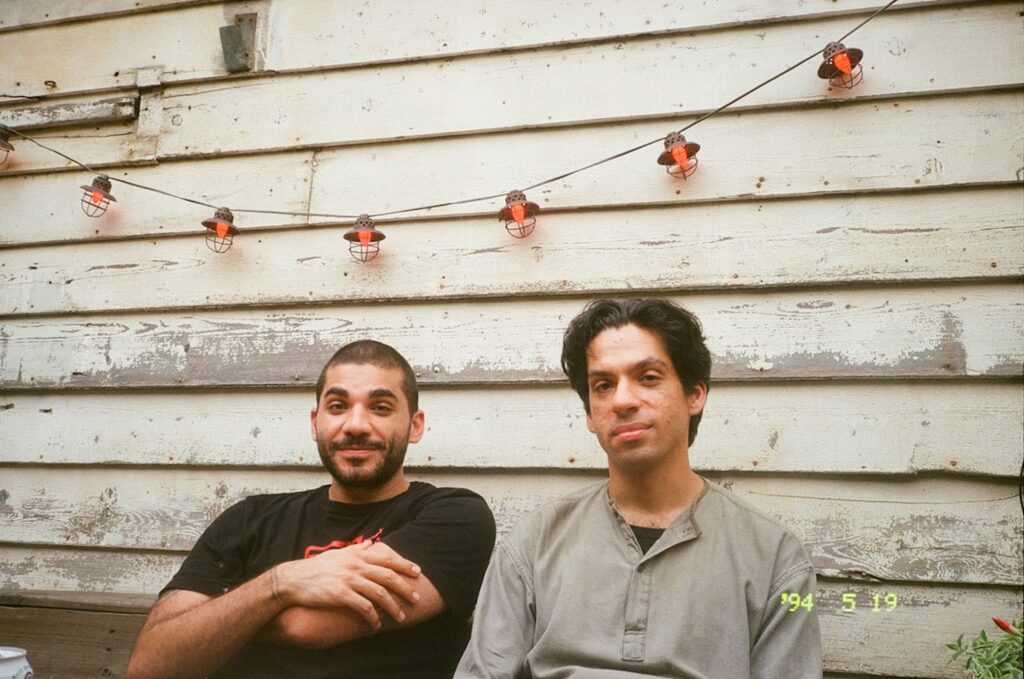
Photo by Matthew Ritchie
In the year and change since losing their studio, Aint Wet has pulled off a prolific stretch of work, all while missing their home base. They leaned on their network while working on rollouts for MIKE, Earl Sweatshirt, Surf Gang, Navy Blue, and numerous Tan Cressida (Earl’s independent label) projects. El Makawy found a couple creative homes to work out of in the meantime, namely Matt Valdez’s space for his clothing brand YaTuSabe, which gave them the chance to branch out into a line of wide-legged denim chore pants in their latest release. There’s also been room to bring to life the inside jokes that once made up their internal monologues. They still laugh about the recently released “WetroCard” hats being the most “crass, obnoxious thing” they’ve ever done, a living monument to the now defunct transit tool that every New Yorker can relate to.
“Oddly, we had a different collection planned,” El Makawy says. “There were like 10-12 different ideas that had to be put to the side because it was more important to reflect on this erasure that was happening because we just experienced one of our own. And I think that’s been a central theme in our collections, always. We use 9/11 as a really important kind of milestone in our lives growing up for several different reasons, but that obviously is a massive example of the skyline changing.”
Saunders continued: “The erasure is a really good point, because this skyline changes, but it’s usually additive. In New York, we always acknowledge that it’s going to change, right? … With us, I think it’s more of an acknowledgement of, ‘They took an old thing down.’ Like yup, ‘One more thing.’”
What Aint Wet’s survival has mostly subsisted on, though, is the friendship and love between El Makawy and Saunders. They haven’t stopped learning from each other, especially during one of the more difficult years of their lives. Saunders credits Abe for his intrinsic ability to have a difficult conversation no matter the venue, a feature that flies in the face of Saunders’ penchant for grinning and bearing any hardship.
The near future for Aint Wet is murky. Their search for a new studio continues, seeking out the right balance of what the old Red Hook haunts provided and room to facilitate organic growth opportunities. So, for now, they’re a label with no permanent material base, but not exactly without a home. Considering all the obstacles facing the peaceful existence of their creative lives, a phrase escapes El Makawy near the end of our afternoon: “The hard reality is that Aint Wet will exist in some way, shape, or form so long as me and Mikey are friends.”