Courtesy of A24
You Can See Everything, Unless You’re in Prison
In the unlikely event that you clicked on this link without first watching 'You Can See Everything,' prepare for heavy spoilers
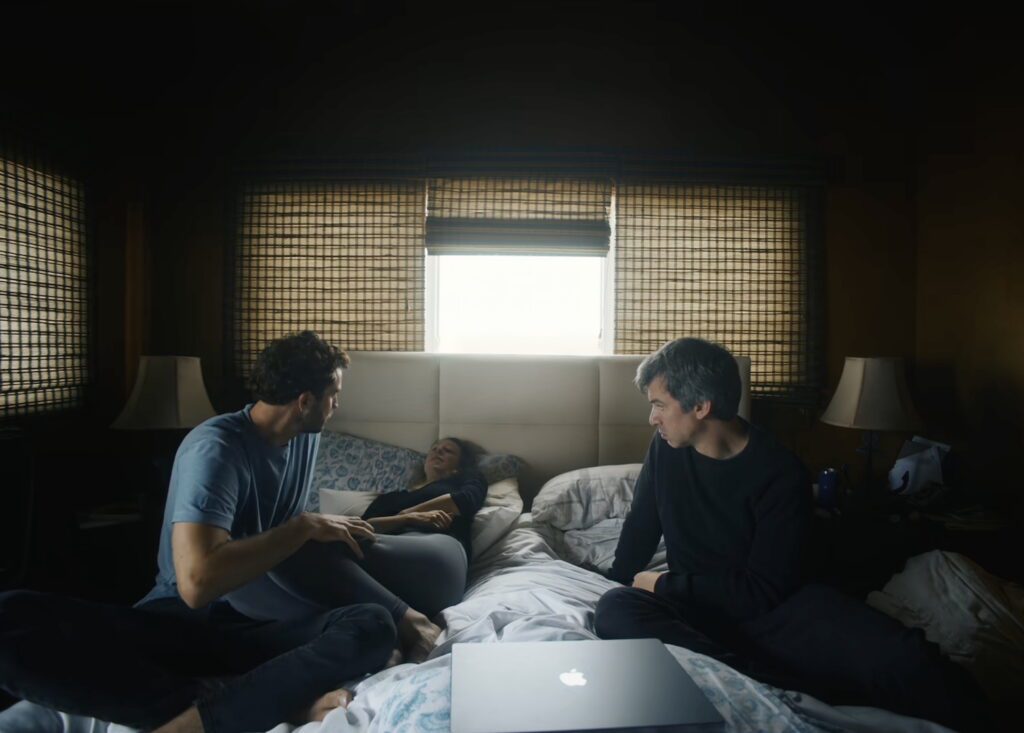
About a week before turning herself into the custody of the Federal Bureau of Prisons, Elizabeth Holmes takes a phone call. She’s sitting on the couch in the living room of her Del Mar beachfront rental speaking, presumably, to her lawyer. It’s an already deeply impersonal space made claustrophobic by Nathan Fielder, Lance Oppenheim, and the small team of cameramen that she has inexplicably invited into her home. What follows is one of the most unguarded moments captured in Fielder and Oppenheim’s resulting metadocumentary, You Can See Everything.
The audience she is performing for (Fielder and his cameras) and the man who jealously guards her performance (her partner, the pre-bloat Billy Evans) are engaged in their own conversation in the kitchen. The film’s eye flits between the two men near the fridge and Holmes, accepting the reality that she is going to prison in real time. She learns that she will be subjected to 3:30am wake-ups, that she will be subjected to “invasive full-body cavity searches,” and that she will not be able to receive visitors during her first weekend in federal prison. When she begins to cry, it is the first time I believe that I am seeing what Elizabeth Holmes is actually feeling.
It is the rare contemporary film that trusts its audience, unconcerned with the question of Elizabeth Holmes’s guilt or innocence according to the letter of the law. That’s a good thing, because these transgressions have been well established and would make for a boring film. Rather, Fielder and Oppenheim turn their access into an opportunity to explore their respective artistic preoccupations: the performance of normalcy, the unknowability of the other, the impossibility of reconstructing reality. Perhaps more than anything else, You Can See Everything is a film about control. Fielder, contemporary culture’s preeminent puppeteer, grapples with whether he is playing cat or mouse to Holmes; Evans appears to dictate everything from Holmes’ tweets and legal personhood to how she scrambles eggs, unless this, too, is an arrangement of convenience, the puppeteer posing as marionette. This question is colored by the ultimate system of control that structures and stages the film: prison.
Courtesy of A24
You Can See Everything is essentially two films in one. Its first act—following Fielder & Co. filming, then living, with Holmes and her family in the month before she is to turn herself into a federal prison in Bryan, Texas—is about living in the shadow of one’s impending loss of liberty. Its second is about the experience of incarceration itself, capturing the cultural zeitgeist while presenting the looming weight, then reality, of a prison sentence. Incarceration represents a swath of experiences that simultaneously structure American life, while largely staying relegated to its subconscious. Achieving this feat through the unblinking eyes of Elizabeth Holmes renders the inevitable conversations it will spark somewhat fraught.
This is because Holmes is a particularly unsympathetic character. She is a wealthy, blonde white woman with a knack for manipulation and, by virtue of the human cost of her fraud, a difficult person to muster up much empathy for. The crime for which she was convicted (defrauding obscenely wealthy investors whose wealth was built in large part through investing in companies as overtly scammy as Theranos) is perhaps the least troubling criminal conduct one could imagine; the harm she inflicted upon would-be patients relying upon her dysfunctional product for diagnoses is profound and well-established. It’s like getting Al Capone for tax evasion. These two countervailing tendencies—her white collar privilege setting her apart from the vast majority of American prison inhabitants on one hand, and the scale of her public deception on the other—make her a challenging lens through which to represent one experience of incarceration and control. And yet here we have her incarceration and control represented in You Can See Everything.
Throughout the film’s first half, Fielder repeatedly locks swords with the first great foil that his on-screen persona has ever faced. Fielder’s performance during his early exchanges with Holmes is immediately legible to any long-time watcher; his affect is intentionally disarming, ambiently autistic in his jaw-clenched directness. In these stilted skirmishes, Fielder attempts to suss out whether Holmes actually believes that she is, in fact, innocent of the crime for which she has been convicted, or whether she is playing him, so committed to performing innocence that she cannot cede any ground. The film wastes no time on the settled question of whether or not Holmes has done a bad thing, and instead spends much of the first half exploring the psyche of a sociological oddity. It is when her impending incarceration becomes real—through expectation-setting phone calls, last moments with her fidgeting parents, and instructions regarding her pumped breast milk in the fridge—that Holmes comes off as convincingly human. The question implied, as Holmes’s prison date inches closer, is whether Holmes’s fraud warrants her being separated from her family for ten years. Whether or not Fielder and Oppenheim intended to cut together a film about prison becomes immaterial; it is one’s discomfort with the cruelty about to be visited upon the new mother that her personhood is finally effectively manifest, and she wins a measure of our sympathy.

Courtesy of A24
If Nathan Fielder’s body of work is about the impossibility of controlling the world around him, then prison represents his purest nightmare. In prison, you are forced to relinquish all of your autonomy. The film’s first half, in its excruciating march toward the federal facility, portrays the anguish of this lack of control. Evans has Holmes’s likeness scanned in order to “read” her children bedtime stories and dupe investors before moving their family, in a cosmically perfect representation of the 2020s tech boom, to a Cybertruck-flooded Texas. It’s only once Holmes turns herself into custody that the film transcends interesting portraiture and becomes something of a masterpiece. You Can See Everything’s second half is so shocking precisely because the intervention of the prison has made it impossible to see anything, turning the film into one about absence and how we make sense of the violent loss of control that lurks at the boundaries of American life.
Excepting a final, voyeuristic shot of her with her family on the prison grounds during visitation, viewers do not see Elizabeth Holmes once she goes to prison, for Fielder is not permitted to film his visit with her. This, in itself, is unexceptional; the right to star in a documentary from which you might receive pecuniary gain is far from inalienable. But the more mundane cruelties of her incarceration nip at the film’s heels.
Holmes, we learn, is unable to receive phone calls while in prison; she must make them whenever the line of prisoners ahead of her thins out, hoping someone is around to pick up so that she may speak in two-minute intervals. She works at FPC Bryan for 30 cents an hour and is not permitted to spend her wages on presumably overpriced turkey jerky and Aquafina from the visitation room’s vending machines. Guards keep eyes on her while she sees her children grow a week at a time, and she’s forbidden from spending time beyond closed doors with her partner, repugnant as he is. Outside of the prison walls, Evans—who has secured power of attorney over her—runs her Twitter account with a voice that recalls Tucker Max. At one point, Holmes’ de jure representative excitedly shows Fielder a video of her artificially rendered likeness that people online can do whatever they’d like with. When Fielder expresses concern that this image will be used to generate AI porn involving Holmes, Evans swigs his Celsius and demurs that people will do that anyway.
The most compelling narrative thrust of You Can See Everything is how the film transforms in real time, from one about Fielder attempting to disarm one of the few manipulators more skilled than himself into one about Fielder mourning the conditions of her incarceration. It becomes, in a very real sense, a movie about what prison does to its inhabitants and the people around them. Which, of course, gets us to the Holmes of it all.

Courtesy of A24
Amidst the inescapable online conversation surrounding this film, there has emerged a current of criticism that dismisses You Can See Everything as an exercise in image rehabilitation. The loudest of these detractors tend to point to others’ discomfort with the cruelty of the prison sentence visited upon Elizabeth Holmes for defrauding the obscenely wealthy as evidence that Fielder and Oppenheim are, in fact, suckers for having seen this project through. What You Can See Everything actually communicates is that prison, even the relatively cushy, low-security federal facility in question, is too inhumane even for a wrongdoer as egregious as Elizabeth Holmes. The film is not sad because an innocent woman is going to prison, but because a tremendously guilty person is going to prison.
Here is the sort of moral argument that Oppenheim dances around in his other feature-length of the year, Primetime. In Primetime—a Robert Pattinson vehicle best described as a film about the early-aughts mediasphere in a Chris Hansen biopic’s clothes—Oppenheim wades noncommittally around the entrapped, would-be sex offenders whose busts were manufactured for nationwide entertainment on television. If one were interested in stress-testing the American public’s views on crime and punishment, it would be hard to imagine a more universally reviled set of subjects than Elizabeth Holmes and a series of potential child sex offenders. Yet despite Primetime’s tut-tutting at the escalations of To Catch a Predator, Oppenheim remains mostly uninterested with what actually happened to the people entrapped by Chris Hansen. It is not a movie about the righteousness of punishment as much as the cruelty of transforming punishment into content. By comparison, You Can See Everything’s tack seems genuinely radical: discomfort with Holmes’s imprisonment is not rooted in the notion that the legal system went haywire in her case, but in the inherent cruelty of caging even unrepentant fraudsters.
You Can See Everything is able to conjure up from its audience genuine empathy for Holmes despite her evident (and, if the film is any indication, future) wrongdoing. In the American media environment that produced To Catch a Predator, enamored with bad guys getting their just desserts, that is a minor miracle. I would be remiss, then, to not state the obvious: that Holmes’s portrayed plight pales in comparison to the overwhelming majority of the nearly two million Americans currently in jail or prison. Elizabeth Holmes is rich, despite the massive restitution judgment made against her in her criminal trial. It’s this fact of her wealth that allows this film to exist in the first place. Where most people convicted at state or criminal trials are held in jails or prisons before beginning their official sentences, Holmes is able to get her affairs in order and spend time with her family on the beach before her sentence by securing a family home as collateral for her appearance. Evans and his children are rich enough to move to Texas in order to visit Holmes frequently, whereas for most prisoners, the experience of being shipped far from their home city makes family contact financially and logistically impossible.

Courtesy of A24
At one point, Evans attempts to scare Fielder out of recording a conversation with Holmes by suggesting that such recording might get her transferred to a higher-security prison. His concern—seemingly unaware that when you are incarcerated, all of your phone calls conversations are being recorded, whether you like it or not—is that he does not want to have to move to Arizona, belying the sort of financial flexibility that is unthinkable to most families with incarcerated loved ones. Holmes is still, at least, able to speak with her family every night despite fees, extortionary and prohibitive for many inmates, associated with phone credits in carceral facilities. Whatever emotion that AI rendering of Holmes serving as a placebo presence for her children conjures within you, very few other children of incarcerated people share that “luxury.” The fact that You Can See Everything attempts to represent the realities of incarceration at all is noteworthy, but the conditions of incarceration the film does represent are, somewhat unbelievably, the most relaxed that America has to offer.
Holmes’s sentence is not just demonstrated as cruel, but as a failure. As the film makes painstakingly obvious, the ten years that Holmes is forced to spend separated from her family does nothing by way of rehabilitating her: she and her increasingly paranoid partner still work doggedly toward recreating Theranos for the right-wing tech milieu of the 2020s. If the world of transparent grifts swirling outside the film’s frame is any indication, her sentence accomplishes nothing to deter other would-be fraudsters from chasing their own first billion. Even those predisposed toward a purely retributive theory of justice must think carefully about whether a decade behind bars is adequate punishment for defrauding the Murdochs, Krafts, and Waltons of the world. The bitter irony undergirding You Can See Everything is that the prison industrial complex it portrays operates much like the woman it is seen caging: unblinkingly insistent, against mountains of evidence, that the scam it’s selling actually works.