Photos by Javier E. Piñero
Watching The Bird Watchers in McGolrick Park
How a North Brooklyn bird watching group is building community, connection, and focus in the attention economy
Most Saturday mornings, like this one in late summer, Michael Lombardo walks around McGolrick Park’s half-mile expanse, scanning the trees with his hands as if framing a scene. The founder of the McGolrick Bird Club is hyper-aware, paying attention to every minuscule sound and motion. He separates colors and notices changes in direction, small jumps that reveal an efficient system of movement beyond flight. He tracks social interactions and behaviors that shift with the seasons and serve as inspiration and insight for his Substack dispatches on The Noticer’s Monthly, which publishes far more frequently than its name suggests.
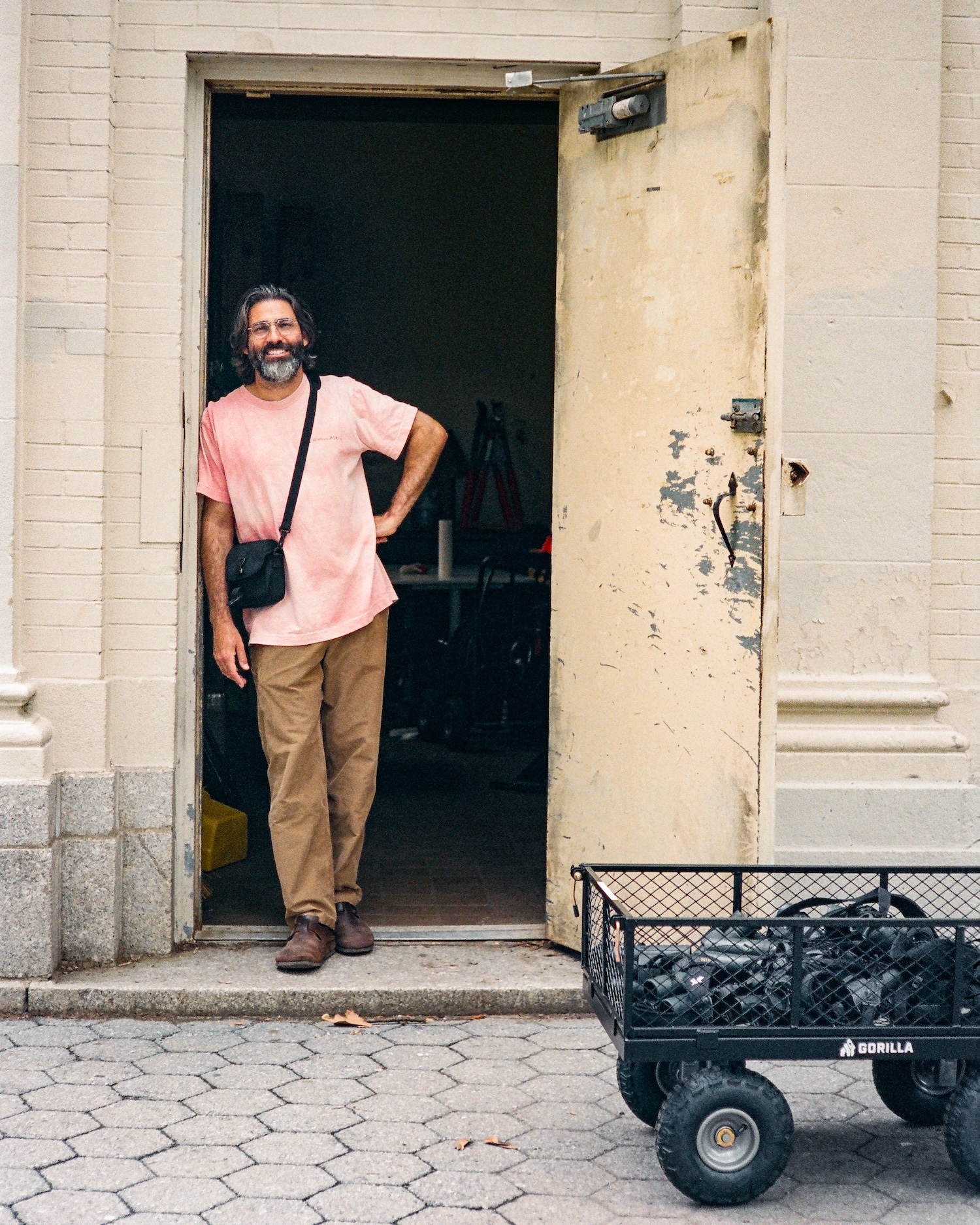
Photo by Javier E. Piñero
If, on a given Saturday, you find yourself swept into Lombardo’s highly ceremonial bird watching summit, you’d catch glances of the watchers, the dress code, the coffees, and the matchas. You’d hear the chatter and laughs and collective pauses, and notice the ways people take up space. And, before you know it, you’d be looking up, too, fidgeting with focus on your binoculars, squinting hard in all directions across a visual field far vaster than you’d ever anticipated, and trying to fend off the impulse to check each intermittent vibration from your side or back pockets. With another glance, you might also suspect the mission of the group in this North Brooklyn park goes beyond its stated mission. Lombardo wants people to connect again.
That mission began in 2023, when Lombardo transitioned from San Francisco-based YouTube employee to full-time Brooklynite birder. For more than a decade, Lombardo had worked in tech, admittedly “Kool-Aid-drunk” on its early promise of bringing the world’s information to people. Eventually, he began seeing something different taking shape. “In the right light, Big Tech looks a lot like it runs on addiction and the fracking of attention,” he says. The contradiction became harder to ignore when he became a father. He was making good money, had the salary and stock options, but came home to his one-year-old daughter feeling “half-present and dissonant,” working on something he no longer believed in. There was shame, he tells me, that he’d become “someone my daughter wouldn’t be proud of.”
After multiple conversations with his wife, therapy, and what he calls “many dark nights of the soul,” Lombardo acknowledged had felt the effects of too much technology and too little nature, and walked away from his job. The agreement he’d come to with his wife was simple: He had one year to figure something else out. There was no business plan, and certainly no intention of becoming a professional bird guide. He planned to write, and, on the first Saturday after leaving his corporate job, he started taking people birdwatching.
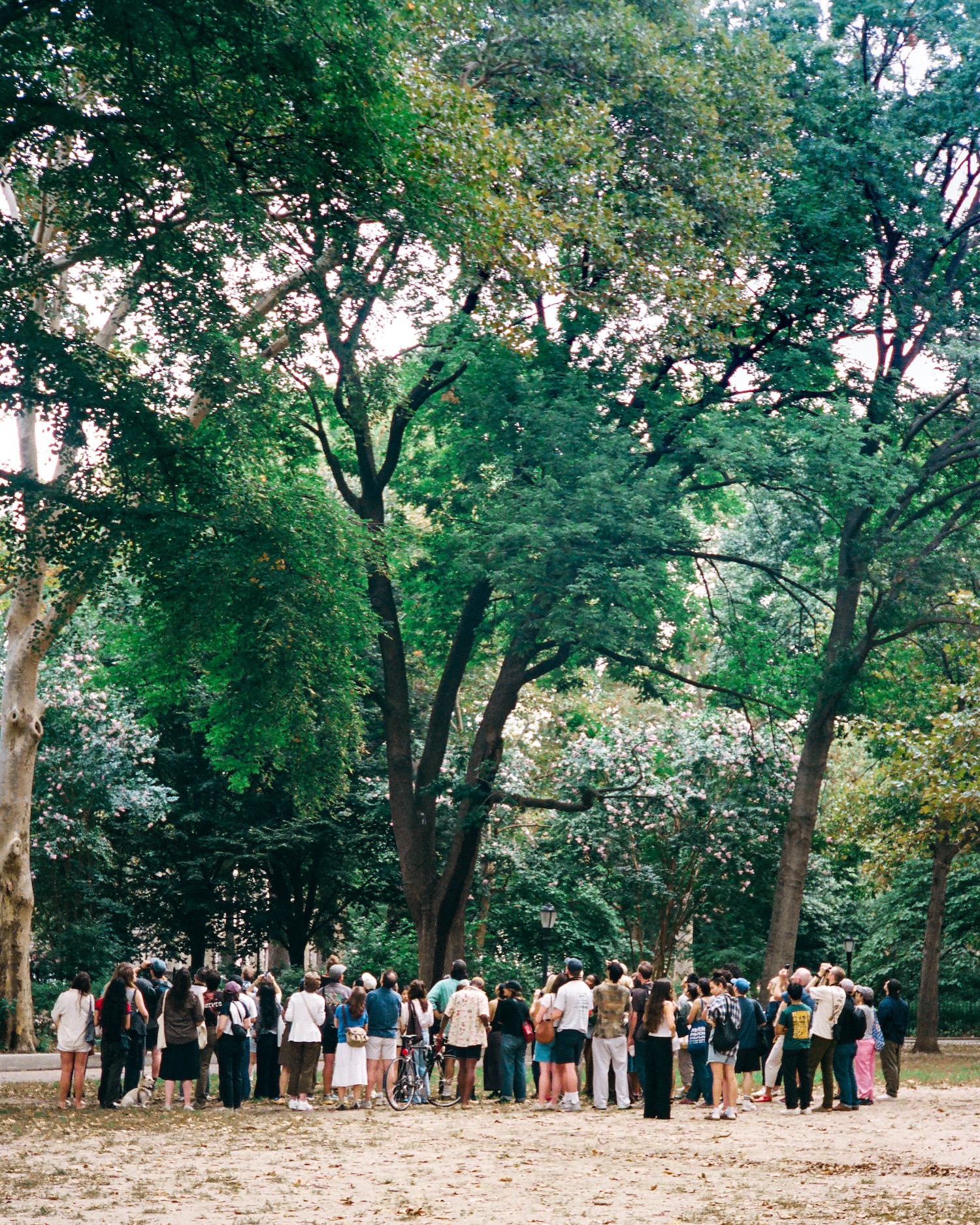
Photo by Javier E. Piñero
Three years later, the experiment is his full-time job, although the economics are less attractive than the philosophy. During the week, Lombardo writes and illustrates his Substack, designs graphics, plans events, handles accounting, reaches out to brands, and, in his words, spends time “generally banging my fists against my head to come up with some next thing.” He does it while raising his kids with his wife, who takes over parenting duties during the club’s outings. “Being a happy dad and calm husband while trying to build something is not an elegant balancing act,” he said.
Making the club sustainable introduced another tightrope. Lombardo wants to make a living off a practice built partly in opposition to the devices designed to seize and commodify our attention. His solution has been to draw a boundary around Saturday mornings. He describes the weekly gathering as a “third-space kind of sanctuary,” where relationships can form and attention can be practiced, but monetization is effectively absent. He’ll make money around it, just not inside of it.
Writing, private guiding, events, and carefully chosen partnerships increasingly support the work without turning the Saturday ritual into another place where someone is trying to sell you something. And Lombardo’s ambition is considerably larger than filling McGolrick Park; he wants birdwatching to escape its niche hobbyism relegation and enter conversations around mindfulness, health, and what he calls “attention activism.” The argument is almost embarrassingly simple: stare at your phone and your senses retreat; look for a bird and they come rushing back. “You’re actually using your senses, and you feel alive,” he says. “Like an animal. Like our ancestors.”
Lombardo imagines bird watching becoming bigger than yoga, a book somewhere along the way, maybe even earning the distinction of “Nike’s first sponsored naturalist,” with his very own Huarache colorway. And, if everything really goes according to plan, an Anthony Bourdain-esque show would follow, where he takes people like Barack Obama to gaze at the trees and see where the conversation goes. “I know a good host,” he says.
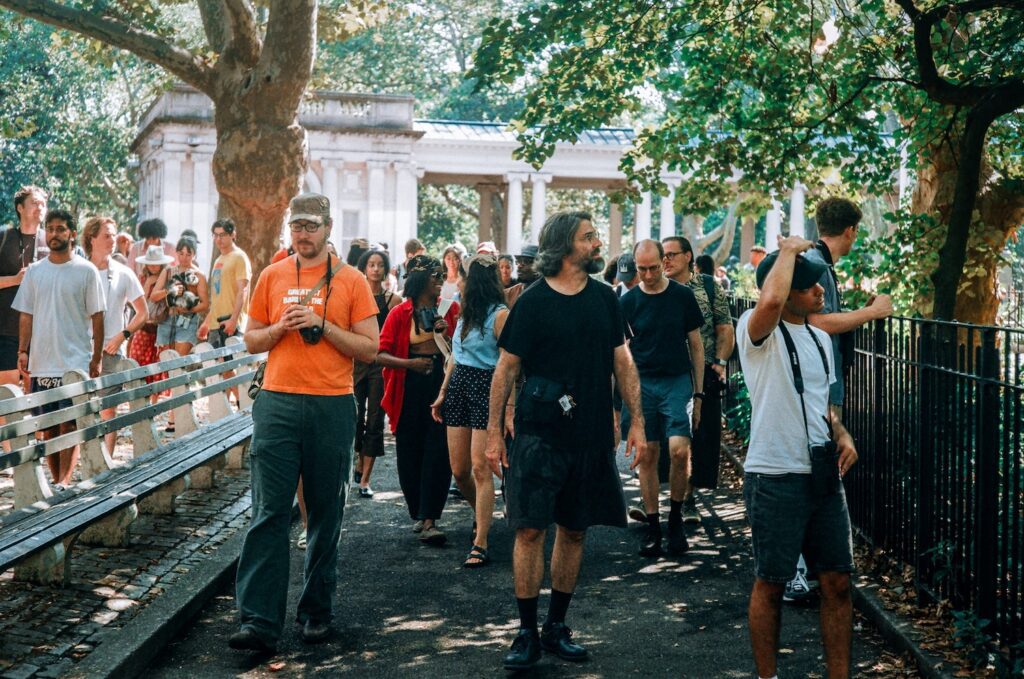
Photo by Javier E. Piñero
It’s hard to argue with him. Lombardo has the energy of someone consumed by his craft. He’ll be in the middle of a conversation and suddenly stop you because, somewhere above the noise, he’s recognized a chirp. His eyes race towards a tree, and almost immediately find what everyone else is still searching for.
At times, more than 100 people can ripple around Lombardo. He moves; everyone moves. He stops; everyone stops. They aren’t always paying attention to the birds—or even their guide—but seem to sense them and him, and the subject of his focus, as they talk, drink their coffees, meet strangers, disappear into conversations, and eventually look up again.
Maybe that’s part of what he’s actually offering. For a couple of hours on a Saturday morning, nobody has to decide where to go; there’s no feed to refresh, route to recalculate, restaurant to choose, or reason to introduce yourself to the person standing beside you. You just follow a weirdly good birder through a tiny park and submit to whatever happens around that. The birds give everyone something to look for, Lombardo gives them somewhere to go, and, in between glances, people stop and find each other.