Tupac Shakur and James Belushi in ’Gang Related.’ Photo by Orion/Getty Images
Starin’ Through My Rear-View: Nitehawk Celebrates Tupac in Film
Thirty years after Tupac Shakur’s death, the Prospect Park theater will screen his short but indelible catalog of movies
Halfway through Poetic Justice, John Singleton’s subversive 1993 rom-com, Tupac Shakur’s South Central LA postal service worker, Lucky, is out of the city, driving up the California coast from LA to Oakland, when the enticing smell of barbecue wafts into his mail truck. He pulls over with Regina King, Joe Torry, and his co-star Janet Jackson, and his nose leads him to the Johnson Family Reunion, an idyllic gathering replete with wheelbarrow races and volleyball and frisbee tossing in a park off the highway. The quartet decides to crash the party.
Pac is posing as a Johnson, playing a role within a role and clearly fucking with the uncle giving him a tour of the event, but also clearly enjoying himself, out of his element at the wholesome daytime affair. For, once he is on screen, not an archetypal hard-nosed detective or a posterboy for societal decline, just a working man with a beautiful lady on his arm for the afternoon. “This is kinda cool,” Pac remarks, half-bewildered and half-envious. “I ain’t never seen so many Black folks in one spot and ain’t no fights.” He’s no less comfortable or compelling at this moment than he is throughout the rest of his filmography, which is full of rage, anarchic humor, and tragic pain. It’s the kind of performance that suggests an entire range of characters he could’ve played and emotions he could’ve expressed on screen if he hadn’t run out of time just three years later, when he was murdered in Las Vegas.
Shakur appeared in a total of six films over four years: Juice, Poetic Justice, Above the Rim, Bullet, Gridlock’d, and Gang Related, which is incredible when you consider over this period his star simultaneously exploded and imploded. He released four albums (and recorded hundreds of unreleased loosies), was shot five times, was arrested four times, spent a year in Clinton Correctional Facility in upstate New York, started a war between two entire coasts that resulted in the deaths of the two greatest rappers of their generations, and walked off the set of another film, Menace II Society, over creative differences that led to him assaulting director Allen Hughes. As a partial result of this instability, his filmography is a mixed bag, with flawed to often bad genre pictures the sensitive genius elevates, like Robert Ryan or Robert Mitchum in the generations that preceded him, breathing pathos and dimensionality into what might have been rote villains in lesser hands.
Looking at the six films that comprise Shakur’s filmography makes for a fascinating snapshot of the industry for Black actors in a mid-’90s transition period that saw rap explode from a somewhat niche artform to a multibillion-dollar industry. Following Wild Style, Breakin’, Beat Street, and Krush Groove, the first wave of hip-hop films specifically dedicated to the culture and featuring rappers in the early ’80s, the modern era of the rapper on screen begins with Singleton and Ice Cube’s Boyz n the Hood in 1991, when an emergent crop of young Black directors saw the opportunity to pull the trick Hollywood has capitalized off since the inception of the medium: converting pop artists to box office stars.
By the end of the ’90s, Ice Cube was pivoting between hood films and prestige plays with George Clooney; rappers like DMX were getting their own action vehicles; and Will Smith was the biggest and most bankable star in Hollywood. The four years Shakur was working represent a bridging of these realities. How his talent was used—almost exclusively in gritty exploitation pictures—is a reflection of, and commentary on, the lack of imagination Hollywood had for a star as dynamic as Pac.
For all his immense talents, committing to the bit was Pac’s superpower. He was a natural performer who didn’t get to do much more than scratch the surface of his potential. And the camera loved him, as did all his scene partners. As an actor, Shakur was so convincing—whether in love or threatening to kill someone—the viewer was ready to jump in a foxhole with him, or kill for him.
One of my favorite jokes from Chris Rock’s great Top Five (2014) is a debate over where Tupac would be today if he had lived. There is a suggestion that he would’ve become a political leader, and Rock counters that maybe that is true, or maybe he would’ve become “the bad dark-skinned boyfriend in a Tyler Perry movie.” And what’s sad is not just that both options are equally viable, but the kinds of roles Shakur might have played are a fascinating thought experiment (because he would, in fact, have made a fantastic villain in a Tyler Perry movie.)
The incredible performances we did get from Shakur will be on display throughout the month of September at the Nitehawk in Prospect Park, where programmer Desmond Thorne has curated the films of Shakur’s career in honor of the 30th anniversary of his death. So I got on the phone with Thorne to run through Tupac Shakur’s volcanic acting career, one film at a time.
(This conversation has been edited and condensed for clarity.)
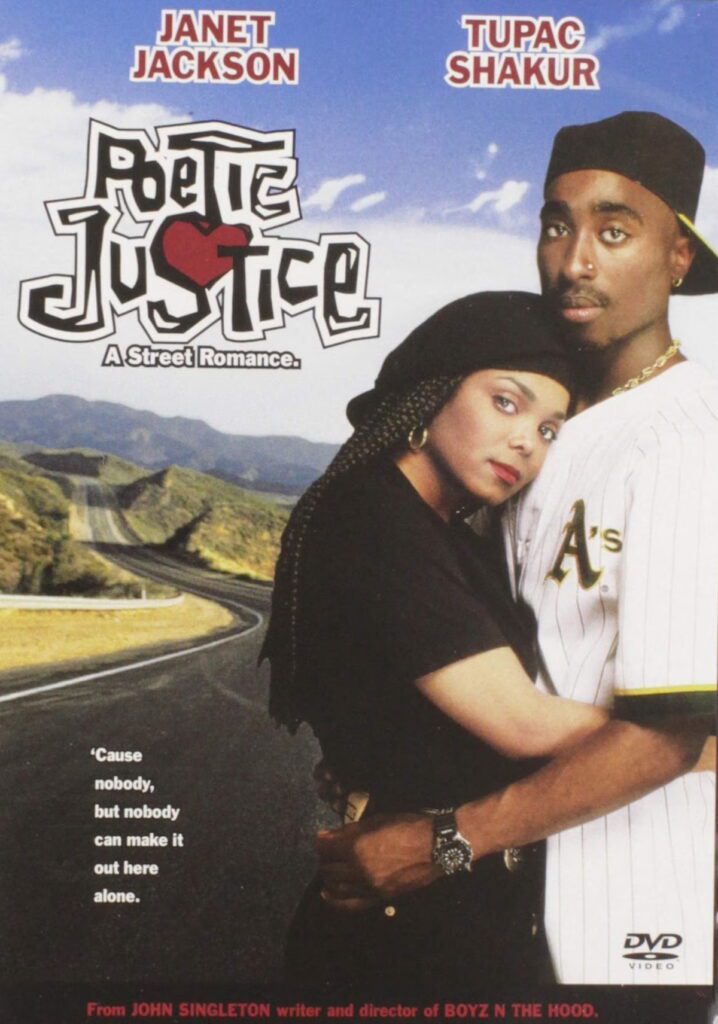
Poetic Justice (1993)
Director: John Singleton
The series is not programmed chronologically. Was there any logic behind the way you sequenced it?
The way that I tend to look at the calendar when I’m doing a program is that I want to begin strong and then end strong. In this case, that has less to do with quality and more to do with the most well-known films Tupac was in. That’s why, not including the documentary, we start with Poetic Justice and end with Juice .
Poetic Justice was the first film that I saw him in decades ago. It was my introduction to Tupac as an actor. This VHS was in our house growing up, and it’s such an iconic cover. Such an iconic poster. He is so charming, so charismatic. He has incredible chemistry with everyone, absolutely everyone, and that kind of surprised me because growing up, I always thought that a performance from Tupac would be similar to what we get from many singers-turned-actors. They’re usually somewhere between okay to good, most of the time. Especially when they aren’t people who have made the “full transition.” People like Whitney Houston and Beyoncé.
Or Janet.
Another great example of someone who is a singer who is acting that is doing a fine job, versus Tupac, who is doing something different. I think Tupac was really able to tap into what made him a special performer as a musician, as an actor. That is very rare. Especially because he didn’t get the opportunity to act for very long.
The context for Poetic Justice is so important—that at this moment, Singleton was the king of the world, the first Black director nominated for an Oscar, at 24 years old, and he’s anointing Pac. It ends up being a smaller, slightly stranger movie by design, but the hype and the expectations were enormous.
Absolutely. And, also, giving him something to chew on, setting up Lucky as a character we might expect to see Tupac play, then continuously adding more and more layers to him throughout the movie. He gets to hang out with Maya Angelou, who apparently helped him relax on set when shit was going down. Just very interesting connections with this movie in terms of what he was dealing with in his own life. This feels like a character that is very close to the chest, and at the same time, it doesn’t really feel like he’s just playing himself, which is what we do get from a lot of singer-actors.
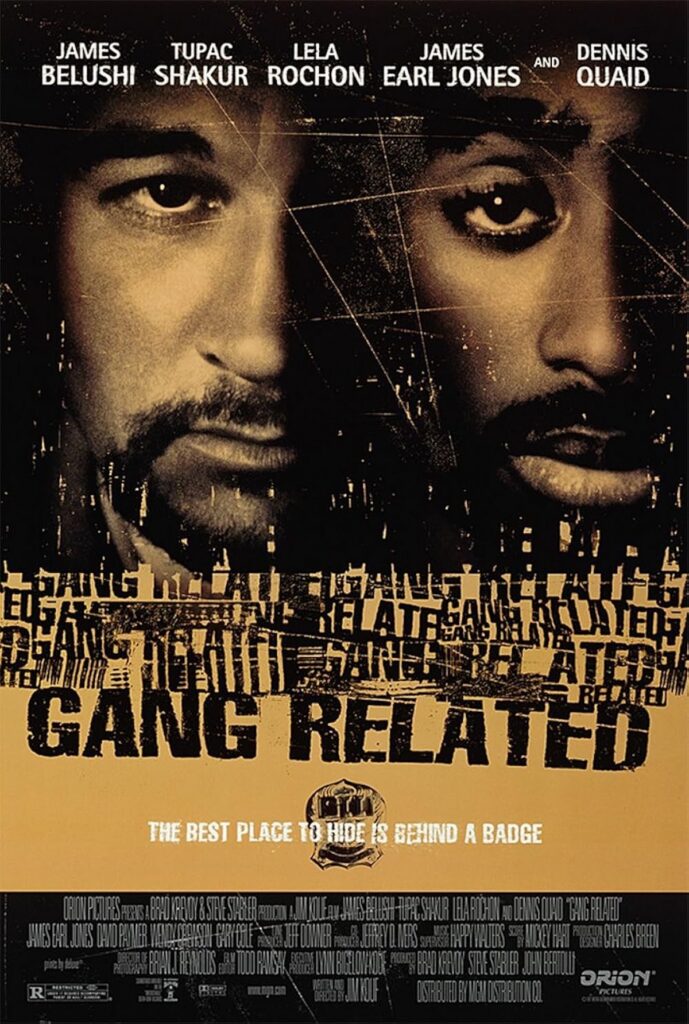
Gang Related (1997)
Director: Jim Kouf
I appreciate how absolutely surprising this movie was. It is a wild ride. I didn’t know what to expect coming in because of the title. It’s not about gangs.
Well, isn’t it?
Exactly. I don’t know if it’s novel but you have movies like The French Connection, where those cops are pieces of shit and we know it. But at the same time, there is something about them that is inherently cool. You’re still kind of supposed to be on their side. But here, you know from jump that these dudes are pieces of shit. They are terrible, and they have to go through this comedy of errors to fix what they’ve done.
It’s in the tradition of Bad Lieutenant or Internal Affairs.
You also might expect Tupac to be the villain in this, but he’s not really, which is really refreshing. He’s playing a cop in his final film, which is cool to see, which suggests this is the direction he might be starting to go in. It’s a departure from his other characters in terms of his groundedness, next to [James] Belushi.
He’s “Detective Rodriguez,” which is hilarious. They couldn’t even bother to rename the character.
Crazy. I was like, OK, so are we saying that Tupac is Dominican? What’s happening? What are we doing here? And apparently Belushi had beef with him because Tupac wanted to get things done in one or two takes. And Belushi was like, “No, I need more time.” But in Gridlock’d and Gang Related, there’s a maturity that starts to come through, and you can really start to see Tupac get even more versatile, working with the likes of Jim Belushi and Tim Roth. He’s now being put with these seasoned actors, and he’s still holding his own, if not blowing them off the screen. And to be clear, I’m not pointing them out just because they are white, but pointing them out because of their experience in the business versus his lack of experience.
The racial element is also a really valid point because the other movies he makes are almost exclusively Black films. So it is interesting to see him step outside that world and bring those dynamics into his scenes.
It is also a marker of the business itself taking him more seriously and letting him branch out. Those hard genre movies are not necessarily movies that are well regarded, but it does show what might have been the next step for him, a potential trajectory. You can start to really see even more of the skill in this film. This character is truly actually quite different from him and a lot of the other characters that he played. It really makes me wonder, what would have come next? This is not an original thought, but I certainly think that had he lived, he would be an award-winning actor. He’s really that good, you know?
I was doing some research for this, on Bullet, and Bulletproof randomly popped up, which reminded me there was this whole field of action-comedy team-up movies that originated with 48 Hrs and Pryor/Wilder shit in the ’80s but turns into lesser, mostly forgotten films like Gang Related by the mid- to late ’90s, where you would put a Black actor with a white actor to see what happens. And you can look at that field of actors, and what kind of careers they went on to have, and think about Tupac in this Damon Wayans role, or Tupac in this Chris Tucker role, or Tupac in this Martin Lawrence role. And it’s a really interesting thought experiment.
Someone who could kind of have an interesting parallel in some ways is someone like Larenz Tate. Imagine Tupac in Love Jones? Imagine Tupac in something like Why Do Fools Fall in Love? as Frankie Lyman.
It’d be interesting to see Tupac in a Spike Lee film—Clockers, or… as he would have eventually gotten older, maybe something like 25th Hour. I’m not going to say he would have been better than Samuel L. Jackson in Jungle Fever, but he could have played a role like that.
Or Da 5 Bloods. What’s so fascinating about him is you could literally throw any role out to me, as long as it’s not a big stoic guy, and I could see that. He had so much range. He really just had the gift.
Imagine him as the twins in fucking Sinners? Imagine him in The Wire?
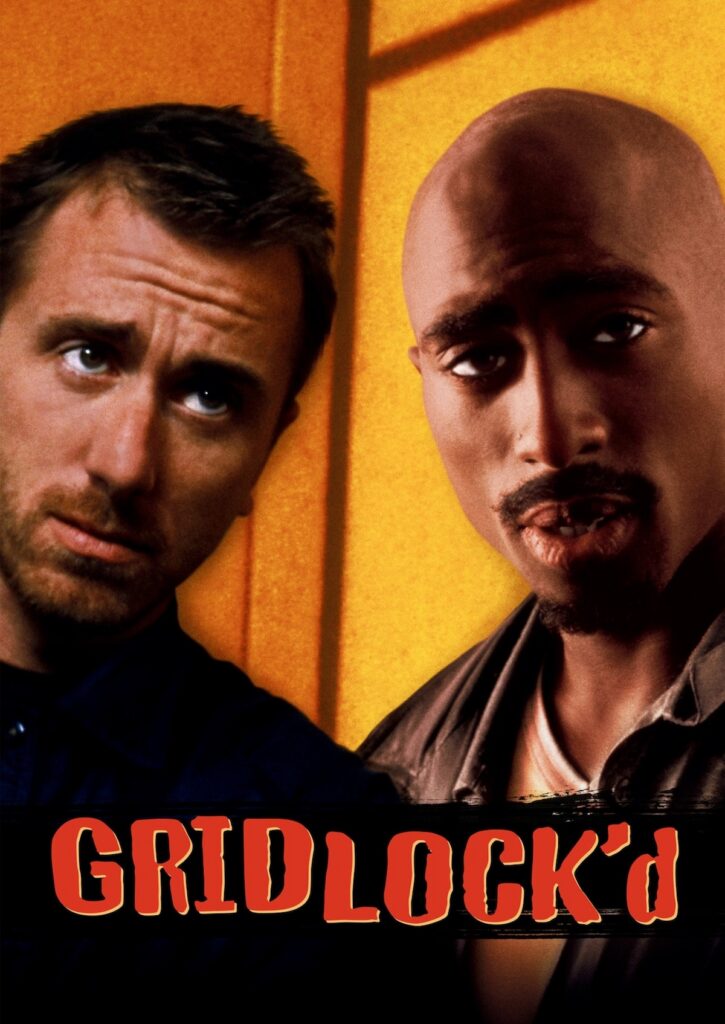
Gridlock’d (1997)
Director: Vondie Curtis-Hall
I never realized this was directed by Vondie Curtis-Hall. That is crazy.
A fantastic actor who gives us one of the best moments in Coming to America, and I still think his crowning achievement is Glitter. Gridlock’d is another one that I found to be surprising in that it was very spot-on about how the system treats addicts. Some movies would like you to believe that the day you decide to get clean, you go through a montage and come out on the other side. This movie does not do that. They’re trying their best to get clean through the healthcare system, and they’re just meeting so many dead ends while they’re being chased, while their friend, played by Thandiwe Newton, is in the hospital after an overdose. And there’s other surprises in the cast, such as Bokeem Woodbine, Lucy Liu, Vondie Curtis-Hall himself, and the voice of Roger Rabbit.
It again shows a different side of Tupac as an actor, with some comedic moments, but it’s very much a drama, and had certain elements been approached in a different way, it could have been what people would consider a prestige drama. But the script has some things here and there that one might tinker with. What matters is the relationship between Tupac and Tim Roth is so incredibly watchable. They are not having fun in the movie, but you can tell that the two of them have a lot of fun together.
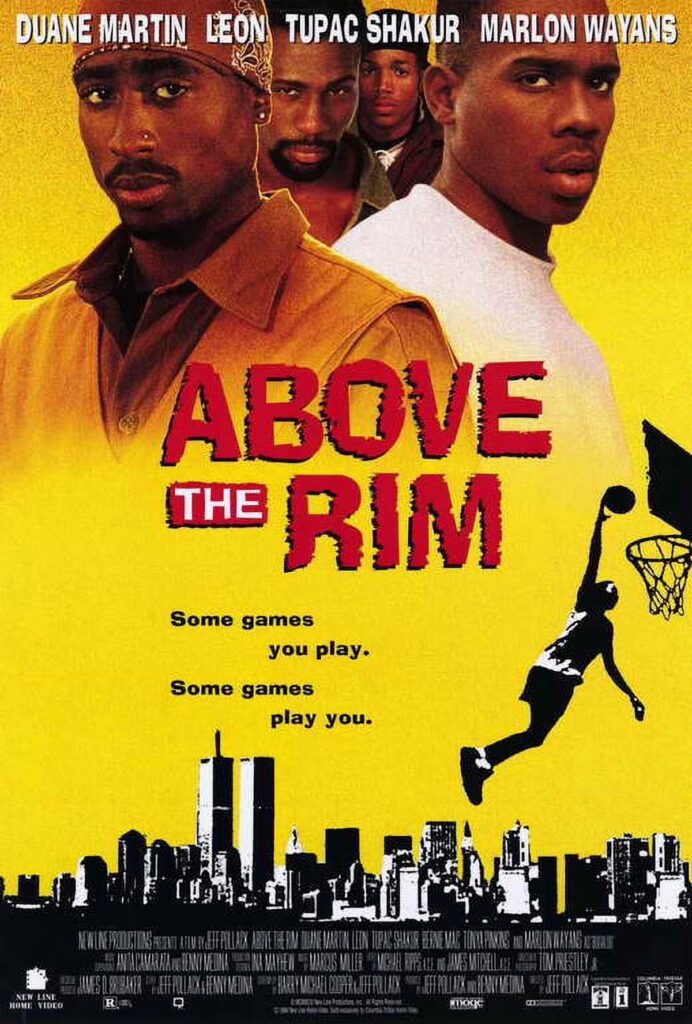
Above the Rim (1994)
Director: Jeff Pollack
A hood classic, and I mean that as the biggest compliment possible. Underrated by some, but not by Black folks. This is up there with Menace II Society, Belly, Friday—these are movies that we all grew up with on VHS, DVD, all that kind of shit.
You can program this on a Friday night til the end of time and it’ll sell out.
Exactly. We all know this movie, and it’s part of that hood classic lexicon that I love. Birdie is an evolution of Bishop [from Juice]. This is a character that has more dimension to him. Birdie is more of a supporting role, but Tupac is able to show us this depth behind a character that so easily could have been one note. They initially present Birdie just as this guy who runs the neighborhood. He does vicious shit, like killing Bernie Mac, but he has these parties, everybody loves him, and you get it, through the screenplay and rhythmically, why he is the way he is. The conflict is actually tough for Dwayne Martin because of Tupac’s magnetism and humanity.
He brings a lot of that honestly, a lot of that raw emotion that you feel in his music from track to track to this performance. Above the Rim is the most like watching Tupac in the studio recording an album. His albums would have these songs where he’s going hard, and then these songs where he’s more introspective and more emotional. This is especially true with Leon. A couple of Tupac’s scenes with him are incredibly moving. The reveal of them being brothers when he is at their mother’s grave is so beautiful. And it also really touched me because I lost my mother in March, and that scene feels very real and tapped in, like he knew what was expected of him and took it a step further, if that makes sense.
It does. Sorry for your loss.
Thank you. But again, chemistry. It’s not just Leon, it’s everyone: Bernie Mac, Marlon Wayans, Duane Martin, Wood Harris in his onscreen debut. He was an incredible screen partner. It’s such a great New York movie as well.
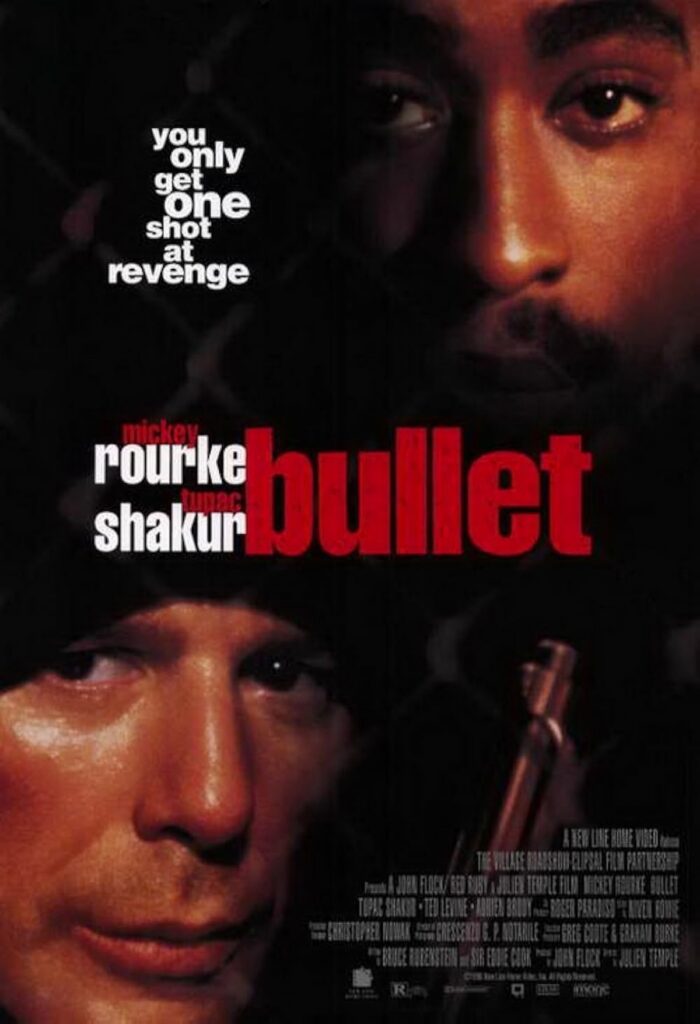
Bullet (1996)
Director: Julien Temple
Another New York movie with pop. This was a huge surprise for me. I did not expect to like this movie, and I found it to be so incredibly fascinating. I kind of see this as a part of a Tupac trilogy: Juice, Above the Rim, and Bullet, and this does feel like the perfect closer of roles in that vein. Tupac is Tank, this swaggy gangster with an eyepatch and great costumes who’s truly running things where he is. And, probably out of all of these films, this is the smallest role that he has, and yet he makes such an impact when he’s on screen. He’s in this movie with Mickey Rourke, Adrien Brody, and Ted Levine. These are heavy-hitters, really excellent actors, and he continues to hold his own, like he’s been doing it for as long as they have. There’s also an early Peter Dinklage cameo.
With the Mike Tyson shirt on. Electric.
Totally. What I think is really special about Tank, and Tupac in general, on display here is that when he’s playing these villains in B-movies, there’s an interesting softness that he brings to them. And I don’t mean that as in weak. But he’s vulnerable, which these kinds of characters never are.
Even when he’s desperate, enraged, and holding a gun to a child’s head, you can see the pain in it.
One hundred percent. One hundred percent. I wish I could talk to him, or more of the people who were around at the time to know what were the choices that he made as an actor and as someone who was tapping into some of these characters, because I really do think what he’s able to do with Bishop, Birdie, and Tank.
And you can also tell, even though they are enemies in Bullet, that Tupac and Mickey Rourke got on so well. They really loved each other and had a lot of fun working together. And that does come through on screen.
I did not expect to have this much fun with this movie. The characters are fantastic. All the dynamics are great. They’re really nice to this gay character. I didn’t expect that for the time that this came out. There are several times in this movie where you think it’s going to go in a direction that’s really bad, and it stops itself, somehow. It’s kind of a one-of-one watch. I understand why it got a direct-to-video release in some ways, but in other ways, I don’t. I think it definitely fits within a ’90s film canon. I’m really glad that we are showing this one.
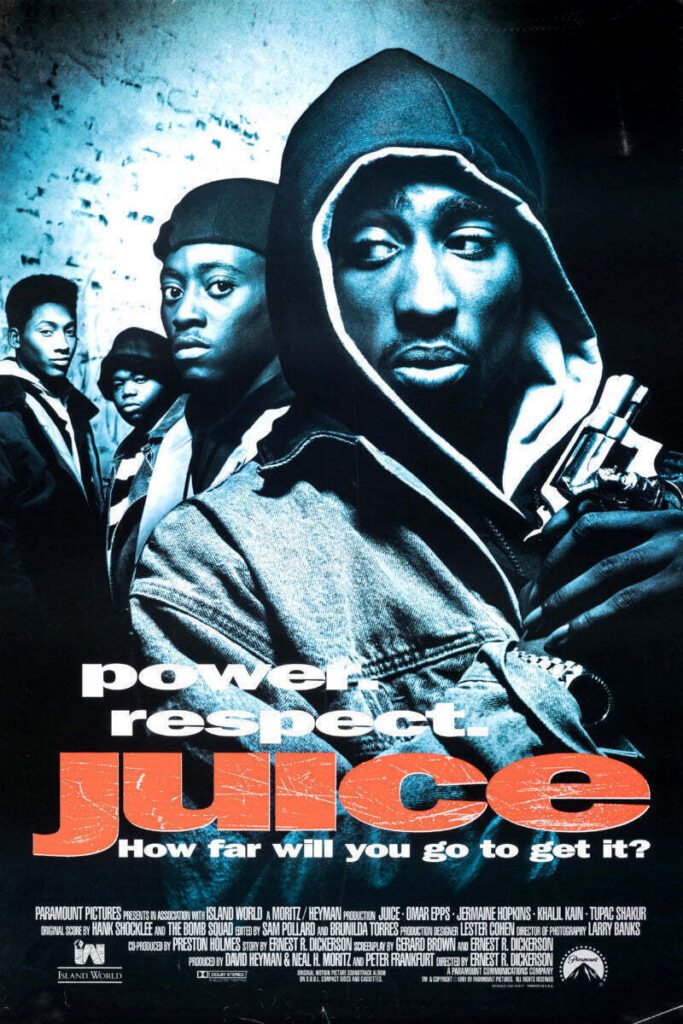
Juice (1992)
Director: Ernest Dickerson
You go back and watch this, and it’s his first performance, and he just had it. The movie is already good, but I think he takes it to the next level and really makes that film memorable.
Bishop is one of the most iconic characters in Black cinema, full stop, and as scary and cartoonish as he can be, also has that classic Tupac charm. You know he’s bad, and at the same time, you would absolutely hang out with him, even though you would be scared the whole time.
This is also the first feature film that Ernest Dickerson directed and wrote. It’s Omar Epps’ first movie, so it is such a big first for a lot of people, and to see them all working out together is truly a beautiful thing. It is a classic for a reason, the perfect final narrative film in the series to take the viewer back to the beginning and see where it all started.
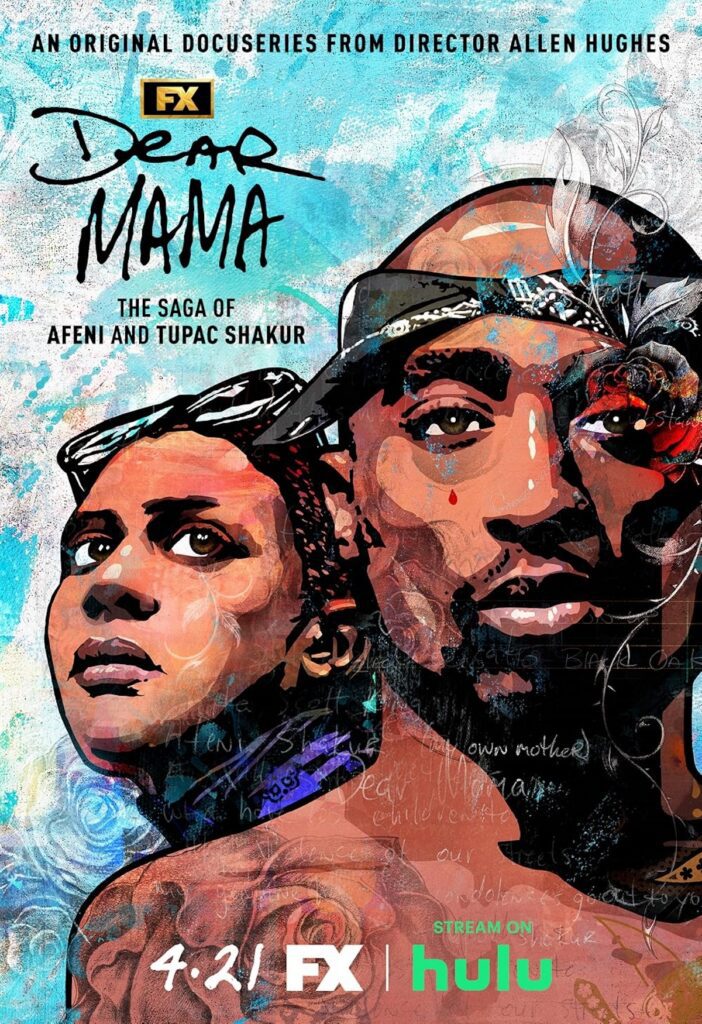
Dear Mama (2023)
Director: Allen Hughes
For me, this is up there in terms of docuseries, like The Last Dance and OJ: Made in America, that do such an excellent job tracking the lives of historic Black figures, along with what was happening within Black history at the time. It tells the parallel story of both Tupac Shakur and his mother, the Black Panther Afeni Shakur, and how similar their stories were coming up. I don’t think you can really honor and celebrate Tupac’s life without also honoring and celebrating the life of his mother, who passed away 10 years ago. So I thought that that would be a really good closer for people who have followed the entire series of films throughout the month, to get even more background on everything they just saw.
It was directed by Allen Hughes, who has a whole history with Tupac and directed some of Tupac’s videos. He includes some great BTS of “Brenda’s Got a Baby.” Hughes is vulnerable and honest enough to bring in his own turbulent experiences with Tupac, because we all know about the Menace II Society issues and the rift that came between them at some point. Early on, he steps in front of the camera and he’s like, “OK, so let’s talk about it.” And that’s such a beautiful thing about that entire series, feeling his love, as well as his complicated feelings around things that happened between the two of them. It’s what separates this from many other works that have been made about Tupac. Because Hughes knew him so personally, he’s able to get the people he’s interviewing to really say some interesting things.
I think more people should see it, and we are very thankful to FX for allowing us to screen the first and second parts of the five-part docuseries. It was really fucking cool of them; that’s not something they had to do at all, but I’m glad I reached out and they did. If we had time to show the whole thing, I would, but I wanted to give people at least a taste of the series, because it really is truly excellent and gives an incredibly comprehensive look at who Tupac was.
You know, when people die, we have the tendency to canonize them, and I appreciate that this series also talks about some of the things that he did in his life that weren’t great. It’s really honest about who he was as a person and as an artist, and from seeing all his films and this closer of Dear Mama, you can imagine what Tupac would be doing now, as not only an actor and not only as a rapper, but as a political figure. I think you can really see what he could have been. And, of course, that makes it sad, and at the same time, you are thankful that this life was lived in the first place. It’s a really, really, really beautiful body of work.