Photo courtesy of Miramax
Tourists: Julian Schnabel’s ‘Basquiat’ at 30
The complicated legacy of the 1996 biopic, according to the people who made and inspired it
Near the end of Basquiat, Julian Schnabel’s 1996 biopic dedicated to his peer and rival in the 1980s art world, the painter, played by Jeffrey Wright, is literally out to lunch for an awkward reunion with his longtime on-again/off-again girlfriend Gina, played by Claire Forlani. Jean-Michel Basquiat is not doing well. He is strung out, face covered in lesions he picks at compulsively, barely present in conversation with Gina. Instead, he locks in on a nearby table of leering old white men indulging in a cliché power lunch with cigars and brandy. Schnabel mostly shoots the table from a distance. The filmmaking is ambiguous; it’s unclear if what we’re seeing is an accurate portrayal of “reality” or Jean-Michel’s stoned and paranoid delusion that the table is focused on him. He calls over a waiter and pays for the table’s check, instructing the waiter not to tell the table who covered their lunch. “Why?” Gina asks. We can’t be sure. It comes off as spiteful and impulsive, a potentially empty gesture.
The scene is based on a true story that occurred at Barbetta, a recently closed, white-tablecloth Italian time machine in Hell’s Kitchen. At the table were Jean-Michel and his longtime girlfriend Suzanne Mallouk, christened “The Widow Basquiat” by the poet and critic Rene Ricard when Jean-Michel was still alive. She was the main inspiration for Gina, a composite character that contained elements of several of Basquiat’s lovers.
In Mallouk’s retelling, there is no ambiguity as to what was happening. “He was the only Black person in the room, and we were young, in our early 20s. We could overhear them saying, ‘How can they afford to eat here? He must be a pimp and she’s his ho.’ And that made Jean really mad, because we ate there at least twice a week. That’s why he bought their meal. It was a power move,” Mallouk says. “That’s my main issue with the film. Jean just looks like this drug addict rebel without a cause when he was very purposeful in his rebellion, and that rebellion was focused on the racism he suffered, because it wasn’t depicted at that lunch or in the film. It was so overtly, casually racist back then. You have no idea. It was horrible.”
Jean just looks like this drug addict rebel without a cause when he was very purposeful in his rebellion. —Suzanne Mallouk
The chasm between Schnabel’s portrayal of this scene and the first-person account of what occurred—what was included and what was omitted—is indicative of the critiques the film has received since it premiered 30 years ago, nearly eight years to the day Basquiat died. Schnabel’s impressionistic portrait of one of the leading lights of American neo-expressionism was and still is a beloved, well-made, impeccably cast and acted film that, besides Basquiat’s own work, is the defining, lasting mythological artifact depicting the artist. But it is also one of the stranger instances of conflicts of interest in authorship in the history of American cinema.
“His story is very much about his life versus attempts to define his life, or to categorize his life. And so the film is a kind of further meta-illustration of that,” Jeffrey Wright says over Zoom. Basquiat asks, and may answer, the question: What would happen if Salieri got to make a movie about Mozart? On the occasion of its anniversary, and with a new batch of work dedicated to Basquiat coming this fall, I reached out to Wright, in addition to several surviving friends and collaborators close to Basquiat in life, and who, in some cases, contributed to the making of the film, to get a sense of how Schnabel’s debut represented or misrepresented their memories, his possible intent in making it, and Basquiat’s legacy.
***
Julian Schnabel has always had a charmed sense of timing. He got his break at the last possible moment in American culture that a fine artist could be a pop star. His big, loud, bombastic work came to prominence at the end of the ’70s and anticipated the cultural and financial excess of the ’80s. Schnabel became infamous for his hedonism. He switched out model wives, dressed for openings and interviews in silk pajamas, published a memoir at 36, built himself a pink mansion on 11th Street and the West Side Highway, compared himself to Picasso, and dismissed the many critics of his art and films as “unhappy” people. It is rumored he inspired Martin Scorsese’s contribution to the 1989 anthology New York Stories, written by Richard Price (who would do a pass on the script for Basquiat years later), about an eccentric, horny, brash, juvenile, pretentious artist, played by Nick Nolte.
If Schnabel was an architect of this moment, Basquiat became seen as its brightest star, its most original voice, and its most tragic victim, overdosing from a speedball at 27, when he was forever memorialized as Greg Tate’s titular flyboy trapped in buttermilk. He grew up bouncing around Brooklyn (Midwood, Flatbush, Boerum Hill), doing battle with his strict, middle-class Haitian father. His Puerto Rican mother was mentally disturbed and spent much of her son’s life in institutions. He first emerged as SAMO, an enigmatic prose graf handle he conceived in high school with friend and fellow graf writer Al Diaz. This led to him being lumped in with a group of proper graffiti writers who came to prominence when the art world briefly embraced graffiti as avant garde. Basquiat would go on to become one of the few from that class able to make the transition to “real” art world prominence, fame, and fortune.
Over a seven-year burst of productivity, in which he created approximately 1,000 paintings and 2,000 drawings, Basquiat invented an individuated visual language sampled from the impossibly omnivorous and rich diet of culture he was reading, looking at, and listening to. His was a mixed-media project with traces of Rauschenberg and Twombly in its DNA that translated the protean sensory-overload collage of New York City life to his pictures, the transportive process of a disorganized mind related to his compositions that guides its viewer and teaches us how to look—and think—like its creator.
His work doesn’t age; it becomes more reflective, more in conversation with our politics and concerns as time passes. This is perhaps because the transgressive subject of his work was laser-focused on the wonders, nightmares, and contradictions of the historical and contemporary Black American experience, an idea Schnabel’s film pays lip service to and a viewer might mistake for a life experience Basquiat discovered when he became famous.
***
In 1990, approximately two years after Basquiat died, a Polish director named Lech Majewski approached Julian Schnabel to talk about his relationship with the artist for a movie he was writing. Schnabel took interest in the project and, by his accounting, laid out $50,000 in funding for Majewski to develop a screenplay. As the work progressed, Schnabel realized their visions for the film were too far apart and decided to buy the rights to the story from Majewski for $250,000.
Schnabel spent the next six years trying to get the film made under the working title Build a Fort, Set It on Fire. Once Majewski exited the project, Schnabel next found the artist Michael Holman, who first met Basquiat at The Canal Zone party in 1979 and went on to found Gray, the no-wave band Basquiat (and future filmmaker Vincent Gallo) played in at the Mudd Club and other holy sites of the downtown scene. As a novice screenwriter, Holman leaned on his personal relationship with Jean and continued Majewski’s research over months, speaking to dozens of Basquiat’s personal and professional acquaintances, turning in a draft he has shared with me to consider for this piece. Eventually, Holman would have the credit for the screenplay taken from him, receiving a “Story By” credit in exchange for not fighting the extravagantly wealthy, famous artist.
Schnabel proved himself a capable producer, able to use his art world connections and learned skills in executing a 32-day shoot—coming in under budget on a meager $3.3 million, on location in New York City—with an artist’s DIY pragmatism and expediency. He secured that budget by putting up a third of it out of pocket, with producers Peter Brant and Joe Allen covering the rest. It was capital Schnabel was able to talk them into by guaranteeing their investment with paintings from his personal collection. All the actors, including Willem Dafoe, Paul Bartel, Michael Wincott, Courtney Love, Christopher Walken, Dennis Hopper, Parker Posey, Gary Oldman, and David Bowie, worked for scale. Schnabel got the songs on the stacked dad-rock soundtrack licensed on the cheap. When Gerard Basquiat, Jean-Michel’s father and the co-executor of his estate, refused to allow Basquiat’s work to be displayed in the film, Schnabel and his artist friend Greg Bogan were able to produce the replicas that you see on-screen themselves by hand.
But the production’s greatest triumph was a judgment call “discovering” Jeffrey Wright, who had just won a Tony for his portrayal of Belize in Angels in America, but was getting his first opportunity to lead a picture. Every person I interviewed for this piece, who hung out, spoke extensively with, did drugs with, and slept with Basquiat agreed that Wright’s portrayal is a kind of magic. He nails the mannerisms, the patterns of speech, the crooked grin, how Basquiat smoked, how he held his brush, the rapid, unpredictable, unsettling shifts in mood. They also uniformly agree that Schnabel’s portrayal of Basquiat misses the mark in large, problematic ways. It’s an opinion Wright shared while making the film.
***
I get the impression being portrayed in a film that purports to represent your place in history elicits complicated emotions. For instance, you might think you’d be thrilled to be portrayed in a film by an Oscar-winning all-time great like Benecio del Toro, but Al Diaz, who is quick to acknowledge how good del Toro is in the film, takes issues with certain fine points when it comes to the character of “Benny” that partially represents his role in Basquiat’s life in the film (as well as the downtown multi-hyphenate artist John Lurie, whose couch Basquiat would regularly crash on). “The story is just fiction. It’s all these myths that have been perpetuated. The timeline is upside down, completely fucked. And Benny never existed. I was never much of a basketball player, and I never would’ve given Jean-Michel any kind of professional advice. He didn’t need any,” Diaz says.
It’s not particularly damning or relevant to the story that Rene Ricard, Edit DeAk and Diego Cortez become a single engine behind Basquiat’s rise represented by Ricard alone, or that Basquiat sells a postcard to Bruno Bischofberger (a delightfully droll and Swiss Dennis Hopper) instead of Henry Geldzahler (Paul Bartel). The act of composite and timeline smoothing are the necessary fudged chronologies and broken-egg details of narrative convenience in screenwriting.
The larger issues present themselves when questions of the basic characterization of the subject are misconstrued by the writer and director. As Suzanne Mallouk recalls, Basquiat was a deft industry operator and networker, and when it came to his business, the exploitation always ran in both directions. “When Jean walked into a room, he lit it up. He was extremely elegant, but messy, you could tell he was really special. He was highly, highly intelligent. He could see right through people and have them figured out within two minutes of speaking to them,” Mallouk says, speaking to her feeling the representation of Basquiat in the film was that of a shy, spacey, introverted, low-energy savant drifting on the periphery of this world that used him up and spit him out. “Jeffrey Wright is amazing, and he did the best job that he could, but that didn’t come across, and how could it? I don’t know how an actor could do that.”
But it was a critique Wright himself had of the film. In press for the movie that was ostensibly going to make him a star, Wright didn’t pull punches when the subject of his feelings about the representation of Basquiat came up. “That’s Julian’s editing of the film. He was really going for the ‘radiant child’ side of Basquiat,” Wright told Pauline Adamek in 1996. “It’s very much Julian’s take on Basquiat’s life. My hope is that the essence of who he was comes through. His work is powerful and speaks more about him than this film. If people come away from this and actively seek out his work, then, no matter how we screwed up, his story will be overridden by his own voice.” He also frequently clashed with Schnabel on set, and Schnabel has said he nearly fired Wright off the film.
The main bone of contention between Schnabel and Wright focused on Basquiat’s “danger,” as Wright puts it, particularly in regard to race—the issue that animated Basquiat’s work and made it confrontational and important—and how to best express it in Wright’s characterization. “There’s never been a Black painter in art history that was really important, you know that?” Rene Ricard (Michael Wincott) tells Basquiat in the film. But Basquiat already knew that cruel (arbitrary) truth and carried the offense with him his entire life. In Interview Magazine in 1983, the curator Henry Geldzahler asked, “Is there anger in your work now?” Basquiat replied, “It’s about 80% anger.” This is what Wright was trying to impress upon Schnabel.
He’s playing the notes from a very specific sheet of music, and it’s music that I love, that I’m born of, that I know intimately. —Jeffrey Wright
“He was dangerous to the spaces that he inhabited. He was dangerous to the establishment, even though he was this golden child. He was dangerous to so many of the traditions of the art world. He was an enemy to the status quo. He was an army of one. He was a general. He wasn’t taking orders from anybody,” Wright says now. “That was the thing that I tried to find space for. He was a young Black man. [That] comes with a set of political, cultural, historical awarenesses, and those are expressed so powerfully and evidently and insistently in his work. And I’m not sure that everyone quite gets that, you know? He’s playing the notes from a very specific sheet of music, and it’s music that I love, that I’m born of, that I know intimately.”
For his part, in a commentary recorded for the rereleased black-and-white version of the film in 2024, Schnabel said it was important for Wright to downplay Basquiat’s anger so as not to alienate, in a film that never even utters the name Michael Stewart. “I think my main direction was lose the battles and you win the war. If you take the blows, the audience will have sympathy for you.” Schnabel said. “If you seem angry, and belligerent, you’re gonna lose your audience.”
Wright carried anger and resentment for a long time after the filming. “I think my performance was appropriated, literally, and the way I was edited was appropriated in the same way [Basquiat’s] story has been appropriated and that he was appropriated when he was alive,” Wright told the journalist and author Phoebe Hoban in her exhaustive biography Basquiat: A Quick Killing in Art. “Julian made him out to be too docile and too much a victim and too passive and not as dangerous as he really was. It’s about containing Basquiat. It’s about aggrandizing himself through Basquiat’s memory. It’s really fucking barbaric. But maybe our culture can’t take the real danger of Basquiat right now.”
Ultimately, beyond directing the film, Schnabel believed his authority over Wright’s interpretation of his character was derived from his long, personal, intimate relationship with Basquiat. “I don’t know what [Wright] knew about him but he certainly didn’t know what I knew about him,” Schnabel said. But how well did Schnabel actually know Basquiat?
“I almost never saw them together,” Mary Boone, the art dealer who took on both Schnabel and Basquiat as clients, told New York Magazine in 1996. There was a real rivalry between the two, which John Lurie characterizes as bordering on disdain. “I don’t think Julian and Jean-Michel were close in any way. I say this with some certainty. The only times I remember Jean-Michel mentioning Julian was derisive. I have some affection for Julian, but back then we kind of all mocked him. It was easy to do, and that is pretty much how that scene was.” Lurie tells me. Al Diaz puts a fine point on it. “Schnabel wrote himself into history. They weren’t close friends,” he says.
Holman attributes his differences with Schabel over his screenplay to a lack of familiarity with his subject. “He wasn’t interested in these elements of Jean that really told who he was. But not because Julian wanted to suppress that. I just didn’t think he got it. He didn’t see it the same way I saw it, but he didn’t know Jean. He wasn’t in a band with Jean. He wasn’t friends with Jean. He had already blown up and was part of an earlier scene, Max’s Kansas City and all that. So it’s understandable that he didn’t understand it and didn’t appreciate it,” Holman says.
Much like he did with Wright on set, today Schnabel dismisses these accounts as lacking an authority only he had. “We spent quite a bit of time together. I don’t think anyone that was friends of his really understood his relationship with me, because he was a painter and I was a painter,” Schnabel has said. He has also alternately attempted to have it both ways, trying to excuse any discrepancies in how others perceived Basquiat. “The film is my portrait of Jean-Michel. It’s not a standard biopic. I took some liberties,” Schnabel said at the Venice Biennale in 1996.
Great biopics have been made about subjects who died centuries before their writers or directors were born. Knowing your subject isn’t a prerequisite to making a good film about them. What is fascinating about the production of Basquiat is that it’s an instance in which the writer/director believed his just-close-enough proximity gave him authority to tell the story. By virtue of this proximity, the director decided that the many voices around his subject insisting his vision of his subject wasn’t the person they knew could be dismissed and ignored in favor of his. “That’s ego, right?” Holman tells me, as his way of trying to explain how Schnabel landed on his translation of Basquiat. “I mean, that’s what can happen if you think you’re right all the time.”
***
Why did Schnabel want to dedicate six years and a million and a half dollars to making a film about Basquiat? In New York Magazine, Schnabel admits he was initially not a fan of Basquiat’s work (“I couldn’t see it”).Taken at his word, at the Biennale in 1996, Schnabel said his call to make the film derived from a sense of duty towards Basquiat, to do him justice. “I made this movie because I cared about and knew this man. We were in a similar situation—I’m the only painter in America that was. The amount of attention that we had. We showed in the same galleries. Stuff about our personal lives. People were always writing attacks. Even though he was Black and I was white, we went through a lot of the same stuff…I didn’t want to have some tourist come along and make this film.” He repeated a version of this 22 years later in British GQ. “Someone was interviewing me about Jean-Michel, and they were a tourist, and I just thought, ‘I should get this right. I owe it to him,’” Schnabel said, referring to Lech Majewski. “I never thought I was going to be a moviemaker, but I did that to speak to him, for him.”
“Tourist” is a word Schnabel would use frequently in the many interviews he did around the film, beginning in 1996 and continuing until recently. The implicit suggestion is that he had the life experience, he understood the world of the film and he actually knew Jean-Michel Basquiat. That he had authority, and it was his story to tell. That he was not a “tourist”.
There is also a cynical read. As Charlie Rose said when he interviewed Schnabel in 1996 for the film, Basquiat “would seem to be the ideal movie subject.” In this light, when Majewski initially approached Schnabel with the idea, his eventual decision to take that idea and pivot to auteur director could be viewed as an opportunistic move at the right moment for a savvy careerist. Schnabel would be 44 by the time Basquiat was released in 1996, and his star was waning. In 1995, Schnabel released an album of country songs. He was exploring options of where to move next. A chance to adapt one of the great lives and careers of the American century, aggrandizing himself by attaching his name to Basquiat’s arguably larger and longer-lasting stardom, ended up serving as a more viable future than the path of country music star.
Another common theory is Schnabel used the story of Basquiat to make a movie about himself. “As it went on and on with Julian looking for the right person, Glenn O’Brien would say, ‘I don’t know why Julian doesn’t just play Jean-Michel himself,’ which pretty much nails it,” Lurie says. Schnabel did little to disavow this notion by casting Gary Oldman as his surrogate. Oldman’s character, Albert Milo, is a rich and successful artist who once cooked for a living. His paintings are Schnabel’s. His daughter Stella is Schnabel’s daughter Stella. His parents are Schnabel’s parents. He lives in Schnabel’s apartment. In one scene, Basquiat comes over to this apartment and is shown a painting Schnabel made in Basquiat’s honor the day after Basquiat died.
According to Holman, placing Schnabel as a character in the film was his idea. Schnabel initially resisted the suggestion, but wound up embracing it more than even Holman had intended. “I’m the one who convinced Julian to put himself in the film. I saw him as this antagonist to Jean,” Holman says. “But then, instead of doing that in a humble way, he made himself more of a kind of a hero that he wasn’t to Jean.” Though there is tension and antagonism and rivalry in the onscreen depiction of the relationship, you can see Holman’s point. The animosity is primarily coming from Basquiat, directed at a largely benevolent Milo/Schnabel.
In a 1996 profile, the writer Jim Shelley understands the film as a kind of justification for Schnabel’s personality, excusing his infamous ego as a defense mechanism against critics mad at his unapologetic success. “The film highlights how difficult it is for an artist, a serious artist, to cope with modern celebrity and all the consequences that his talent accords him…. The implication is that without something like Schnabel’s own thick-skinned self-invention, Basquiat had nothing to protect him,” Shelley writes.
Over the years Schnabel has referred to the film as a love letter and a requiem. “I really became my brother’s keeper in this film. But I think he would’ve liked it. I think he would be really happy about this. I think if he saw it, he would laugh,” Schnabel told Phoebe Hoban in Vogue. She doesn’t sound as sure. “One wonders what Basquiat, who once peed in Schnabel’s hallway (an incident shown in the film), would think of this homage from the painter he once challenged to a boxing match.” But in a 2024 director’s commentary, Schnabel doubles down on this. “I dreamed [Basquiat] was standing at the foot of my bed and I asked him, ‘Do you want me to make this movie about you, or do you want Fab Five Freddy to do this?’ And he said, ‘No, I want you to do it.’ And I woke up thinking he was actually alive.”
I think [Basquiat] would have hated [the movie], because he was a master at controlling the way he was marketed. And so anyone else promoting his legacy, he would have found faults with. He would have been enraged by all of it. —Suzanne Mallouk
Basquiat’s friends have a different opinion of how he might have reacted to the film. “I think he would have hated it, because he was a master at controlling the way he was marketed. And so anyone else promoting his legacy, he would have found faults with. He would have been enraged by all of it,” Mallouk says.
“I would imagine that he would say, ‘Oh, this prick is making a film about me? I fucked up,’ you know?” Diaz says.
This is not to say the concern of a filmmaker should be the approval of their subject. What makes Basquiat so fascinating is it is difficult to think about or discuss without asking ourselves what the writer, or the director, or painter owes to their subject. It’s an appropriately thorny, postmodern issue that challenges the very notions of identity, memory, history, and reality. How do we think about Basquiat as a fictional representation of Basquiat, a deceased nonfictional person? Is it “fair”? Does it have to be? “The weird thing is everyone’s memory is distorted, everyone tells stories about their experiences that help them. Their agenda, or whatever, me included. This is how stories travel through history. But whose history? Who is telling them? Who gets to tell them? What’s left out? What’s left in? What are the ethics, who’s responsible for legacy?” Mallouk asks.
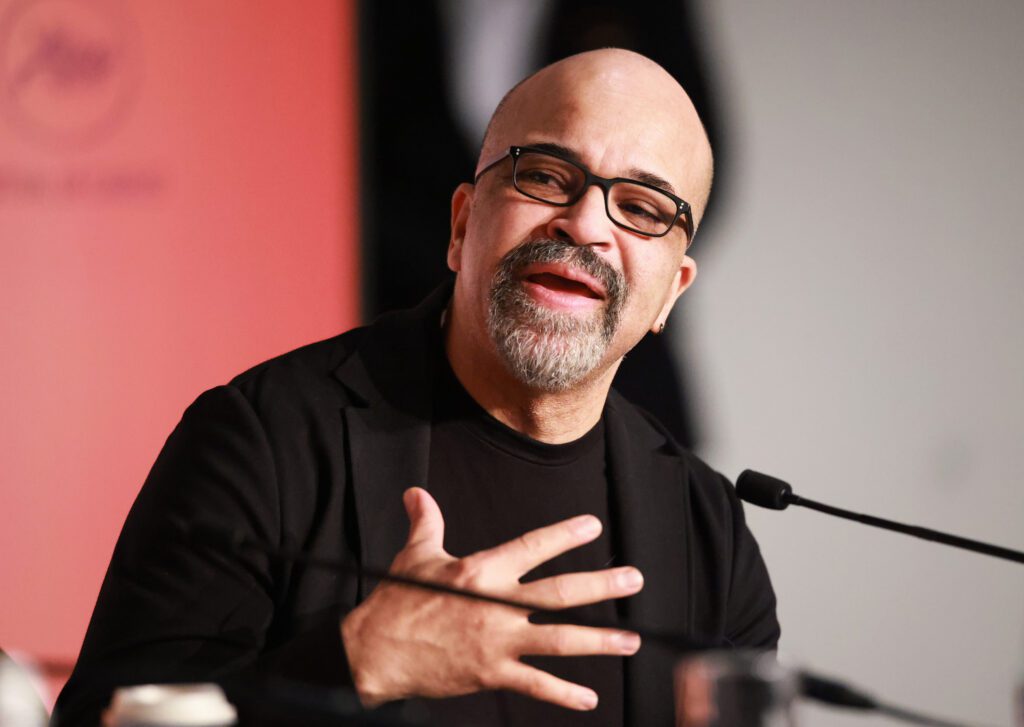
Jeffrey Wright. Photo by Clemens Bilan/Pool/Getty Images
It’s a subjective question with an answer that can shift for each of us over time. Today, Wright’s feelings have softened considerably on Basquiat’s representation in the film that launched his own stardom and remains some of his best work. “Every movie is told from the perspective of its director. It’s through his lens and represents his perspective. But that said, I love the film. I love that I was part of it. Among my film work, it’s the nucleus of everything that I’ve done. I’m proud of what it’s meant as a magnet for attracting attention to– not to the film, but to Jean-Michel’s life and to his work,” Wright says. “And I’m older now. I’m not sure if I’m wiser, but I’ve experienced more. And at the time, after the film, I was younger, and you’re still kind of hot, and raw with feelings about it. And those feelings were valid, but I now feel that was a wonderful gift from Julian, to ask me to be a part of the film.” Wright has remained close to Basquiat’s work and story, so much so that in several months, he’ll play Gerard Basquiat, Basquiat’s father, in Julius Onah’s SAMO Lives.
“What I do know is that history is a lie,” Schnabel said in a 2017 interview. “Everybody has their version of history.” Which would be a convenient position to hold in the event you are attempting to absolve yourself of any responsibility to it.
***
Basquiat came in a wave of films both about and by artists including Robert Longo, David Salle, and Cindy Sherman. Of all those artists, Schnabel is the only one who has made films semi-regularly since. His career as a director peaked in 2007, when he was nominated for Best Director at the Academy Awards and won Best Director at Cannes and the Golden Globes for The Diving Bell and the Butterfly.
In his 2025 Criterion essay about Basquiat, Roger Durling wrote Schnabel’s main characters all confront a similar conflict: a physical as well as allegorical sense of internment and isolation. And they are all subjected to living in a world that doesn’t fully understand them. The lone exception in his filmography is arguably Miral, a passion project commercial and critical bomb written by his then girlfriend, the Italo-Palestinian journalist and author Rula Jebreal, which cast Mumbai native Freida Pinto as the titular Palestinian, and was followed by a messy breakup. Miral largely wiped away all the goodwill from The Diving Bell and the Butterfly, and Schnabel’s filmography since has yielded diminishing returns, including his most recent, Gal Gadot-starring The Hand of Dante, which you may not know was unceremoniously dumped onto Netflix a few weeks ago.
Roberta Smith once praised Schnabel for a quality in his art that extended to his debut feature. “The film’s rosy-tinted, soft-focus romanticism is in keeping with a genuine sweetness, even a delicacy, that can be found in many of Schnabel’s best paintings….In the end, the great thing about Schnabel is that he can’t help himself, which makes him tremendously vulnerable to error and also extremely inclined to trust his own instincts,” she wrote. This quality would eventually lead to his decline as a director: his seeming inability or outright refusal to curb his worst instincts. Another way of saying this is that, over the years, his films have increasingly suffered from an excess of unchecked ego.
When I asked Al Diaz what bothered him the most about the depiction of the friend he created SAMO with nearly 50 years ago in Basquiat, he reminded me of myself, and the dumb, impressionable 12-year-old who first discovered this movie, fell in love with it, and accepted its narrative as gospel. “The Schnabel character, Milo, says to [Basquiat]—and it’s almost prophetic—that: Yyour audience hasn’t been born yet. And it’s funny, because the people that are watching that, that young audience is taking that film as a kind of historical document. That’s what they’re basing their knowledge of Basquiat on.”
Michael Holman believed the film has had a tangible financial impact as well. “Mary Boone has argued with me about this, but Jean’s market was unstable. It was going up and down, and there was a chance that he’d be largely forgotten. And then the movie came out and his market went through the roof. I really believe that the film is why. Jean’s posthumous value, the $100 million paintings, it’s because of Julian,” Holman says, referring to the 2017 $110.5 million sale of an untitled 1982 Basquiat painting of a skull at auction. Schnabel agrees. “That’s why the paintings are so damn expensive. Because someone made a movie about him, and people see that, and it goes out in the world,” Schnabel notes. The largest amount a Schnabel painting has sold for was also at auction in 2017—$1.2 million.
Wright agrees with the film impacting Basquiat’s life and legacy positively, and takes pride in it. “I took the responsibility of the role very seriously, because it was obvious at the time that we were not ‘the house,’ but this film, for most people outside of the art world, was a doorway, through which people could enter his life, and explore, and discover. He’s now the most popular and influential artist in the world born in the last, maybe, 75 years, period,” Wright says. “Now, he is the iconography that he celebrated. He is The Undiscovered Genius of the Mississippi Delta, found.”
In their lives and afterlives, great artists may be remembered or misremembered as misunderstood or underappreciated in their time. They may have to settle for posthumous recognition and the immortality that comes with it. Schnabel seemed to defensively acknowledge his lot, and his subject’s, in history. “The only way to be a respected artist in this culture is to be dead,” Schnabel told Shelley.
The last time Schnabel saw Basquiat, he invited the artist to his studio. “What? So you can humiliate me?” Basquiat allegedly replied, turning him down. Unless you count the film Schnabel would release eight years later, they never spoke again.