Photos by Marty Sohl for the Met Opera
The Afterlife of Frida Kahlo and Diego Rivera
In ‘El Último Sueño de Frida y Diego,’ a new opera by Nilo Cruz, the legendary Latin American artists reunite on the Met stage
For the Pulitzer Prize-winning playwright and librettist Nilo Cruz, Frida Kahlo and Diego Rivera are no mere historical figures. The giants of Latin American art, twice married, are larger than life, their legacies transcending time and place. So when Cruz started writing an opera based on their life together, he set out to do more than trace the highs and lows of their relationship.
“Their relationship was turbulent, contradictory, passionate, destructive, nurturing,” Cruz says. “Yet, beneath all of that, there was an undeniable spiritual bond. What fascinated me was not the tabloid version of their lives but the possibility of imagining what happens after death, when the body and ego no longer govern love in the same way.”
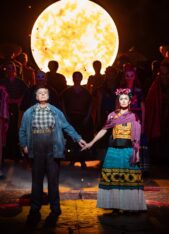
The result was El Último Sueño de Frida y Diego, showing through June 5 at the Metropolitan Opera, a retelling of Frida and Diego’s time together that bounces between the worlds of the living and the dead. El Último Sueño de Frida y Diego marks the Met opera debut of both Cruz and Gabriela Lena Frank, the Pulitzer-winning pianist who composed its music. It’s also only the fourth Spanish-language production to be performed at the institution. “The Metropolitan Opera occupies such an important place in the history of opera and world culture,” Cruz says. “To bring a story centered on two Mexican artists, written by Latin American artists, onto that stage carries enormous meaning for us.”
El Último Sueño de Frida y Diego opens in a cemetery in Mexico during Día De Los Muertos. Family members and friends place ofrendas and decorations on the altars of their deceased loved ones. In wanders a distraught Diego, performed by Mexican baritone Carlos Álvarez, yearning to see Frida again. In the spirit world, Frida, performed by Argentine mezzo-soprano Isabel Leonard, finds herself at peace, free of the physical pain and challenges that colored her life. That is, until she is summoned by Catrina, the ornately adorned Keeper of the Dead, performed by Nicaraguan soprano Gabriella Reyes. Catrina tells Frida that Diego is summoning her to the world of the living and that she must go see him while the bridge is open.
The score in the opening scene, and throughout El Último Sueño de Frida y Diego, is unsettling. The opera is neither a horror movie nor an idealistic romance, and its musical accompaniment is not warm and comforting but, rather, hauntingly atmospheric and divorced from cultural stereotypes. It reflects the murky space where desire, regret, and eternity intersect, and serves as the thread weaving together Cruz’s three worlds: life, death, and art.
“I loved responding to Frida and Diego’s own love of the surreal and the fantastical,” Frank says. “There are no electronics or amplification in my orchestration.” The score is entirely acoustic: “two piccolos mixed with a celesta against a full choir humming; marimbas that are bowed with bass bows instead of struck with mallets against nasal trumpets; triangles against muted strings; bass clarinet and harp while a woman begs onstage.” The resulting sound is one Frank calls “ancient and otherworldly.”
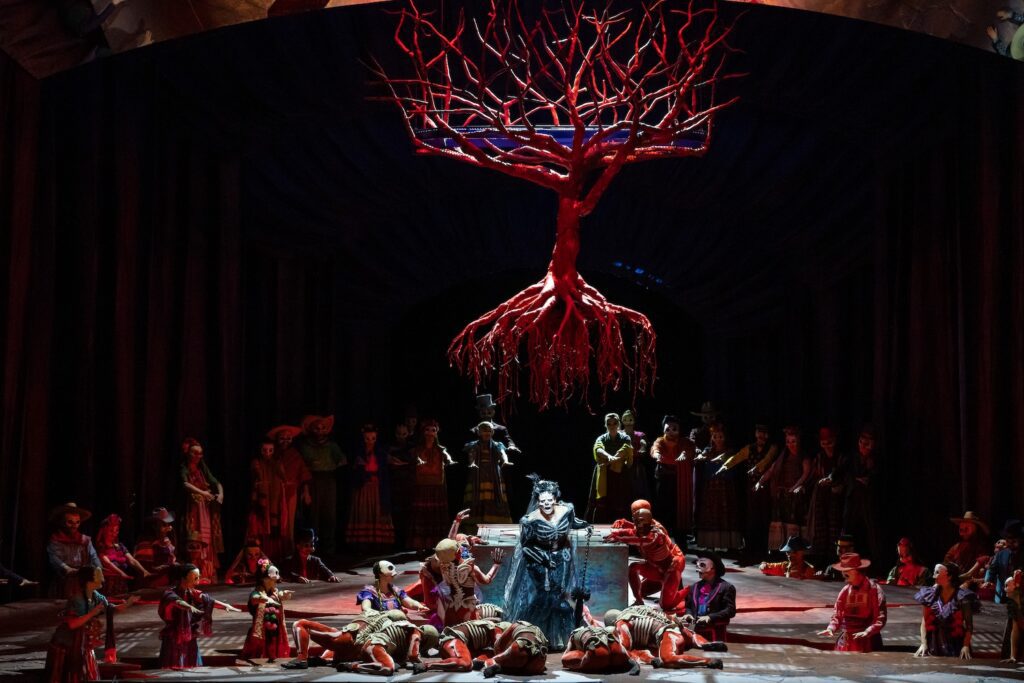
When Catrina takes the stage, her phantasmal allure and authoritative presence command attention. The character, known as La Calavera Catrina (Catrina the Skull), emerged in the Mexican art scene in the 1910s. Created by artist José Guadalupe Posada in the midst of the Mexican Revolution, Catrina was an indictment of Mexicans who denied their indigenous roots and claimed themselves to be of European descent. Over time, Catrina became an icon of the Day of the Dead and has resurfaced in popular culture as an interpretation of the Aztec death goddess Mictecacíhuatl.
Her wardrobe changes as she slips between the afterlife and the world of the living. In the former, she dons an iridescent dark grey organza dress, allowing her to appear airy and delicate, with an ornate skeletal facial prosthesis and design on her bodice. Later, as the clock runs out for Frida to return to the afterlife, Catrina appears as a vision in gold, the weight of her power demonstrated by the gilded details of her headpiece and full-skirted, historically accurate turn-of-the-century-style dress.
Catrina’s skeleton henchmen help distinguish the opera’s universes. They skulk along the stage, speechless and unidentifiable, performing their choreo athletically. The aerial skills, breakdance influence, and electrifyingly static movements of the dancers shine a sensory light on some of the most unique elements of Frank’s composition.
As Frida considers Catrina’s command, we dive into one of the most poignant scenes in the opera’s first act. Frida pours her heart out, expressing her hesitation to return to life, describing both the acts of living and of loving Diego as “agony.” You can’t help but consider how her work would have developed if she weren’t emotionally impacted by Diego’s commanding, often volatile presence.
Diego is portrayed as a pathetically remorseful and ashamed husband who wouldn’t be out of place in a telenovela. Cruz intended the character “not to reduce Diego to a contemporary psychological diagnosis or a simple moral category,” the librettist says. “Diego could be domineering, excessive, unfaithful, deeply flawed. But he was also capable of immense tenderness and devotion. Yes, he was messy, but he loved Frida in a profound way, even if that love was imperfectly lived.”
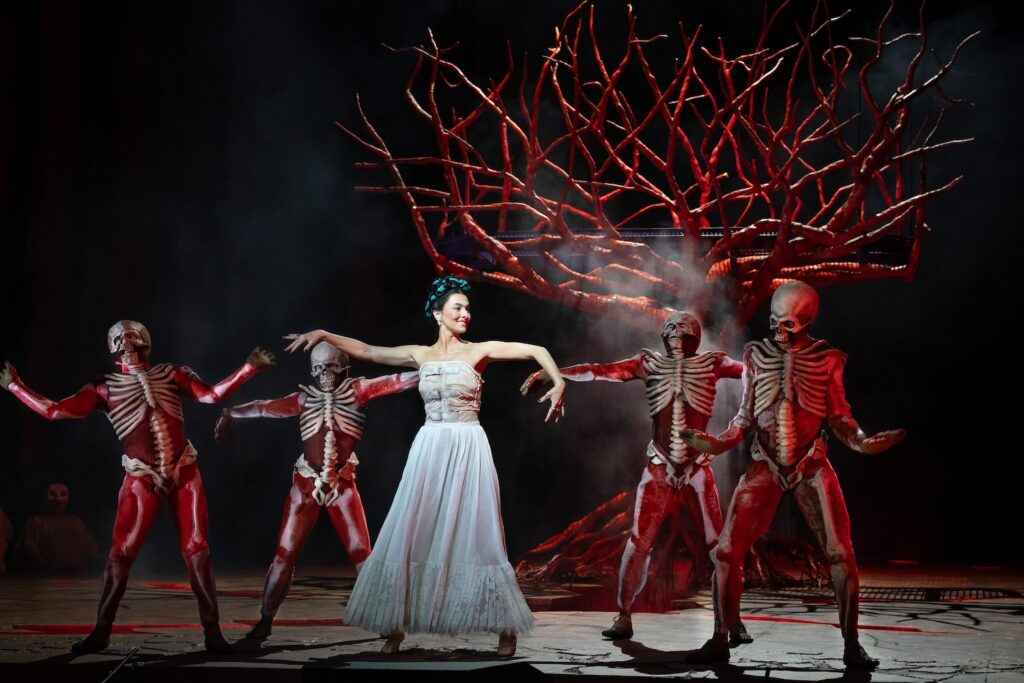
Set designer Jon Bausor crafted a malleable universe of his own for the Met stage. Every element of the set feels alive, from a colorful opening cemetery scene to notable iconography of Casa Azul to a live studio scene with scaffolding featuring one of Diego’s murals at the sketching stage. Eventually the studio transforms into a spiritual place where past and present meet, and we find multiple portrayals of Frida standing on the scaffolds: one a version of Kahlo’s 1944 self-portrait “The Broken Column,” the other an androgynous look inspired by “Self-Portrait with Cropped Hair,” from 1940.
El Último Sueño de Frida y Diego is a fantastical exploration of Rivera’s last days through the mythological universe of Dia De Los Muertos. Through it, we get to meet Kahlo ourselves and experience what a spiritual reunion between her and Rivera might have felt like. “What fascinates me about Frida is that her physical suffering never reduced her imagination,” Cruz says. “In fact, her limitations became portals into another reality. She painted herself again and again, but each self-portrait was also a transformation—a becoming.”