Courtesy of On The Radar
On The Radar is Building a Digital Bridge for Every Era and Region of Rap
Behind the scenes, sets, and spaces of On the Radar, where each sub-genre and offshoot of hip-hop gathers under a big neon-green tent, governed by a simple criterion: Is it dope or not?
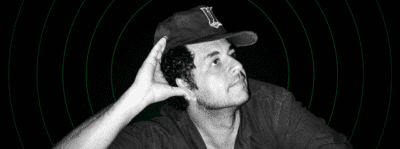
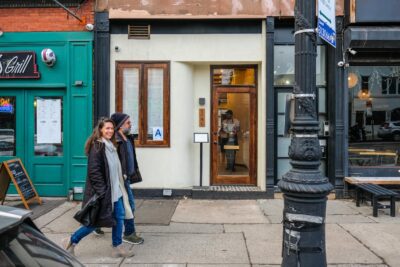
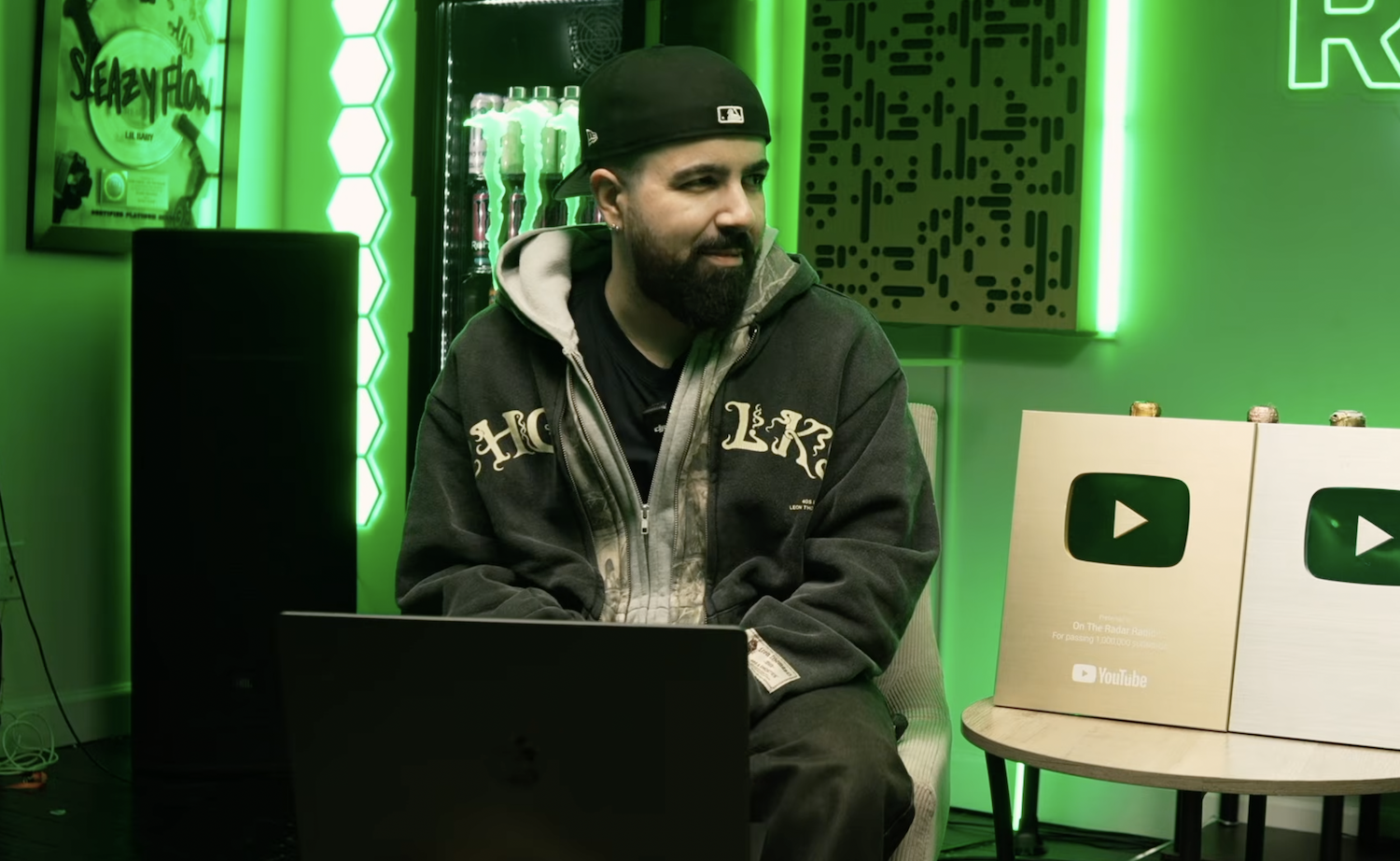
It’s an early February evening on a desolate Williamsburg block, and I’m outside the building that houses On The Radar, hip hop’s most essential digital content platform. Founder and host Gabe P greets me at the door, wearing a black 40s & Shorties jacket, dark gray cargo pants, and a “PR” hat representing his Puerto Rican heritage. We walk up two flights of a nondescript complex that also houses a tattoo studio before I see the brand’s signature lime green hue glowing from ceiling lights. Spaces that you’re used to watching through a screen often upset your expectations in person. I’m not sure what I thought the On The Radar studio would feel like, but it’s “watch your step” cozy. I’m treading lightly amid the cords, beam lights, and cameras lining the perimeter of the room.
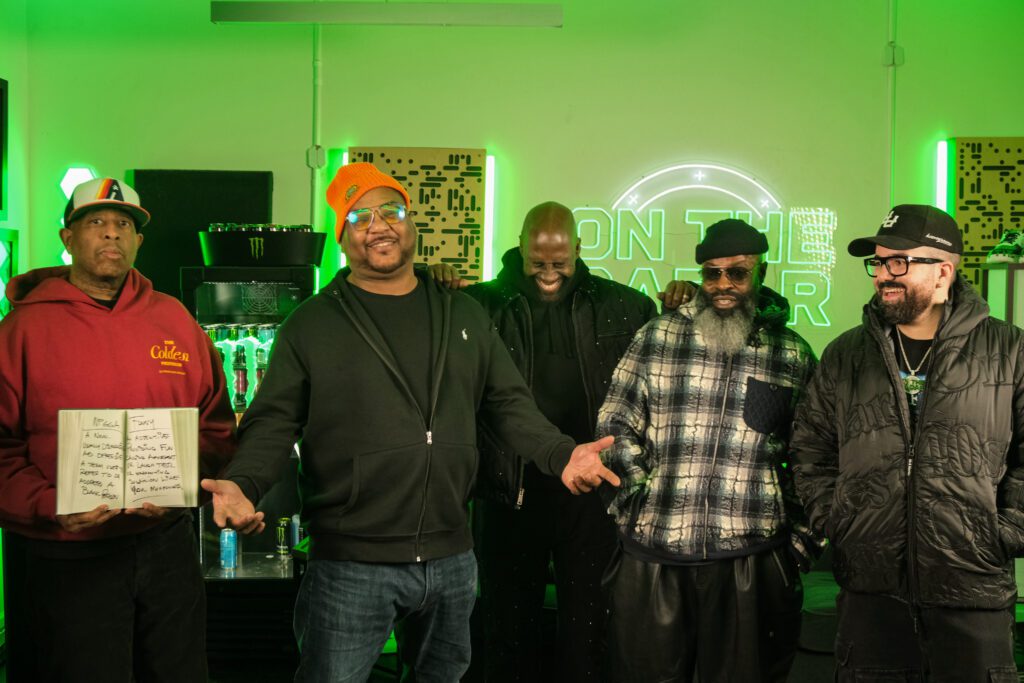
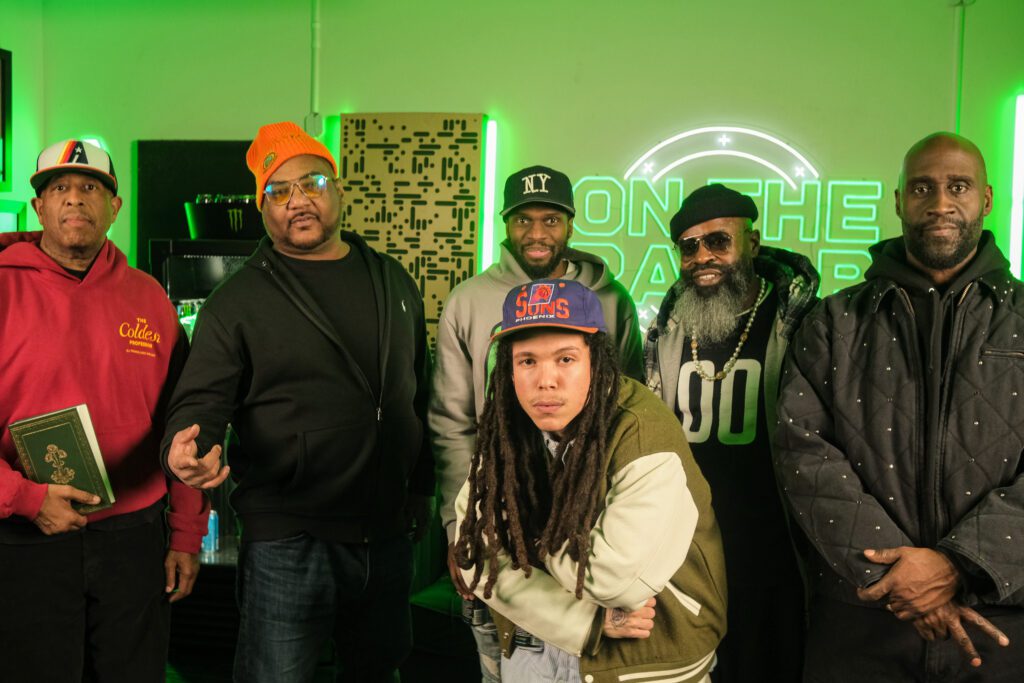
The last two shoots of the night speak to On The Radar’s versatility. DJ/media personality Annabelle Kline of media outlet ThatGoodShit and DJ Quincy Davis are in the midst of a turnt up DJ set, featuring a bunch of Gen Z artists spitting and moaning over rage and plugg beats. It’s followed by living rap history with a Golden Age revue of De La Soul performing a two-song set, including “En Eff” with their legendary peers and collaborators, Black Thought and DJ Premier. Thought arrived first, sat quietly in a side room which doubles as their greenroom and production space, before stepping out on the balcony to smoke.
When the members of De La still with us—Kevin “Posdnuos” Mercer and Vincent “Maseo” Mason—appear, they perform “Wonce Again Long Island.” The artists took it light, planning out their choreography while the cameramen calibrated the specs. Premier and Maceo giddily decide, on the spot, to do a two-man dance.
They took promotional pictures, then flicked it up with some fans in the building before recording. One of the artists has some trouble with his verse, repeatedly tripping up at the same juncture right before it ends. He apologized, but the veterans in the wildly accomplished room with nothing left to prove were enthusiastically encouraging. Between takes, Premier talks about Justin Bieber’s then-recent Grammy performance in boxers, emotionally and literally near-naked. “Can’t front, that shit was dope,” he tells Posdnuos as he autographs a stack of comic books commemorating his Light-Years Mass Appeal album with Nas.
Later on, the conversation inevitably meanders to the rap nerds’ favorite rappers, such as DOC. Black Thought excitedly spits bars from “The DOC and The Doctor,” while Pos exclaims, “woo,” and Premier lauds, “DOC was stupid!”
“Don’t get me started, we’ll start doing every rhyme,” Thought jokes, fanning out in this shrine to rap.
Courtesy of On The Radar
In the greenroom, plaques commemorating On The Radar’s rapidly accumulating greatest moments line the walls. There’s a nod to their Drake and Central Cee freestyle, their most viral moment to date. One celebrates 11+ million plays for Brooklyn group 41’s 2022 cipher (now at 20 million), and there’s another for their 2021 Ladies’ Cipher.
They’re a reminder of how the rap media ecosystem is continuously reshaping—that the days of terrestrial radio and editorial media serving as the main power-brokering medium of rap stardom are long gone. Rap City is defunct, DJ-helmed mixtapes are exceedingly rare, and the few radio stations that still host “freestyle sessions” get most of their traction on YouTube or TikTok, where the freestyle now lives. Programming like 106 & Park and TRL, which were the primary non-IRL methods of viewing live performance, are also gone. They have taken a backseat to a type of very clipable video promotion arguably pioneered by on-air-to-online talents like Sway Calloway and DJ Funkmaster Flex in the years between.
On The Radar Radio fills these gaps with an ambitious brand that stretches across social media’s many apps with a steady content drip of interviews, freestyles, DJ sets, live renditions of songs, weekly new music listening sessions, a producer breakdown series, and On The Radar Records, which shares freestyles and multi-song “experiences” from some of their performances on DSPs. They have nearly 1.7 million YouTube subscribers and 1.8 million Instagram followers who rely on them as the top platform to see their favorite rappers, DJs, singers, and even bands, do their thing.
And now, they have more space to house it all in one building. Calvin Schneider is the Showrunner, A&R, and Head of Social Media for On The Radar. He says the team does about 100 shoots per month, and though the schedule structure is similar, every artist is “wildly different” from the last. “No two days are the same, which is the magic of On The Radar.” Some artists bring a slew of well-dressed friends, while others, like Milwaukee artist JP, bring a violinist and backup singers. At any given time, at least six staffers in the 15-person operation are in the room either filming, overseeing the audio, or organizing for the next performance. Their new space now gives them more room to accommodate artists, as well as record DJ sets and artist performances at the same time.
After I drop my belongings in the greenroom, Gabe takes me through the rest of what will soon be the compound’s extension. They show me digital mockups of what each currently empty unit will become. One room will be a bodega-themed space crafted for DJ performances, as well as Gabe P interviews (which he tells me he can’t wait to get back to). Another will be a full recording studio with MTA-centric decor designed by singer Devvon Terrell, the Head of On The Radar’s Sponsorships & Live Stream department.
When I return from the brief tour, the DJ booth is removed from the main studio, opening the space for its guest artists to get busy. I have visited On The Radar sets twice within a month. Both times, it’s been a smooth operation, where the roughly dozen-man crew works with an efficient ease through quick turnarounds. Their wide variety of ambitious acts, from full bands to rappers seeking unique post-production visual effects, like Chicago artist earthsignchels, necessitates a versatile crew. “Obviously, we do have limitations of what we can’t actually physically do in-studio,” Schneider says. “But that being said, we love doing live instruments. We’ve been pushing the limits of the bands. We’ve had 10-piece bands in here now. A lot of it is learning as you go, figuring out the true limits of the studio.”
The platform started as Gabe P’s space to showcase up-and-coming artists, and has since expanded into a go-to spot for artists of every level of accomplishment to reach youth culture where it scrolls. When I talk to Gabe, he’s thinking globally, days away from hitting Puerto Rico to film for the On The Radar Latin Takeover. “Right now, the goal is for us to do our freestyle series,” Gabe says. “So every time we go to a new region, we do originals. We do 75 to 120 artists. And those are all the originals that will release and co-release with the artists, in hopes of allowing those artists to live in a more mainstream lane, using us as a bridge,” Gabe says, sharing plans that will travel far beyond Puerto Rico.
“What’s cool about OTR is [that] this is the place where you can see where the influence is,” he says, leaning up against the kitchen island in the soon-to-be recording studio. “You could see the biggest rappers in China coming over to America and seeing how we’ve influenced them, or the biggest artists in Australia coming over and seeing how we’ve influenced them. Brazil, Latin America, Europe; we took everything that came before us, and we expanded on it in a more global sense. We’re bringing American sounds to the world, but also we’re bringing that shit back home with us. I’ve always wanted to build bridges through music.”
Along with bringing On The Radar to new locales, the brand has begun showcasing artists from across genres, including country, K-Pop, rock, and more. Some expansions have gone better than others, leading to oversaturation critiques by detractors. Gabe admits that it’s “trial and error,” that they enjoyed their country experience in Nashville, but would go about it differently next time. “We might do a K-pop artist, and then everybody fucking hates it, and we’re like, ‘Oh, damn, maybe we shouldn’t have done the K-pop thing,” he joked. “But I think expansion is also getting an audience used to seeing new things. It’s obviously gonna be jarring, no matter what we do.”
Courtesy of On The Radar
Gabe “P” Pabon grew up in Long Island, in a strict Puerto Rican household where they didn’t have cable until he was around nine years old. Watching 106 & Park, Rap City, and MTV Jams, and listening to Hot 97 during car rides with his aunt, shaped his early tastes for hip-hop. He went to college at St. John’s in Queens, joining their radio station WSJU within his first week.
“I saw myself in a lot of the people that were there,” he recalled. His first show was called No Genre, which he co-hosted with two other friends. The title was literal; their shared love for a variety of music meant they were liable to play anything from hip-hop to Latin music to TV show themes. “We’d play the That’s So Raven theme song on our show if we wanted to,” Pabon tells me of No Genre’s versatility, a core value carried over to On the Radar.
In 2014, St. John’s alum J. Cole returned to campus after releasing his 2014 Forest Hills Drive album. Gabe missed out on speaking with Cole, but still had a breakthrough moment interviewing artists Cozz and Omen, which got the attention and praise of the station’s upperclassmen, who pushed him to pursue radio as a career after demonstrating his chops with the Dreamville roster. A year later, the school tabbed him to interview Angie Martinez alongside DJ/media personality—and Pabon’s then-classmate—Nyla Simone. The interview went so well that the radio legend brought both of them on as interns at Power 105.
At the time, adversarial, clickbait-thirsty media disruptors were gaining cultural power. A young artist could speak with Adam22 or DJ Akademiks and face invasive questions about beef or legal issues, or they could end up like Lil Yachty, screamed at by a red-faced Joe Budden on Everyday Struggle. Incidents like the latter compelled Gabe to present a more peaceful alternative for artists.
Gabe learned a lot from Martinez’s ability to balance journalistic ethos with an amiable interview tone and regard for her subjects. Though Tupac has been gone for 30 years, Martinez is still loath to release their 1996 interview, because she feels like it would be “inflammatory.” Gabe seems similarly protective. As of the writing of this piece, the De La videos haven’t come out, as Gabe waited for their approval before scheduling. “The one thing I always want to keep with me throughout my career [are] those relationships and respect,” Gabe says. Like Martinez, he comes from the same place as many of his subjects, fostering a relatability that motivates him to put interview subjects in their best light. “I want to create a space for artists where they feel like it’s a neutral ground,” he tells me.
“When it was the drill kids, I used to sit there with them, coaching them through it,” he says. “If they weren’t prepared, I would sit there like, ‘Yo, your brain is moving faster than your mouth. You got to take a deep breath and let it flow naturally.’ I feel like I got that from [Martinez].”
“What Would Angie Do?” could stand in as Gabe’s journalistic mantra. Later in our conversation, he assures me that “he could never abandon” hip-hop as the “core” of the platform, even as he plots its expansion. “My OGs are staples in this game. I don’t want to think about the phone call I would get from Angie Martinez.”
Pabon started On The Radar in a small room in the iHeartRadio building while interning for Martinez. The show grew gradually until the COVID-19 quarantine temporarily hindered its momentum, forcing a pivot to Zoom interviews. They started filming interviews and freestyles at Terrell’s Brooklyn studio when quarantine restrictions loosened.
On The Radar moved to its own space and asserted a distinctive visual identity after a year or so. Terrell’s studio had a teal-ish set with a large monitor behind the artist’s right side, a couch on their left, and clouds on the ceiling. Gabe initially wanted to mimic the cloud look in his new space, but he was convinced otherwise. Instead, they went with the hexagonal, honeycomb pattern that overlays their studio’s ceiling, with two panels flanking the famous couch.
Robert Arroyo is an Executive Producer for On The Radar who oversees audio engineering. After studying advertising in school, he suggested making the set green. “I understand brand identity,” Arroyo says, while standing in a corner of the empty recording studio space. “A lot of that is based on first perception. Color is huge. [So I was like], if the logo is green, and we have the capabilities, let’s just stick to the uniform.”
Terrell, sorting items on the other side of the crowded room, chimes in. “I was like, ‘Green ain’t cool, bro.’ Let me tell you something: I was very wrong.” I ask him what color he suggested. “He likes the shit that be changin’ colors,” taunts John Nurse, co-CEO of On The Radar. The room erupts in laughter while questioning, “Rainbow?”
“My old boss at iHeartRadio [Tony Pino], was like, ‘I used to doubt the green.’” Gabe recalls. “And [Rob] would always tell me, ‘Never doubt the green.’ [Now Tony’s] like, ‘Damn, you did pretty good for yourself!’” When Gabe mentioned wanting artists to enter a tension-free room, that includes a production crew that’s as easygoing as possible. A good rapport does wonders for a heavy lift. And with six-to-eight shoots per day, and most people performing multiple roles that belie their official titles, everyone on the team needs to be on the same page. After interviewing people for over a decade, I trust my ability to pick up subtle hints of hubris and ego; in the elapsed five or six hours I spent around Gabe, I never experienced that. And being around the crew as a whole felt like a group of college buddies who struck gold together. That bodes well for the brand.
Gabe says the May 2022 weekend, when they released clips of Ice Spice and AJ Tracy—both of which went fantastically viral—became a major inflection point. “That little weekend right there was the [epitome] of On The Radar,” he surmises. “On The Radar is providing a lane for the New York drill kids like Ice Spice, who was destined to become this international superstar, and AJ Tracy, who was already one of the biggest rappers at the time in the UK.” And now, it’s become established enough for artists as historically significant as De La Soul and Black Thought, and as globally resonant as Drake.
Not long after it went live, the Toronto rapper liked the Tracy clip on Instagram, but took it back after Gabe shared a screenshot. Regardless, the OTR chief knew he had Drake’s attention.
A year later, Gabe received a DM from Drake, asking to appear on the platform with Central Cee. Schneider says that particular freestyle was a game-changer, growth-hacking their social following with its immense international reach. Gabe recalls Drake arriving at the studio like a true megastar, “shutting down the block,” and having his security sweep the studio before his performance. In less than five years, Gabe had reached the peak of pop culture. But he didn’t take much time to revel. “After we did [the] Drake [freestyle], the next day, I literally said, ‘Okay, cool. We’re putting out Drake next week. What do we do after that?'”
Aronys “Ro” Perez is Director of OTR LATAM (Latin America). He compares On The Radar to music video platforms of yore. “We’re like BET Jams, almost,” Perez says. “There’s no physical channel, no cable anymore. Now you go on YouTube and watch our episodes.”
“We’re inspired by everybody who came before us, and we’re carrying on that legacy beyond America,” Gabe adds. “Obviously, they captured such integral moments inside of American hip-hop culture over the past 20 years. What I think is cool about us is that we also capture those moments now for this generation. But we get to take it a step further and make the world a little bit smaller for the people who watch us.”
In 2024, On The Radar had a set at New Jersey’s Powerhouse Concert. One of the featured artists was Chow Lee, a Long Island rapper who, with 11 OTR appearances, might hold the record. He tells Brooklyn Magazine his first performances on the platform dovetailed with the buzz he and Slizzy comrade Cash Cobain had been fostering, helping to grow his following. He notes the Instagram post promoting his Sex Drive On The Radar experience got particularly good engagement, giving him a hefty follower boost.
And he’s witnessed it happen for other artists firsthand. “I seen artists go up there in real life [and] they whole shit change,” Lee says. “Their whole career just goes crazy. [If] that shit hit the algorithm the right way, you out of here.”
Two weeks before the De La Soul shoot, I was in a giant room in Studio City with rap’s future: 10 hungry MCs hoping that On The Radar’s New Class cipher would help elevate them. Upon its release, some social media users suggested that they had supplanted the XXL Freshman Class as a vehicle for artist discovery. On The Radar had done numerous ciphers by that point, but Gabe says he saw viewers clamoring for more bars. “I saw all the comments,” he says. “People wanted a real lyricist cipher, but I’ve been working on that this whole time. I just been waiting to figure out what we’re gonna do.” After rewatching Eminem and Slaughterhouse’s BET Awards cipher, Gabe got the idea to showcase a bunch of spitters in front of a grittier background than their traditional set.
Artist discovery and curation are huge components of the brand, and they’re always looking for new talent. The group has a Slack channel where they collectively pore through 50-100 artist recommendations per day. Each member has their particular musical preferences, which helps them cover all their bases in the music world. It’s how many of the MCs congregating on set got here.
The environment is loose pre-cipher, with the young, eager rappers dapping and joking around. “I know you got some shit,” Ben Reilly tells Marco Plus as they greet. Within 30 minutes, the room expanded from just in-house personnel to about 40 people, including artists and their teams. DJ Nick Seale spins some tracks while artists alternate between bantering and going over their bars in their corner of the room. Gabe, wearing yet another 40s & Shorties jacket, black pants, and a gray fur trapper hat, gently oversees the production, making sure all the specs are running right without hovering.
Shortly before the cipher is set to begin, Seale turns on a doleful, dusty instrumental, custom-crafted by rapper-producer Ovrkast for the cipher. The “New York-sounding beat” inspires some jokes from the assembled talent. One rapper grabs the mic and rhymes, “Spiritual, miracle, lyrical.” Another one yells, “Ayo dun, we need you over here, B” at another MC in the far end of the room. I can’t read how a stoic Ovrkast, perhaps going over his bars internally, feels about the riff.
The freestyle itself obliterated the idea that lyrical sparring has to be acrimonious. Like the OGs who recorded weeks later, every MC is serious about their verse when it is time to spit, but are otherwise playful and supportive of the next man. The mood stays light throughout the shoot, which is much longer than the YouTube clip’s 22-minute runtime.
It’s my first time at a recorded cipher, so observing the extra takes is a new experience. Rob tells me that most guests record at least twice, because they’re warmed up after the first go around. Before the cipher, Hell’s Kitchen MC Marlon Craft tells me he was one of the very first On The Radar guests back in the iHeart building days, and he’s proud of Gabe’s growth. “I’m almost 10 years in the game now,” Craft says. “Whenever you see your respective peers doing shit, and your careers evolve, that’s always really fulfilling to me.”
Courtesy of On The Radar
Both in the room and in the broader, freshly enriched digital media ecology, you get the sense that hip-hop’s generational fracture seems to be subsiding. The “I never heard Biggie songs ” and “why do these kids dress like that” ragebait headlines are less prevalent than they were in the prime of the so-called “mumble rap” era. That collective acceptance is a credit to agnostic platforms like On The Radar, which give equal time to artists across the musical spectrum. On The Radar puts viewers up on everything, from icons like De La Soul and Black Thought to the young spitters who The Fader said “saved the cipher.”
Relegating the platform to any one of their ciphers or viral moments diminishes their ravenous, omnivorous taste. Every video starts with an MTA-inspired “next stop” audio clip; a viewer can go to their page, turn on auto-scroll, and take a multi-generational journey through hip-hop and beyond. If an old head saw De La Soul’s episodes and started ranting about how people aren’t rapping like that anymore, the New Class cipher would shut him up mid-diatribe.
As Gabe and the team repeated throughout our time together, they feel there’s still much more to do. He says that he wants to start a terrestrial On The Radar Radio show and expand the label’s focus from reissues of YouTube performances to original music, including posse cuts. “I want to make my compilation tape. I want to bring people together,” Gabe says.
There are no artistic, geographic, or generational confines to the scope of On The Radar. The staff was just as geeked to take pictures with De La as their generational peers at the cipher. Hip-hop may have splintered off into dozens of subgenres, internet-fueled hybrids, and regional offshoots over the last decade or so, but at On The Radar, they all gather beneath a big tent, governed by a simple criterion: Is it dope or not?