Photos by Alex Hodor-Lee
Is The Future of New York Hip-Hop in a Bushwick Warehouse?
Behind the scenes of Three Times Louder, a Brooklyn label writing the music industry's next chapter by putting artists, and taste, first
“That’s going to be studio number four. This is going to be studio number five. The idea is to give artists and producers space to create. Let’s say one of our artists is working on an album, we can have different producers in different studios working at the same time and they can bounce from room to room. Or maybe it’s two artists working in different studios on different projects at the same time. They can run into each other in the hall, shoot the shit, compare notes, feed off the vibes. I can send you the rendering. The goal is to have this up and running by our two-year anniversary, November 1st.”
I’m walking through the second floor of an industrial building which once served as a storage space for an importer of medicinal Chinese herbs with Trinidadian-born, Flatbush (and Crown Heights, and Canarsie) bred Randall Medford, better known as Sickamore. The 40-year-old music industry veteran has done every job you can do in the business of rap besides rapping. He’s been a mixtape DJ competing with the likes of Clue and Kay Slay in the early aughts. He’s been a talent scout who discovered the rapper and Entourage guest star Saigon (“The Yardfather is good. He’s beefing with Joe Budden right now.”). Under the tutelage of Kyambo “Hip Hop” Joshua, he’s been an artist manager—once for Nicki Minaj, and more recently, for Don Toliver. And perhaps most famously, he’s been an A&R for notable albums from artists who found their sound and launched their careers when they got in the studio with him. Now, he’s adding to that resume with a new-ish gig, as the CEO of Three Times Louder—an audacious young music label operating a few blocks off the Jefferson L stop, and he’s giving me a tour of his professional home since 2023, which is currently under construction.

Photo by Alex Hodor-Lee
Sickamore is tall and slim, bald and bearded with wire-frame glasses. With most record executives, you feel like they’re trying to read your Thetan quality or upsell you TrueCoat. But Sick is matter-of-fact, soft spoken, and at ease. He retains the energy of a lowkey college roommate who has no issue bringing women back to the dorm but would rather spend his time and energy locked in with chunky headphones on, smoking blunts, and making beats on Fruity Loops, nodding his head silently at the desk. Most of the rooms in this 4,100 sq. ft. section of the building are empty, white boxes that are all concrete and drywall, but Sick walks through the space with purpose, sweeping his arms around expansively according to an invisible floor plan, referring to an architect’s schematics on his phone. He sees the future, what the space will be and the purpose each room will serve, with the vision of a zealot building an ark or a baseball diamond in the middle of a cornfield.
In New York, the major labels all have similar setups. They’re housed somewhere on the west side of Midtown, between Times Square and 57th Street. They are perched high up in tall buildings. To reach them, you need to check in at a front desk with security in a brass and marble lobby, where their company is listed on an embossed placard, slotted in among dozens of Fortune 500 companies that share the address. You step into an elevator at a bank that launches you into the sky, depositing you on their floor where there is another grand lobby to wait in, this one lined with platinum plaques, magazine covers of their marquee artists, photographs of their famous, mononymous executives meeting with renowned athletes, titans of business, and world leaders. The lobby flows through carpeted, mahogany paneled halls into glass-walled conference rooms and executive offices with panoramic views of the Hudson, seemingly designed to make you feel like a poor and cloutless cog in a war machine, blessed to be granted brief audience with Oz-like wizards. Many of these labels are international conglomerates with their flagship planted in New York, and if they rep a local artist, it’s a coincidence. Visiting is an intimidating, impersonal experience. The offices are golden calves, mausoleums dedicated to institutional power and the entire modern history of the recorded music industry.
Three Times Louder, or IIIXL, is tucked away on Willoughby Avenue, a few blocks from Maria Hernandez Park, catty corner from an open-air thrift store/junk lot, and seemingly every currently buzzy restaurant in Brooklyn, over an airy street-level cafe next to record stores and hipster bakeries and dive bars. It’s a fortress at the center of a several square-mile hedge maze composed of haunted shipping containers and bombed-out, flat, block-long textile factories, boobytrapped with dead ends created by train tracks and canals. There are no offices. As of now, there are two modest studios and one large, open common area with a few couches and a flatscreen next to an enormous “table” that is a great thick panel of tempered wood with filing cabinets for legs everyone works around. The space is sparsely adorned, the walls bare, decorated mostly with promotional t-shirts hanging from the ceiling and stacks of music and art books scattered everywhere.

Three Times Louder curator Ezana Atakli, left (Photo by Alex Hodor-Lee)
On the afternoon in mid-June when I visited, two interns—Marissa at St. John’s, Jane at NYU—were clacking silently next to label curator Ezana Atakli. A visitor gets the impression that it is, in fact, here, in this renovated factory, on these laptops and in these studios, the yeoman’s work of moving New York hip hop incrementally forward is actually being done.
All of this is by design. Sick has worked at and with many major record labels and pointedly constructed a space in opposition to the standard. He looked to Rick Rubin’s Shangri-La in Malibu and Abbey Road in London as open-concept co-working models. He frequently refers to Three Times Louder as “A SoHo House for artists”—a concept that is in no way novel, but is becoming increasingly rare. The way many artists of this generation make music is the way many aspects of social interaction operate now—in solitude, behind screens. A producer sends stems for a beat via direct message to a rapper they have never met, who lays down a verse and passes it to another rapper who contributes a feature, a singer delivers a hook by email, all scattered and isolated.
Sick’s career working with intensely collaborative artists drove home the power and influence of in-person chemistry. He is a believer in the magic you create, in the ideas and sparks of inspiration that fly when creative people come together in a room to make something together. It’s a belief and practice that flatters the taste of any music journalist, but he’s arrived at it in good faith. “We’re trying to build something that makes sense for a label in the 2020s. What you do need as an artist is a place to record the music. You want some other place to go just to get out of your own head. Space for a photoshoot, a video, brainstorming, and that’s becoming even more urgent with AI. By 2030, when everything is automated, what do you have left? You’re going to want to see people for real,” he tells me.

(Photo by Alex Hodor-Lee)
Three Times Louder may sound like a small-market indie underdog story, but it’s not. The label is a joint venture seeded by SoundCloud, which made an investment in Sickamore, his 20 years of experience, and his team. As an A&R, Sick’s specialty was taking the artists languishing on label rosters that were struggling to make sense of their talent, and finding the best expression of that talent in the studio. “It’s like being a coach, or an editor. You have a journalist or a player with talent; you need to create an environment within which they can be successful. I’m not any kind of savant. I think what I do well is lock in with an artist, locate what they want to accomplish and figure out how to stay on that path and how to execute,” Sick explains. It’s a feat he pulled off multiple times for the likes of Travis Scott and Lil Durk, and now it’s a job he’s doing for SoundCloud, where he works with Head of Marketing and Artist Relations Maurice Slade.
“The history of SoundCloud is it’s the first place where an artist will upload a song, and those artists have blossomed off the platform—like Billie Eilish, Lil Yachty, Playboi Carti—and then once they get signed, they go somewhere else and SoundCloud gets a little lost in that story. A label like Three Times Louder gives them the option to stay in the family and keep SoundCloud in their story. The label essentially equips us to take artists to the next level,” Maurice says.
In practice, this means the in-house A&Rs at the streaming service find an artist they believe has potential, and offer a white glove boutique to develop/make sense of them. “Sick told us ‘I don’t wanna just build a record label. I want to be able to have a place where people could go to really develop as an artist, similar to Hitsville, USA, like a Berry Gordy Motown type of thing, where there’s a whole apparatus, a stable of producers artists can learn and grow with,’” Maurice says.
The partnership is already paying dividends. The label proved itself early by signing a solid hand of winners, a small but diverse roster, talent packed with buzzy artists including R2R MOE, Liim, Ovrkast, and Laila!.
Some of this can be attributed to the access and collaboration with SoundCloud, but it’s also the work of Sky McLean—”The DePodesta to my Billy Beane,” as Sick puts it. Sky is the son of a literal rocket scientist who met Sick in a screenplay-worthy encounter as his driver to an event at Stanford, where he was studying engineering. Sick recruited the now COO of Three Times Louder to design an analytics-driven tool to identify up-and-coming talent, and that is precisely what Sky did, developing an algorithm called “The Young Internet.”
“Even now, the main way to use data in scouting doesn’t really account for taste. It’s based on metrics such as growth in YouTube views, which could be meaningful but could also be the whims of the algorithm bullshit. Especially in hip-hop, I wasn’t necessarily interested in who was growing the fastest, but instead who was being noticed by the communities of artists and tastemakers that I respect,” Sky says. The Young Internet takes a selected field of between 100-500 social media accounts (generally from Instagram) and scrapes their respective “following” lists for the low-follow (generally under 10,000) accounts of buzzing artists this cohort of “high-value individuals”—executives, fellow artists, writers, influencers—fuck with.
It’s scaling, systematizing, and automating the busy work of scrolling through your favorite critics’ follows and clicking artists you’ve never heard of at random, digging for gold. The tool itself is a reflection of the label, an embrace of science and technology that retains the mind, heart, and ears of a listener. “It’s not a definitive tool to tell you who’s going to be the next greatest artist, but it is a great way to triage and prioritize who to listen to first, because I still believe that our taste should be the determining factor,” Sky adds.
And that’s how the braintrust first found Laila!
19-year-old Laila Smith grew up in Clinton Hill, has been making beats and singing for five years, had less than 2,000 followers when she was “discovered” by The Young Internet, and like most Three Times Louder artists, when asked why she signed with them over the traditional majors that were desperate to lock her down, sounds like she’s been radicalized by a mission statement demanding labels cater to less clients and offer more personal attention. “It made sense for me, especially because they’re based in Brooklyn. I feel like they actually really care about me and care about my music, instead of rooting for me cause they want me to make them money,” she says. Laila! was particularly drawn to the thoughtful, tailor-made strategy she wouldn’t find at a massive label. “Sick and Sky had real plans and goals that were realistic in the sense that it wasn’t the ‘We’re gonna make you a star’ pitch every label wants to sell you. I didn’t realize how cool it was that I was making all my beats and they were quick to center that in the rollout. That really helped me dream bigger.”

Liim (Photo by Alex Hodor-Lee)
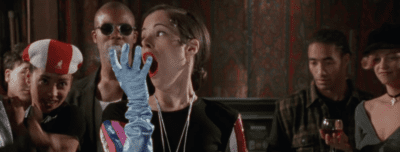
Liim LaSalle is a Supreme-model-turned-Frank-Oceanic-rap-singer with Tyler, The Creator and Tim Robinson cosigns, and whose aura can only be described as, “One of the actual children passing a joint on the couch in the movie Kids now slightly older with the same carefree, cool as fuck charisma.” He, too, speaks of Three Times Louder with the passion of the newly converted, or an investor who got into a hot company on the ground floor. “Before I signed, all I would hear about labels is how it’s all robotic n***** and whatnot, but this really felt like family when I pulled up. Felt like the lunch room,” Liim says. He’s become fast friends with Laila!, who has been promoting his new project on her IG stories and loves the sense of community and motivation she’s found on a team with him. “We’ve been working on songs recently, and like there’s just a lot of synergy, we all share the same love and passion. There’s a certain level of hunger here that you can feel in the air in a good way, it’s good hunger.”
The New York part of the concept—the local, regional, and cultural element crucial to the design of the label—is what Maurice Slade and SoundCloud were sold on. Sick’s vision was working with what he called the ‘post-pandemic New York artist.’ He believes every time New York goes through some kind of crisis, it produces a new Renaissance of creativity,” Maurice says. “Sick thought after the pandemic and what happened with New York being shut down, people had been bottled up, and there’s gonna be this explosion, this movement he wanted to capture. I thought he was spot on, and with the live spaces, the community building, Sexy Drill, all of these artists popping out of Brooklyn, within the first six months of the partnership, the energy was back, just like he said.”
Sick got the idea locked in at Electric Lady Studios in Greenwich Village in summer 2021, early “post” pandemic, as he worked with Travis Scott on Utopia. “From the outside, the perception was New York was like, dystopian, with so many things getting destroyed here. This gallery closed, this event space closed, this restaurant closed, this label left, everyone’s eating in outdoor cubicles, there’s protests in the streets, everyone’s moving to LA. But I noticed there were signs of life, people were outside, they’d been through a war, and it was hopeful. If you were anywhere from a Freshman in High School to a Senior in college during the pandemic, you came out really craving that sense of community you missed out on. The people who were left were people who never wanted to leave New York, resourceful people, survivors,” Sick says.
“That’s why I’m building Three Times Louder. I know New York, and New York has become incredibly undervalued in the music scene. There’s some real monsters here, and people are sleeping on us. So I wanted to be a part of that, set up a space where everyone would want to come. Use everything I’ve learned over the past two decades to run my own thing. I saw a need for a full-service space for a community of artists, and I set out to create one.”
The first night of Three Times Louder has already become famous in label lore. It was November 1st, 2023, and there was a party held to christen the original footprint of the space, in what was a kind of ceremony, the night Liim signed his contract in person. It was also the night producers Jiggy and FckBwoy! created from scratch the first beat ever made in Studio 1, which would become Cash Cobain’s Sexy Drill consecrating, 2020s New York rap redefining hit, “Fisherrr.” Cash was there with his manager, Glyn Brown, who also works as a curator for the label, when he first heard the beat.
Sick brought Don Toliver and, allegedly, Glyn played him the Powr Trav-produced beat for “Glock” for the first time, which ended up on his last album. Glyn remembers it as a wild night, when anything seemed possible. “I just invited everybody. ‘Yo, pull up, pull up, pull up.’ And n***** all came. N***** was in the studio making the beat. This n***** Cash comes in. He started doing his little bop. And I’m like, ‘Oh, shit, something is happening.’ Everybody was freestyling on the beat. It’s the power of the grand concept behind this place, which is get everybody in the same space and something crazy happens, and something crazy did happen,” he recalls fondly.
Cash recalls showing up, having no idea what was in store for him, or the track it would take him two additional months to finish. “I just came through to show love, because I fuck with Sick. But the studio was there, and as a musician, I love music, I always wanna make music. So I heard the beat and I fucked with it. I didn’t know that was gonna be ‘Fisherrr.’ I didn’t have no clue that was gonna be my biggest hit ever to-date, but I love people, I love to come together and collab and create new shit,” Cash says.
Sick remembers the moment in biblical terms. “Everyone’s vibing out to the beat, freestyling to it, then at the end, Cash came and nobody dapped him up, everyone just parted for him, like Moses and the Red Sea. I don’t remember who was in the chair, but they just got up automatically, and he just levitated down and finished the beat, which I thought was the coolest thing.”
For Sick, it represented the culmination of a 20-year journey through the rap industry, and the beginning of everything he wanted to do with his label and the rest of his career. “I always heard about Dame Dash’s DD172, or A-Life sessions, and I was like Liim, a little New York City kid who wanted to be a part of that. So this felt like I had finally built something like that for my people. I love that the room was 40% artists because that’s the goal: to make artists feel like they have a space that’s their own. It felt really dope. It felt really young. It felt really Black. It felt really New York. It made me think, I don’t know if Three Times Louder is going to be the ‘best’ version of whatever this post-COVID movement in New York is going to become, but that night it felt like the purest.”