Photos by Abe Beame
Jaboukie Young-White is Taking it One Set at a Time
How the heart-shaped face of comedy's social media generation is finding his voice by starting over
Dovetail joints get their name from their resemblance to a dove’s fanned, tapered feather tail. They are composed of chiclet teeth, or pins, cut into the end of a piece of wood, spaced between notched out gaps that interlock with an inverse joint to form a right angle. It’s a literal building block of carpentry that dates back to the dawn of civilization. I know this because I’m sitting on a stool in the back of Makeville Studio, a woodworking shop in Gowanus, the day after Valentine’s Day, watching Jaboukie Young-White saw and file one into a block of wood secured by a clamp.
The verbose comedian is uncharacteristically quiet, face drawn in concentration. In 2021’s Dating In New York, Jonah Feingold’s rom-com so conventional, down to its title, it verges on parodic and subversive, Jaboukie ad-libs a joke that each of his trademark curls tell a story. Today, many of them share a story, coated in a fine sawdust that permeates the air, which is heavy with the pleasant smell of fresh cut wood and its suggestion of honest productivity in this brightly lit, open and high-ceilinged shop, cluttered with scrap and piled planks and table saws and drills and spindles, and handmade bowls in various states of completion by other aspiring craftspeople.
The class is over, but the busy noises of whirring lathes and serrated hand saws steadily eating into wood continue on the other side of a thin sheetrock wall subdividing the back of the workshop from a cavernous front section, where certified woodworkers are paying $15 an hour to sit at large tables and detail wooden sculptures or sand down ornate picture frames. Each student is tidying their station, putting away tools in their proper places, and wiping down their surfaces. Jaboukie paces his area with a dustpan, sweeping gingerly with a broom. “This is all about learning how to do it,” the instructor in a sherbert hoodie says encouragingly, addressing his students as they say their goodbyes. “Next week, we put the pieces together.”
My subject looks the part for today’s exercise, wearing chunky black leather boots, loose fit indigo denim work pants, a plain black t-shirt that showcases his defined chest and arms, a wispy mustache that, at 32, is probably never going to entirely fill in, and thick, clear acetate frame geometric glasses that resemble safety goggles and compliment his large, heart shaped face. After I take a few pictures of him posed in front of woodworking tools for the header of this profile, I observe that the outfit is coincidentally perfect for a woodworking class. Jaboukie disabuses me of that notion, that today he is consciously cosplaying as a carpenter on the cover of a paperback airport novel. “Oh, I love a costume,” he says, laughing as we head for the exit.
Jaboukie is taking a several-week introductory class dedicated to nailless and screwless joints and has invited me along to observe. He caught the woodworking bug several years ago when he got the idea that he’d like to make a stool he’s going to sit on when he performs the hour of standup he’s currently finalizing, that he’s been thinking about and developing for years. But first, he needs to master joints.
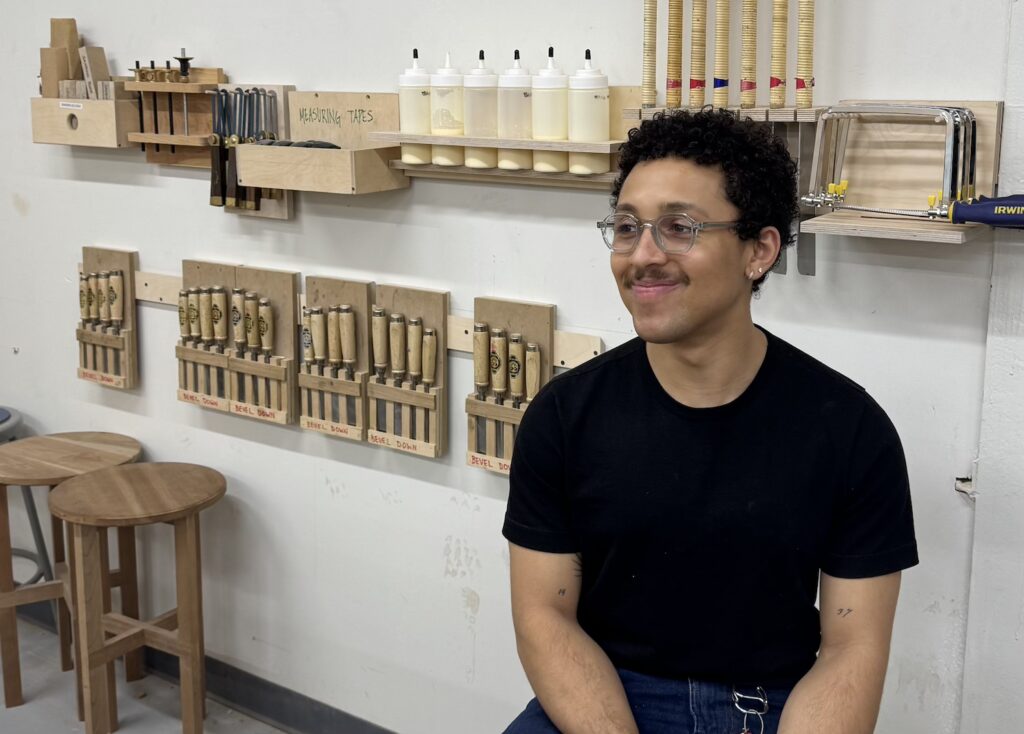
Photo by Abe Beame
I met Jaboukie for the first time a week earlier, over a gluten-free tuna melt at Salty Lunch Lady’s Little Luncheonette in Ridgewood, a couple blocks from where he lives. Jaboukie doesn’t drop his voice and rarely breaks eye contact while conducting an interview in public. He is uncommonly unguarded, as unfiltered and relaxed talking to a “journalist” in his local sandwich shop as he will be on stage in front of 50 people a few nights later, and as he seems when on camera for national television or in a film.
This gives the impression Jaboukie has a complete comfort with being perceived, unapologetically, which has been interpreted by some historically as “star quality”. It’s seductive in that he comes across as someone who has either figured something out the rest of us haven’t, or is a freak who was born like this, which his little brother Javaughn—a musician in Los Angeles who has mythological celebrity lore of his own—confirms for me when we speak over the phone. “I think one thing about my brother is that the way he is now, he was always that way. He’s on TV getting all these accolades, he’s really comfortable in front of a camera, but so much of that is just literally his personality,” Javaughn says. “He’s always been comfortable being the center of attention. If there was a Christmas program at church, he’d take the solo, he’s reading passages. It translated really well to high school. He’s like a legend there. But he doesn’t make a big deal about any of it.”
When Jaboukie was a child, his mother didn’t have anyone to discuss the books she was studying in school for her English degree, so she would pay her adolescent oldest child to read and discuss, say, Descartes with her. Having even casual conversation with the comedian brings to mind the friendliest and most pleasant version of a line Aaron Sorkin once produced: That hanging out with another prodigy made for the age of social media is like “dating a stairmaster”. His conversation is full of organic deflection and tangent. If you are interviewing him and you’re not careful, you will suddenly realize he is, in fact, interviewing you. He will also throw out doctorate level philosophy theorems blended with pop culture references you’re not familiar with, and profound ideas you’d like him to expand on, which has to be balanced with a list of questions a mile long you’re holding in your head, as he’s also casually riffing four or five hilarious and personally revealing separate threads in the last thirty seconds you’d like to ask follow ups to, but he’s already moving onto the next four or five, and and and. This loose and hyperactive mastery of pop culture and theory, able to bounce between Nicki Minaj and afropessimism extemporaneously between bites of his sandwich in a few short sentences, serves as a kind of equation that first made Jaboukie a preternaturally gifted poster with a distinct voice when he achieved an early, easy kind of stardom on Twitter.
Jaboukie was born in 1994, but his career began in 2011, when the teenager registered the account that, at the time I’m writing this, has nearly 763,000 followers. The next year, when Jaboukie was 17, he won the Illinois state speech competition in the “Original Comedy” and “Special Occasion Speaking” categories for his alma mater, Marian Catholic in Chicago Heights. This was an expression of precociousness and drive and discipline, but it was also an act of supreme pettiness, a kind of determined bitchy contrarianism that has animated much of Jaboukie’s life and career. “When I was a junior in high school, when I won the state speech tournament, I got dumped by this guy, and I was like, ‘Oh, you don’t like me? I’m going to make the whole fucking state of Illinois like me. How about that?'” Jaboukie would tell me over table fries and a Shirley Temple many years later, no less indignant.
This attitude was necessary in Harvey, Illinois, 15 minutes outside of Chicago’s Southside, which Javaughn recalls as not the easiest place to grow up as a short, baby-faced, queer child of Jamaican immigrants, but Jaboukie made it look relatively easy. “He’s always been super witty and pestering; he’s gonna get what he wants and advocate for himself, and he literally doesn’t care. He’s detached from whatever happens after that. Harvey is an environment where if you aren’t sure about yourself, people are gonna test you,” Javaughn says, sounding very different than his brother, both in his laid-back temperament and in accent, closer to Freddie Gibbs’ harsh Midwest drawl than Jaboukie’s perfect, regionless, speech-team-honed general American English. “Some of the first fights I got into was me defending him because he would say the craziest shit if someone picked on him. He would turn up because he’s straight to the point, sharp-tongued, and a little bit mean if he needs to be. That’s something I’ve always admired about him, his ability to just say anything if it has purpose. He’s gonna immediately fire back with something hilarious and kinda embarrassing for that person,” Javaughn says.
After following a guy to film school at Depaul, he dropped out and moved to Brooklyn in 2016, a tale Jaboukie relates as part Dickensian, part New York City’s answer to Sunset Boulevard: The fairytale ingenue princeling gets off a bus in the big city, without enough money for a return trip to the Midwest, armed only with his WiFi enabled smart phone. He finds a $650 a month (including groceries) room in a socialist loft via a Facebook housing group, gets a job fundraising at the BAM call center, and within a few months has landed gigs writing for streamers, on stage at The Tonight Show, and before long, on Trevor Noah’s iteration of The Daily Show.
Jaboukie established himself during a moment of generational flux. As he depicts it, networks and studios were flailing, looking for answers for how to resonate with the next demographic crop of consumers that were cutting cords and tuning out at rates that portended a mass cultural shift. Popularity on social media, the algorithm still functioning as intended, with Twitter in slightly less malevolent hands, became viable currency. Jaboukie’s sharp-edged, observational, anthropological Tweets that often took surprising, hilarious turns helped establish an entire new comedic language that rendered him a coveted corporate asset. “If you don’t have digital proof, nobody gives a fuck at all. It’s necessary,” Jaboukie tells me. “Because it’s a mystery to them and they read that as success. They want to know how to gamify their thing.” This partially explains how Jaboukie found himself coming out for the first time publicly on late-night television’s historically, militantly cishet platform. But not entirely.
Jaboukie’s nationally televised breakout set occurred within a month of The New York Times publishing the investigation that brought Louis C.K.’s open-secret sexual transgressions to light, which came a month after The New Yorker‘s bombshell Weinstein exposé, and a year after the first election of Donald Trump. The anger of that moment in comedy is crystallized by Guy Branum’s Vulture op-ed, “Tear Down the Boys’ Club That Protected Louis C.K.”. The white cis gay Branum is palpably over it, ready to move on from a racist, misogynist system ruled and abused by white straight comedians for decades, and with Twitter serving as a bully pulpit everyone in the industry was still very much on, comedy underwent a sea change of diversification that made space for alternative voices, faces, genders and lifestyles (with substantial social media followings), or a “Queer Comedy Boom”.
Representation became a buzzword in Hollywood, on film, on television, and in writers’ rooms across the industry in terms of the stories it was interested in telling and who gets to tell them, and Jaboukie became one of many faces of this shift, seemingly materializing to answer the question of how to move away from the totemic white male power structure on The Tonight Show stage. The effortlessly, routinely viral prodigy oozes charisma throughout his star-making set, self-assured in his multitude of checked box marginal identities: impossibly young, a child of immigrants, vaguely ethnic, working-class midwestern, and queer.
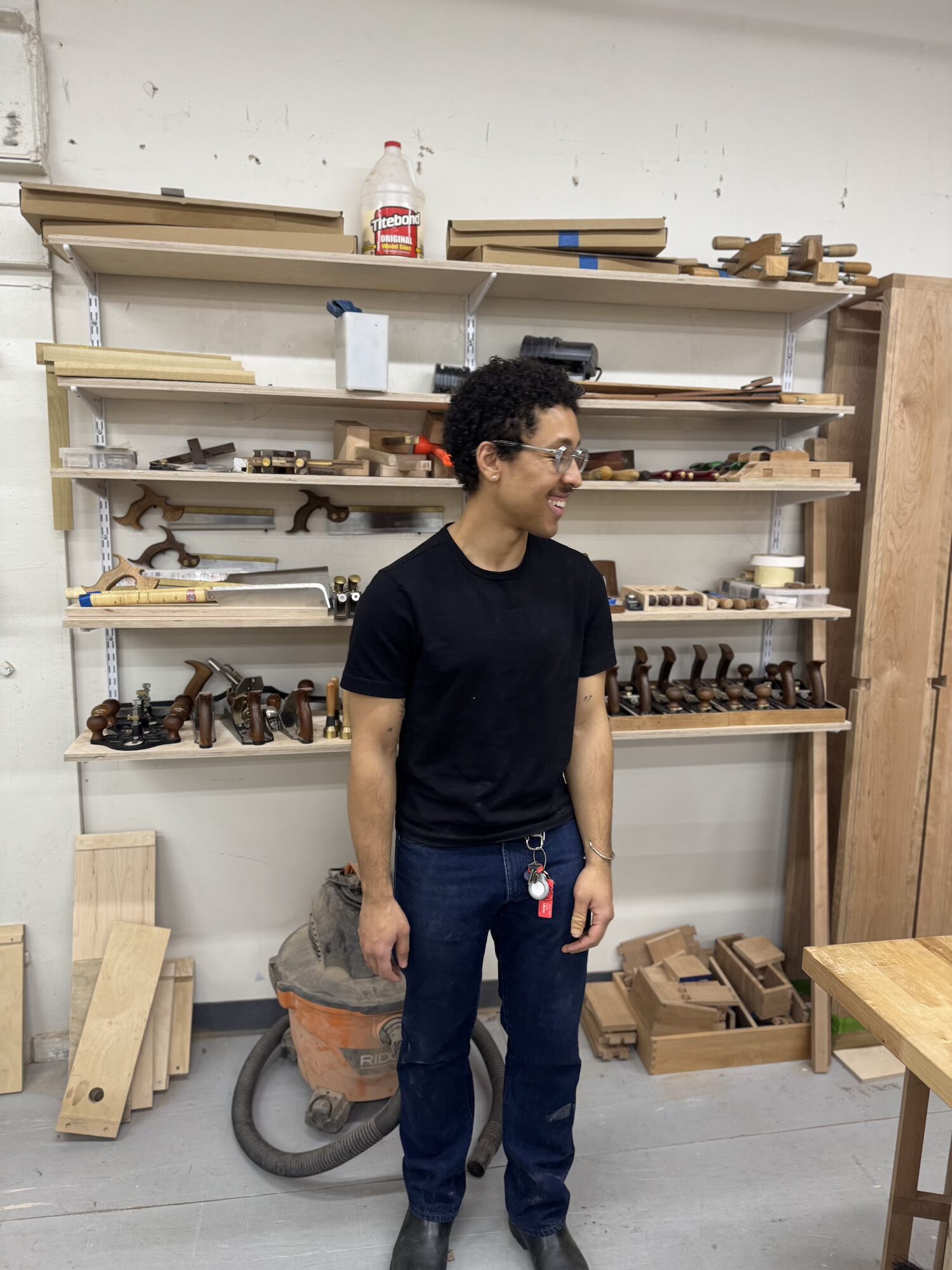
Photo by Abe Beame
The artist River L. Ramirez was another face of the queer comedy boom, who got their break on Julio Torres’ HBO series Los Espookys, and remembers the moment as full of previously inconceivable possibilities. “It was a time where queer people were able to do more than just talk about being gay and being queer. We could just be people, and it was cool—other people wanted to talk like that and be like that. And I do feel like Jaboukie, for me, represents a time when suddenly, we were able to do more and be more in the industry,” they tell me.
Jaboukie was the “Senior Youth Correspondent” on The Daily Show from 2018 to 2021, appearing in 57 episodes as a cheeky, back-of-the-bus little brother/troll to Trevor Noah’s sturdy, Obamacore stewardship of the show, a counterbalance that acknowledged even the alt-news sensibility of the deep cable platform could get stale and was in need of a remix. Opportunities came flooding in. There were appearances on HBO comedy series like Pete Holmes’ Crashing and Issa Rae’s Rap Sh!t, recurring roles on Only Murders In The Building and Abbot Elementary, and supporting roles in films like Mike Mills’ Cmon Cmon. There was a lot of voice work, most prominently as the first openly gay character in a Disney film, in 2022’s Strange World. He released the experimental dance rap album All Who Can’t Hear Must Feel in 2023, and in addition to the hour of comedy he would take to Europe a few weeks from when we talk, he’s releasing a zine of photos he took on his iPhone over the past decade with Pomegranate Press.
To date, Jaboukie’s career has been defined by what could be described as the restless wanderlust of a supremely confident, fearlessly creative person who became successful before he had a firm idea of who he wanted to be. He serves as a co-chair on the BAM fundraising gala board, and along with the woodworking class, he’s also taking courses to learn color grading on the editing program DaVinci Resolve, and the music production program Ableton. “I’m just constantly making things and thinking, maybe I’ll use that someday. I’ve just become a creative hoarder,” Jaboukie says. He credits his openness to his parents and their journey through work in America. “My dad would DJ, he’d do heating and plumbing, he’s a barber. My mom did data entry at a bank, and now she’s an eighth-grade English teacher,” he says. “I never grew up thinking a job was this fixed thing inside of you, or ‘your career’ was this fixed thing inside of you, or that it was bad to start something new and not be good at it immediately.”
So Jaboukie said “Yes” a lot, he tried a lot, and he learned that, however much the entertainment industry played up the idea of fundamentally democratizing and changing and diversifying, in many cases it was just lip service, and even that was temporary. Jaboukie felt typecast and confined to the space the entertainment industry has long reserved for queer actors: The gay best friend archetype. He tried to gravitate towards roles that challenged him and allowed him to stretch. “After a while, I got persnickety about the gay best friends that I’d play. When I’m looking at roles, I’m asking myself, what makes this character different from the last one?” Often, the answer was “Not much.”
Jaboukie didn’t say yes to every offer, and he’s grateful for that now. During the BLM protests in 2020, brands and corporations fell over themselves to use celebrities of color as spokeshields for their multitudes of historical sins and gaffs and missteps. Jaboukie saw the transactional emptiness of the offers coming his way and resisted. “When I was seeing institutional embrace, I was like, ‘This is cool, I don’t fully trust it,’’” he tells me. “It was one of the best decisions I ever made, because imagine I became the face of corporate ‘Woke’? What would I be doing right now? I was like, ‘This is so insincere, I can’t really engage with it.’ Then, when you move on from this, and you have equated me with this, and this is my essence, then where do I go?”
The experimentation with new voices and expanded writers’ rooms was short-lived, as was the promise of a bottomless reserve of resources, projects, and jobs that came with the COVID-era streaming wars and ended with the SAG-AFTRA strike in 2023. When Donald Trump was re-elected in 2024, he targeted the vague boogeyman of DEI and the “quiet part” white grievance, that opportunity had been doled out unfairly to counterbalance racial inequality in this country, and his electorate’s absurd perception that it had come at their expense. This would reflect the taste and the direction many power structures in America have followed since that dark watershed moment.
The outlook for the entertainment industry is bleak for its middle and lower classes, which, as is always the case, disproportionately affects the most vulnerable, “marginal” identities. For instance, Disney learned all the wrong lessons from the aforementioned Strange World, a film that rips and my kids still love, but got lost in the gradual, late-pandemic return to theaters and underperformed at the box office. Pete Docter recently acknowledged he gutted Coco creator Adrian Molina’s vision for his queer coming-of-age film Elio, because “We’re making a movie, not hundreds and millions of dollars in therapy.” Elio subsequently bombed.
Ramirez has contended with the bust, or drying up, of opportunities for alt voices in the industry firsthand. “It makes me sad that when I hear the only offers [Jaboukie] gets are to play ‘Gay best friend’ or something. I think it’s crazy that gay men are still devalued in this way, but it’s the story for so many types of people—Latin people, Black people—in entertainment. It really beats you up… I haven’t had a job in so long, I moved back to Philly, and I’m going to start tattooing again.” They told me they feel like the queer comedy boom was around just long enough to be co-opted by the most cynical elements of the industry and society, at least in New York. “It was a very special time, and it was fun, but now all the jobs are gone and everywhere is Dimes Square and everyone moved to LA, and it’s not ours anymore. I’ve met people who are like, ‘I’m non-binary and so is my partner,’ and it’s a straight couple.”
All this is to say the old models of fame and success in comedy and entertainment are falling away for everyone, but particularly queer comics. Jaboukie shot Trash Mountain—a film written by Caleb Hearon, his friend and peer in the queer comedy scene—in November, with Zooey Deschanel and Jackie Weaver (Jaboukie plays “the love interest”). But the hypothetical NBC sitcom Jaboukie!, starring the comedian and four friends in a Bushwick loft—the one-time endgame goal for comedians following a conventional career path—does not appear to be around the corner.
Even Twitter, the platform that launched him, has been left a desiccated husk of dead internet. Jaboukie still uses it sparingly as a promotional tool, but it has largely lost its romance. “There has been corporate capture of every social media platform. They monetized it, and now it’s so different. It used to be a bunch of mentally ill people trying to out-crazy each other,” Jaboukie says. “Now it’s a smaller part of the larger trend of the gamification of every facet of life, the Polymarket of it all. It’s really hard to find sincerity on Twitter now. The capital is no longer social. Once it becomes hard capital? Dead. The fun is gone. You can’t have that much dopamine and money on top of it, that’s real crackhead type shit.”
So the decision to develop this hour of comedy has a pragmatic logic to it, both for where Jaboukie has arrived in his career and where Jaboukie’s career is positioned within the greater entertainment industry. He previously filmed a 30-minute special for Comedy Central in 2019, but has never recorded a proper hour. “In many ways, standup is my first language, period. I’ve been doing it for 13 years, it’s how I learned America,” Jaboukie tells me. From his perspective, the hour constitutes a reset, going back to the beginning and doing what he would have had he not experienced near-immediate, meteoric success. “When I was 24, I was like, this was not supposed to happen until I was 30. I was thankful for it, obviously, but there was a part of me that was like, I don’t feel in a rush to define myself as an artist at 25. I feel like the last decade I was like, ‘I’m going to do a little bit of this and see what this is like, and do this and see what this is like.’ And now I’m not.”
Jaboukie uses the term “No overhead” a lot when discussing the freedom standup affords him. It’s parlance he picked up spending years in rooms with people, failing to convince them to give him the millions he’d need to develop studio projects that would allow him to be more than a gay best friend. “I view standup as performed personhood. When it’s good, it can be the most transcendent thing in the world,” Jaboukie says, and you can see the appeal of standup for him, the stripped-down simplicity of being alone on stage in front of a room full of comedy nerds, with nothing but a spotlight, his jokes, and a stool.
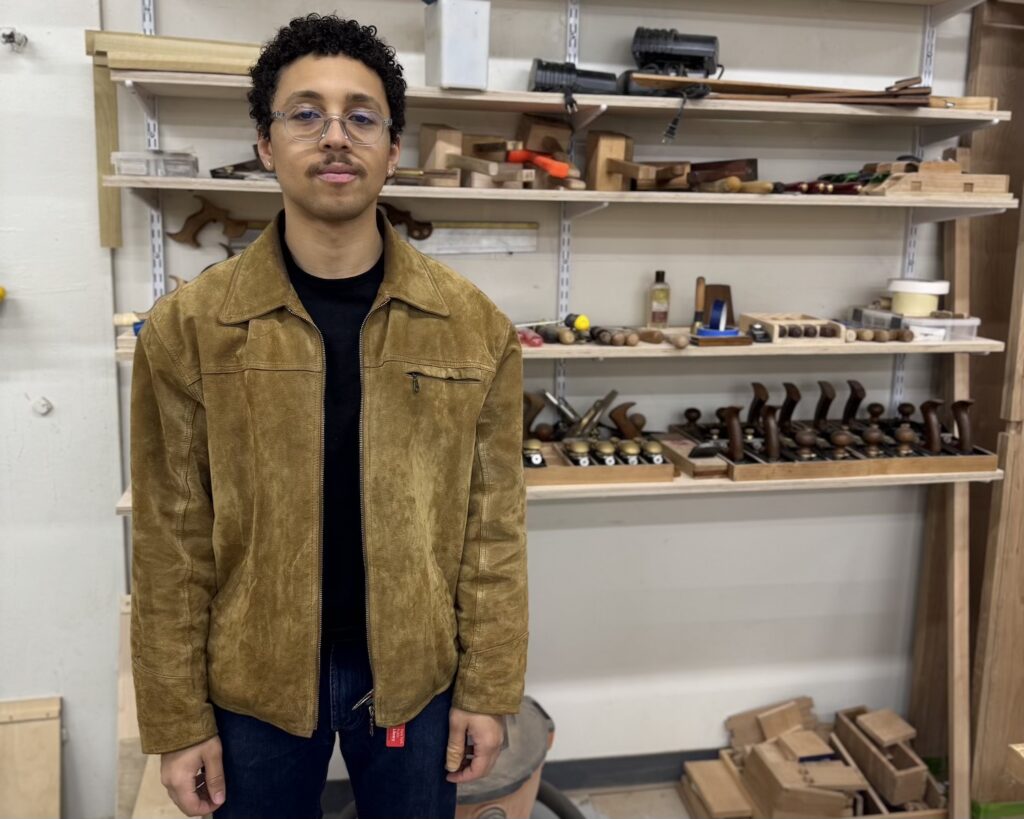
Photo by Abe Beame
Two days after the woodworking class, I’m in the cramped basement performance space at Union Hall, a Park Slope bar with full-sized bocce courts that has long served as an unlikely, historically influential, and beloved alt-comedy stage in Brooklyn. The androgynous crowd is artfully dressed in the still winter-appropriate garb of flannel, wool, and cashmere, and I get the impression I’m the only person in the room who isn’t an amateur-to-semi-professional queer open mic comedian, here to venerate to a patron saint. The opener Freddy Shanel confirms this when they ask the crowd, “Are you bitches gay?” to a near-unanimous response of shouting and hooting. “Well, that makes sense, considering…Jaboukie’s audience.”
The choice of venue, where Jaboukie has been honing the hour off and on for the past few weeks, is intentional. “Union Hall is lowkey where my career started,” Jaboukie tells me before the set. “I love it because you can feel the people. You can hear every nuance of the laughs in there. If I’m working new material, I need a small room so I know exactly what kind of laugh it was getting. I want to know, is that a relief laugh? Is that a tension laugh? Is that a silly laugh? Is that a heady, nose-breath type of laugh? Even when I hear the set back afterwards, I can read those laughs in Union Hall.” And there are many laughs to read during the hour.
“Twitter Brain” is a particular and specific type of insult, but Jaboukie forces me to reconsider it as a pejorative, or at least presents an iteration of it that, particularly for a comedian, is not all bad. He writes with an economy, clarity, and precision, indicating a sense of humor developed within the confines of a character limit. “Twitter is a one-liner academy,” as River L. Ramirez puts it. At one point, Jaboukie breaks out of a bit about the gay experience at a straight club to deliver a profane, elegant appreciation of a word Jaboukie has shared on his grid, so I will relay it here, because it perfectly articulates his joke-writing sensibility, informed by a cerebral lit nerd’s love of language and the logic games. “F***** is the best slur. It has the ‘Fuh’ forwardness of fuck, the ‘Guh’ double G of n***** and the ‘Tuh’ smooth finish of c***.”
Towards the end of the set, that is still very much under construction (“There are 30-40 minutes I’m happy with, and then the other 20 I need to figure out how to stitch into place.”), Jaboukie puts on a steroidal homerun derby display, grabbing his phone and swatting dingers for the crowd, as an elite poster emptying his drafts of would-be viral bangers for our entertainment: “I go to Therapy, which is the name of the gay bar where me and my friends do ketamine”, “Whenever I hear a young kid speaking German I think, you’re too young for that”, “Why do we call it facetime audio and not mouthtime?”, “Have you ever met someone so hot they think the world is a good place?”, “The best compliment you could give someone on their Instagram post is, ‘This made me want to kill myself’”, “Everyone in the Bay Area is spiritually biracial.”
This is not to say the hour set I saw is in any way a dry, Hedbergian joke delivery system. The former theater kid puts as much, if not more, care into the performance of standup as he does the writing. He’s constantly playing with affectation, timing, and structure in his set—more prog rock than jazz. “I get really Rain Man with it and try to take as much away from a joke as I can, doing, and moving, and saying as little as possible,” Jaboukie says. “If you really nail that, you can get to a point where you can raise your eyebrow and the audience is laughing, because they know everything is intentional, this person is taking me on a journey, and I trust them wholeheartedly.” None of this prepared me for how animated the set would be, but his half-committed, very funny impressions, and silly moments of breaking into dance or shouting are working to set up quiet moments where that raised eyebrow can be employed to nuclear effect.
Jaboukie has a taste for intimate, personal comedians of a bygone era. His top five is Pryor, Mooney, C.K., Chappelle, and Bamford. They comprise a cross section of the kind of vulnerable, emotional honesty Jaboukie wants to deliver with this hour, to honor the history of the medium and deliver a true reflection of himself. Accordingly, he’s been letting his public in more recently. In addition to this hour, he’s been working out a 90-minute-long anecdote, with few jokes, that is about the defining romantic relationship of his life, a 17-year odyssey with a man who identifies as straight that Jaboukie describes as “my Heated Rivalry thing”. He’s also made headlines in recent interviews and from the stage, revealing his lack of a relationship with his father, who went no-contact after Jaboukie came out on The Tonight Show seven years ago.
Jaboukie tells me homophobia at home is a reality he has lived with his entire life. “My parents said that growing up, their love is explicitly conditional, and if I were to be a certain way that was kind of beyond my control, they would revoke that love and possibly even hate me.” Javaughn confirms this. “If you’re gay, there’s going to be XYZ consequences. That was something that was verbalized to us. It was wrong to be gay. It was a failure or a sin to be gay. From a young age we knew that.” As a result of Jaboukie’s rift with their father, Javaughn left the house, moved to LA, and has also gone no-contact, though on Father’s Day last year, he sent their father a long text message attempting to mend the relationship. “I told him: Bro, you’re hyper-fixated on one aspect of [Jaboukie]. Look at all the great things he’s doing. It’s kind of fucking weird that you care so much that he’s gay.” Their father didn’t respond.
Jaboukie first told me, along with his audience, of the issue from the stage during his set. When I asked him afterwards why he hadn’t mentioned it in prior conversations with ample opportunity, he expressed the irritation he’s faced discussing it with the majority of his progressive peers, who presumably don’t have parents who hold his father’s traditional values. “It does feel retro in a lot of ways. Privileged people say they’re so tired of sad queer stories, and I understand the need for entertainment and escapism, but I’m like, where do you need escapism as a queer person with your six-figure job in a metropolitan city with your loving family and your various sexual partners?” It’s another element of his experience that makes him feel apart and othered. (This evokes my personal favorite, and most Flatbush-adjacent joke from Jaboukie’s set: “A crazy thing about having immigrant parents is you have a lot of parallel but extreme or different experiences than Americans. I feel like a popular American sentiment is ‘My mom is a Democrat and my dad is a Republican.’ And when you’re a kid of immigrants, it’s like, ‘So, my mom is a sexist socialist and my dad is a pro-union fascist.'”)
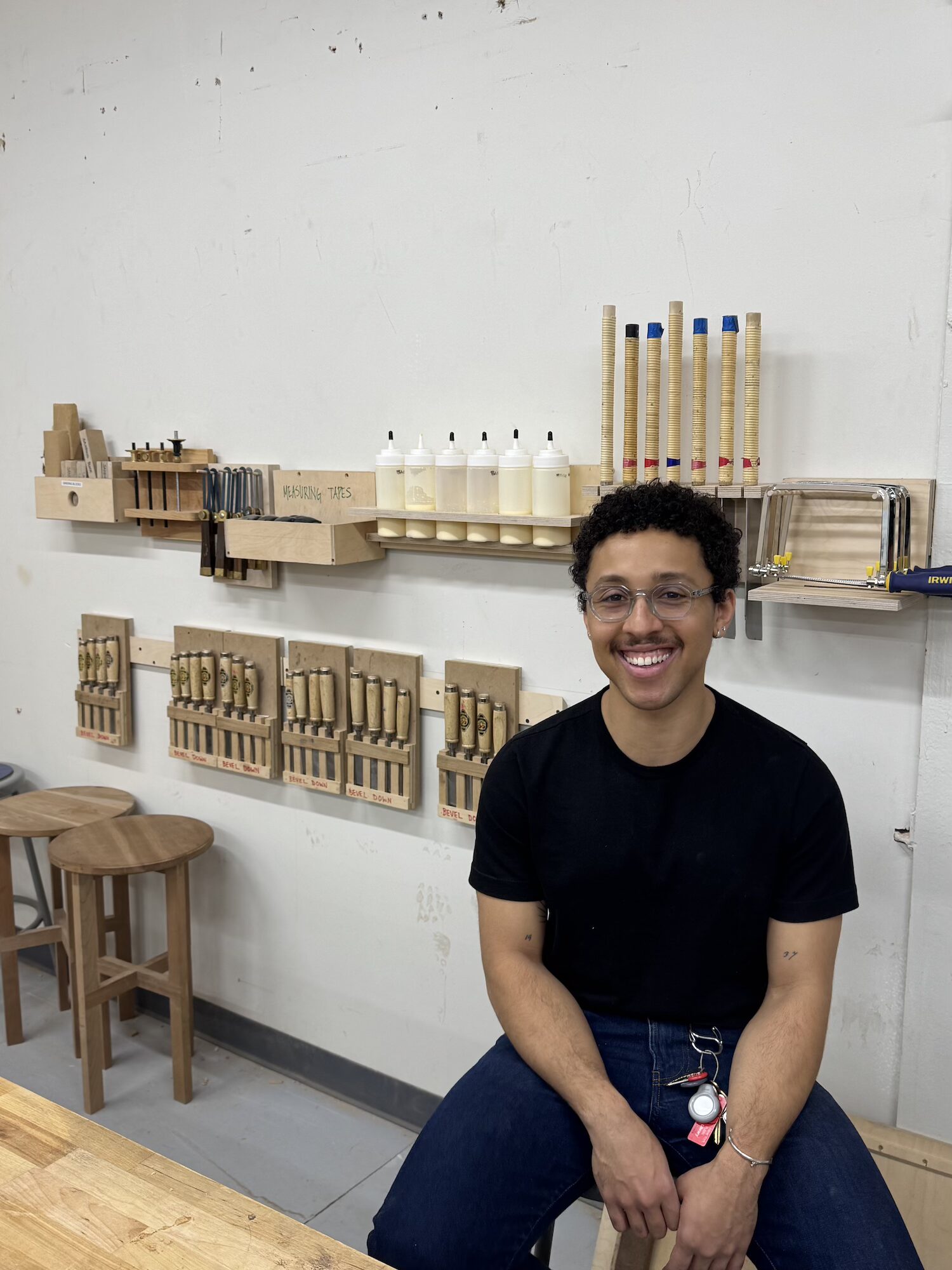
Photo by Abe Beame
Even in its writerly, clever, most Twitter-brained moments, Jaboukie’s set, and the perspective it’s infused with, make clear why he was such a poor candidate to become a “Gay Bestfriend” poster boy to begin with. Jaboukie’s humor encapsulates the absurdities of modern, coastal elite, queer culture clashing with whatever is left of the working-class Caribbean-conservative Midwest monoculture he was raised in, and he lives at the intersection of these worlds, capably taking the piss out of both. He’s a terminally online, overread, culture-fluid ball-knower fluent in many codes. He requests Pop Smoke at Animal, works out to Playboi Carti, and writes jokes to DJ Rashad. He is no one’s stock character.
Whether or not Jaboukie is able to perform another culture-defying miracle, creating a classic hour of standup in an age of comedy dominated by vertical video podcast clips, and redefining himself as an artist in the process, remains to be seen. But he professes he is at peace with the outcome. I ask him what he wants this hour to accomplish in the strategic, careerist sense. “I guess I should probably have an answer to that, but I really don’t. There were a few milestones in my life that I hit earlier than anticipated, which came with this feeling of elation that didn’t last very long, and it made me realize I need to find edification through the process,” he says. In other words, he’s taking it one set at a time.
River L. Ramirez understands the impulse to develop this hour as Jaboukie demanding autonomy over his career. That it’s an act of refusing to allow the industry to define him. “When you’ve been in this for a while, you have to deal with people taking so much control over your whole image and what you think, and that isn’t freedom. You have to find little pockets to be free.”
After the woodworking class, Jaboukie and I walk down Fourth Avenue, looking for somewhere to get a drink, and the conversation turns from furniture to electronics. “I’ve been thinking about how I take what I do with standup and tailor it to me exactly, and I think a part of that is going to involve me entering a diva era where I use custom microphones. I bought my first mic the other day, and I really want to start my own collection I bring around with me,” Jaboukie says.
I suggest the next logical step is to simply make his own microphone from scratch. Jaboukie laughs, but looks genuinely gagged.
“Why did you say that?” He asks incredulously. “You just cost me six months of my life.”