Photo by Kim Pham
Tension, Outrage, and a Little Hope at Mayor Mamdani’s First “Rental Ripoff” Hearing
How the launch of the mayor's housing crisis forum met the earned skepticism of tenants with empathy and a new disposition towards dissent
“NYCHA should be allowed to speak! This is bullshit!” A woman screams from the stage at George Westinghouse Career Technical High School in downtown Brooklyn on an early Thursday evening. It’s the first night of the “Rental Ripoff” hearings, a city-wide series from Mayor Zohran Mamdani and his team, and it’s more or less a familiar scene many jaded New Yorkers who have lived here for any length of time are inured to: Another disgruntled resident, driven near insane by the daily indignities that have accumulated over the course of years at the hands of landlords who skirt their obligations to tenants, working hand in glove with bad faith policymakers in Albany to deprive them of their humanity and basic human rights.
They have been historically left with little to do but yell into the void, and the activist and viral performance artist known as Crackhead Barney is doing just that. She has commandeered the podium in the auditorium with a screen-printed Donald Trump mask pulled over her, perhaps as a nod to our current president, who Mamdani met at the White House earlier that day for an unannounced meeting that resulted in a promise from Trump to dedicate $21 billion in federal funds to a long-discussed affordable housing project in Queens.
Back in Brooklyn, the crowd in the gymnasium had more immediate, material concerns at the first of five housing crisis forums announced by Mayor Mamdani. In response to Crackhead Barney, an impassioned audience member amplified her pleas. “Protect public housing!” they yelled. Barney continued, as officials milled around her at a respectful distance, attempting to bring order to the proceedings while she made the case that the oversight of the New York City Housing Authority was tantamount to a dereliction of duty by the city. Supporters began to get excited by her indignation, familiar with the brand of disruptive antagonism that has made her a viral sensation in organizing communities; repeated cries of Let’s go, Barney! could be heard throughout the half-full gymnasium. “There is no tenants association without NYCHA. Poor people have a fucking voice!” she proclaimed to scattered cheers in the audience.
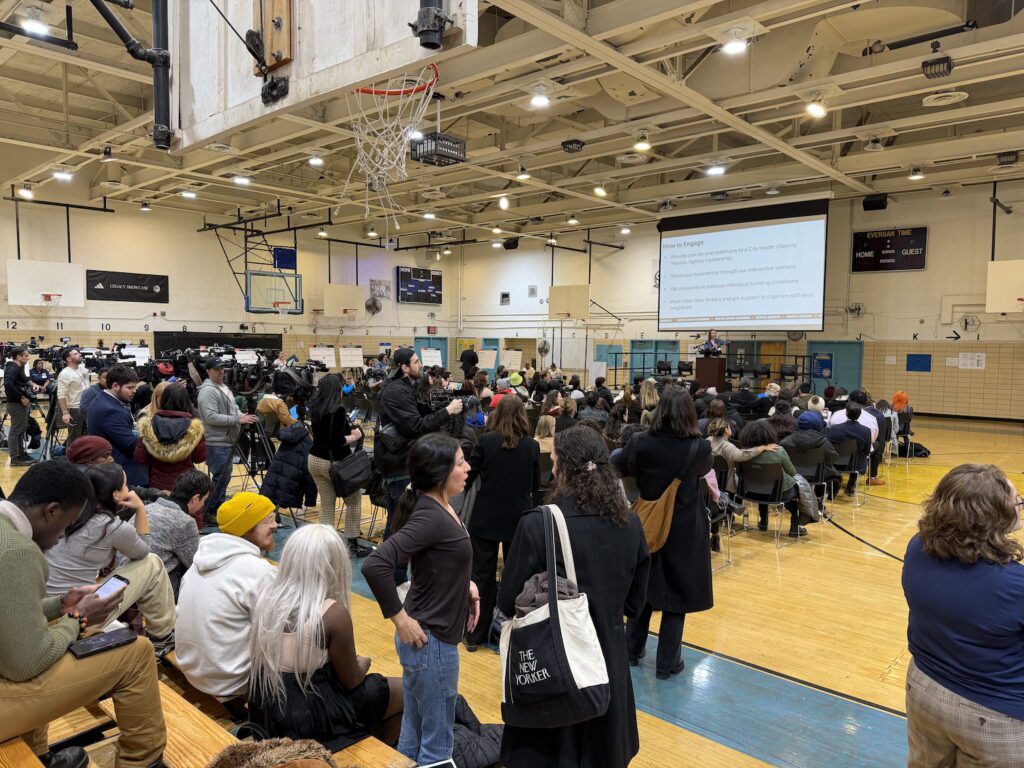
Photo by Kim Pham
The historic victory for Mamdani in the mayoral election was in no small part due to his forthrightness around cost-of-living issues in a city of working-class tenants fed up with taking a backseat to the interests of the real estate developer class. Paramount to his campaign platform were the need for a rent freeze and quality, affordable housing. Thursday night’s event, the Brooklyn edition of hearings that will touch each of the five boroughs, started to put these promises into action. The initiative, led by Cea Weaver and the Mayor’s Office to Protect Tenants, aims to revitalize the department as a voice intended to represent tenants’ key interests in city hall, with the goal of a city replete with safe, stable, and affordable housing. “The most protected tenant is an empowered tenant who knows their rights and can organize with their neighbors,” Weaver said to scattered applause. “Tenants pay their rent every month and deserve a say in the decisions that the city makes that impact their lives.”
In a brief presentation to press and tenants alike inside the school’s gymnasium, Weaver laid out a multi-pronged run of show for the evening’s events. It quickly became clear that what Mamdani’s administration had put into execution was less of an open-forum town hall to express grievances and share struggles amongst tenants, and more of a resource fair that doubled as data collection for various city agencies. The open gym was littered with intake boards that asked for feedback on everything from “junk fees” to maintenance and repair issues. The cafeteria had representatives from all major city housing and advocacy organizations, including NYCHA. Participants could also sign up for one-on-one sessions with deputy mayors and agency leadership to personally tell their housing horror stories to those with the most direct opportunities to effect change.
Despite this unexpected sleight of hand, city officials repeatedly emphasized that the exercise was not just “engagement for the sake of engagement.” Throughout the night, Mamdani’s team stated that the feedback collected would be used to develop policy proposals and recommendations—starting with a report to be generated 90 days after the last hearing and subsequent housing plan, which will ostensibly cover both production of affordable housing and housing quality, including code enforcement.
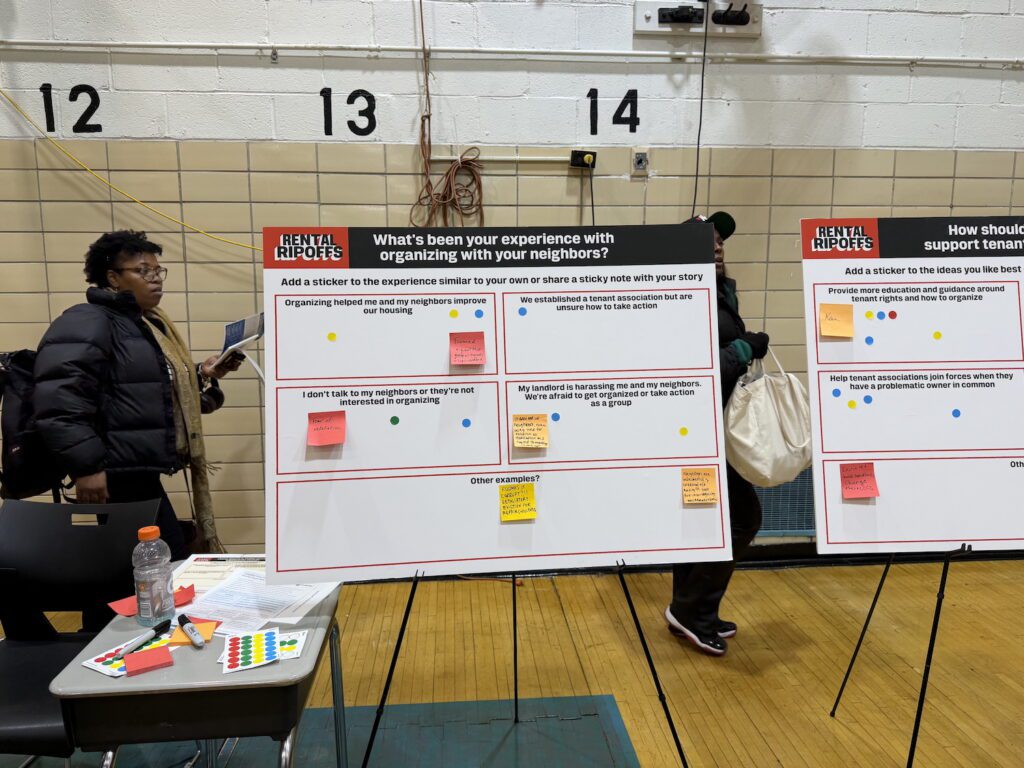
Photo by Kim Pham
When pressed on how the policy recommendations would turn into actionable legislation, however, Weaver demurred, admitting that the policy change would take time, having to go through the same negotiated process of working with the city council and state budget to make these ambitious goals a reality. Still, Weaver insists, “your information and your stories are going to shape the forums that are hopefully going to improve the lives of everyone in this city.”
However, while Weaver’s rhetoric spoke to a well-intended group of city servants who aimed to step up for local housing rights, it quickly became clear that frustration amongst the tenants lay not just with corrupt housing management companies, but the bureaucratic limitations of the city itself. In the moments before the ripoff hearings, housing organizers led a tenants’ rally at the front steps of George Westinghouse. Advocates spoke at length on the various indignities they faced in their deteriorating apartments, laying blame at the feet of the corrupt landlords who allowed them to live in squalor to protect profits, as well as city agencies, such as the Department of Housing Preservation and Development (HPD), citing their ineffectiveness at enforcing housing violations and fees.
Kingdom Justice Church’s Reverend Kevin McCall held up a sign that simply stated, in plain black lettering, “The Mayor don’t CARE about NYCHA.” He doubled down on his frustration throughout the evening’s events. “NYCHA should have been first, and the landlords should have been second, because NYCHA is a city property,” McCall emphasized after being told that Mamdani’s administration made a commitment to address NYCHA exclusively down the road. City officials would repeatedly say that NYCHA residents were welcome to make complaints, but the focus on HPD, which exclusively focuses on private landlords, laid bare a clear discrepancy over which working-class New Yorkers were the focus of the evening’s events. The city agency serves as the direct landlord for over 177,000 apartments. “Don’t put NYCHA on the back burner just because those are the individuals that voted for you.”
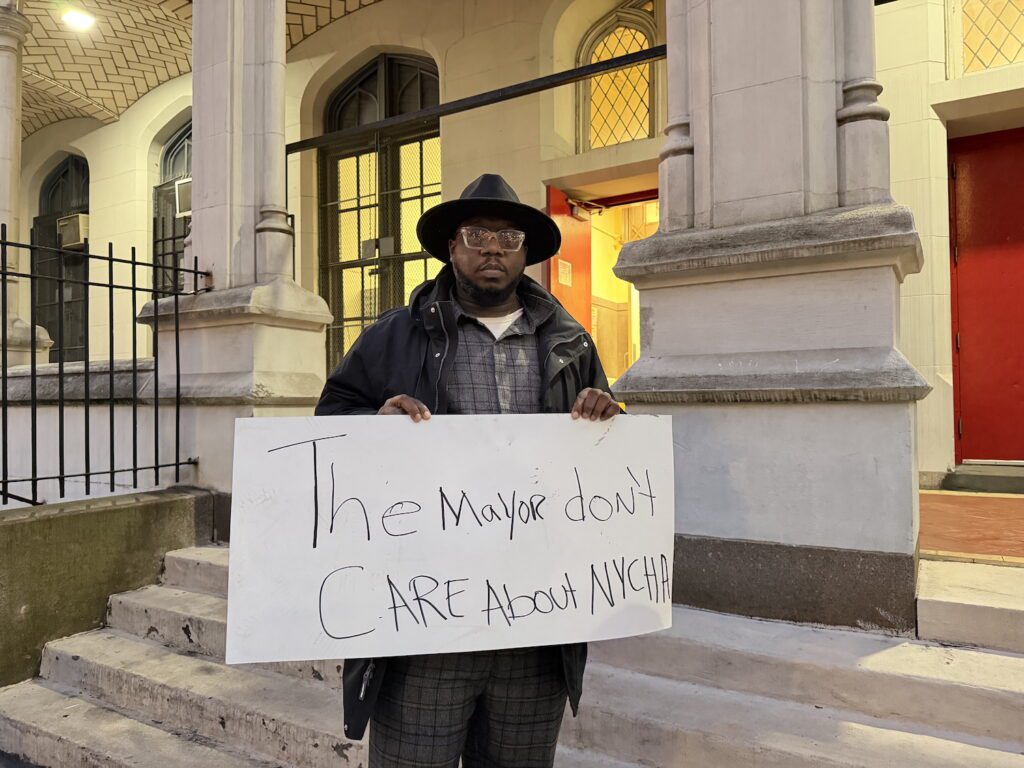
Photo by Kim Pham
There was a distinct class tension that lingered throughout the program, only intensifying as the evening progressed. Tenant advocates were visibly disgruntled, claiming that some of the agency representatives in attendance were part of the problem. “Tenants are calling [HPD], nothing happens,” said Angelina Landress, a tenant association member at 75 Lenox Road. In her purview, tenants exchanging crucial information amongst each other was a matter of life and death, sharing details of faulty windows and fire-escapes in her building, leaving residents immensely susceptible to catastrophe in the case of a critical emergency. “I appreciate Mamdani, I’m glad he’s here, but we all have a voice, and part of that voice needs to be directed—the smoke has to be directed—to HPD.”
The response to dissenting voices also revealed how progress could still be found in the midst of agitation. Where previous administrations may have dragged the activist off stage or escalated to police tactics to restrain and detain Crackhead Barney’s pointed disruption, Weaver and city officials let her grievances be heard. After Barney spoke, Weaver went back on the mic, indicating that NYCHA officials were available to speak to anyone with concerns, inviting NYCHA tenants to also sign up for one-on-one talks with Deputy Mayors at their leisure. Instead of being treated as hostile interlopers, Barney and her supporters were redirected to the appropriate resources to guarantee that their frustrations were put on record.
It falls short of addressing the reality that the new mayor has not yet managed to come up with a targeted plan to specifically address NYCHA needs, but it did indicate an administrative shift that views tension from organizers as an opportunity to expand their tent, instead of responding with punitive silencing, a welcome transition from the dismissals of the Adams era.
Both Barney and Reverend McCall later got direct face time with the NYCHA administrators, and both shared their contact information with city officials. But when asked if he believed that he would get a call back, something beyond gestures and optics, the Reverend maintained earned skepticism from decades of dealing with city bureaucracy. “It can’t just be a dog and pony show because we’re putting the pressure on them,” he stressed. “Will there be actions, and will we see results?”