Photos by Abe Beame
Reviving The Dream of Physical Media at Night Owl in Williamsburg
Along with its neighbors on "Analog Alley," the Williamsburg video store is pushing back against the digitally mediated realities of modernity
Havemeyer Street—named after the German sugar refining family that owned Domino, whose factory still defines the Williamsburg skyline—is a sleepy inlet that runs up a hill off the neighborhood’s main strip on Bedford, in the shadow of the Williamsburg Bridge and the BQE. It’s a mixed-use commercial zone rife with bodegas, nail salons, Dominican restaurants, and dive bars, as well as the standard articles of Williamsburg gentrification: Artisanal coffee shops, cervecerias, pizzerias, and the vestiges of Joe Carroll’s once dominant empire of food and beverage concepts.
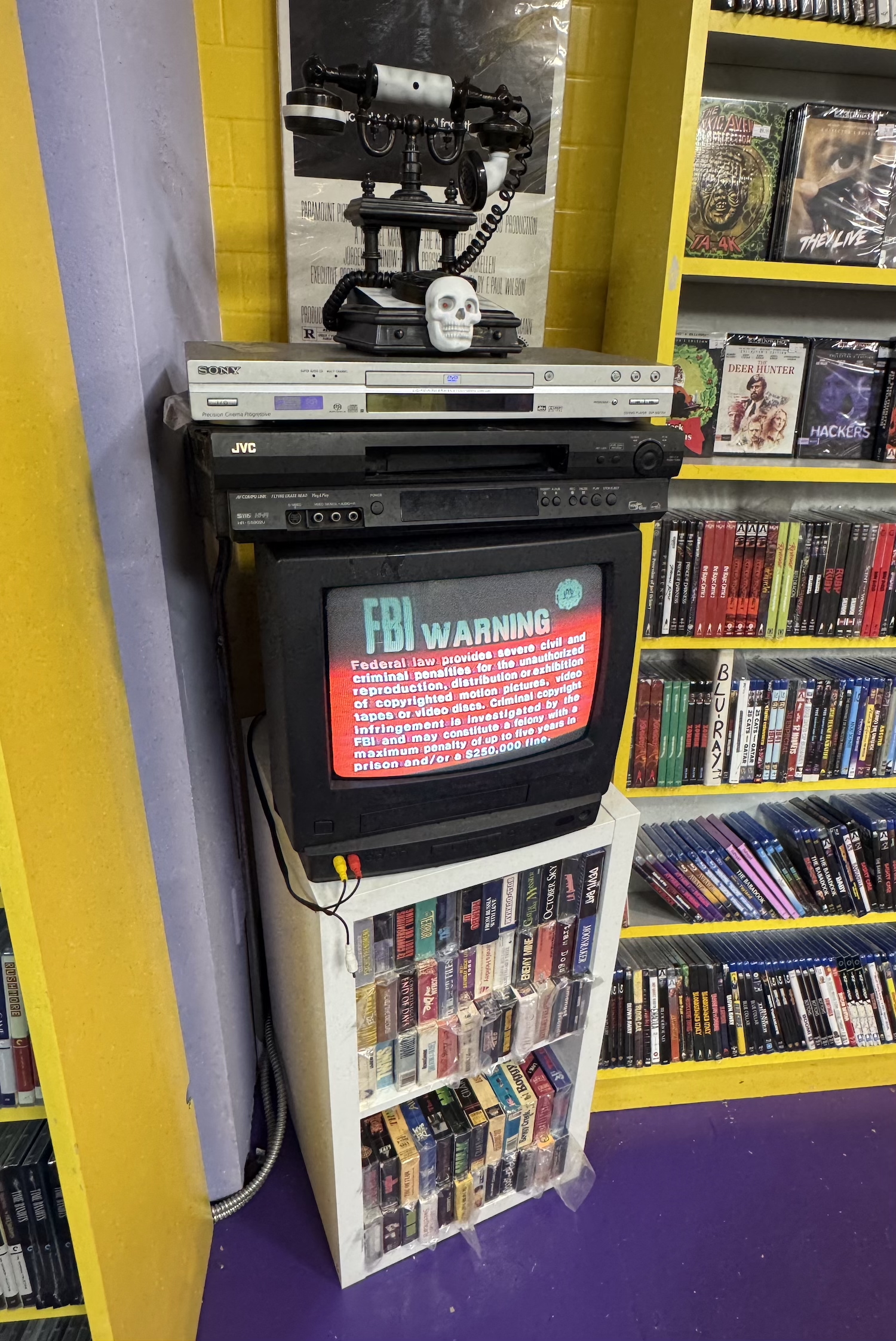
Photo by Abe Beame
Around the corner, on Grand St., there is also an emergent sub-district noteworthy even in a neighborhood as quixotic as Williamsburg. It consists of a horror book store, a tabletop game shop, a pinball bar, a skeeball bar, and a video store called Night Owl. This physical media corridor makes sense in a part of town that has long been a haven for vintage store shoppers and bespoke fetishists, but comes along at a moment in history in which its many independent proprietors represent a poignant trend of parallel thought. They are intentionally pushing back against the digitally mediated realities of modernity, demanding a more traditional and “authentic” relationship with human beings and the art we make. “When Twisted Spine [the aforementioned horror bookstore] opened, we talked amongst ourselves and started calling it ‘Analog Alley,’” Night Owl co-owner Aaron Hamel tells me over the phone in December.
Like many nerds of a certain age, I once had a large DVD collection to complement my large book collection. At a certain point, as my life and family grew, I “had” to decide whether I wanted my limited shelf space dedicated to paper or plastic. The books won out. I confess this personal history because I’d guess others share a version of it, who heeded the siren’s call of streaming in the 2010s, who thought we’d cut cords and all live in a better, cheaper world unburdened by the clutter of our collections, that the entirety of film history could live more comfortably and on demand in our laptops and flatscreen televisions. I left many of my DVDs on the curb, thankfully stored a second tier of my collection in taped shut wine boxes, and reserved a precious few of the best films for a small shelf that was more like a mounted buck’s head in an avid hunter’s study than a functioning film library.
We all soon discovered streaming was not quite the Narnia we were promised. Streaming channels proliferated, then shortly thereafter, quality went down, ads appeared, and subscription fees went up. Transfers of film and TV series, compressed and streamed digitally, can run the gamut from “poor” to “laughably fucked up,” with entirely misletterboxed (not to be confused with Letterboxd) aspect ratios. I’m not one of these “they botched ‘the blues’ on this 4K” types, but we learned how temporal the exhibition rights of films on streaming sites can be. The “permanent ink” of the internet turns out not to extend to movies, where every title is ephemeral. Staples of American popcorn cinema you’d think wouldn’t be hard to stream disappear regularly, and when I had screening-related assignments for work, more and more I found myself turning to an old friend, 123movies and pirate sites like it, out of necessity.
New York doesn’t have a miraculous resource like Amoeba, and the days of big boxes like the Union Square and Times Square Virgin Megastores—the types I used to relish spending hours in walking the aisles, running my hands over the plastic as if in a field of wheat, weighing DVD boxes and rap jewel cases and debating what I’d cobble together allowance to check out—were long gone. Multi-hyphenate businesses like the bar, rental store, and screening space Videology, formerly of Williamsburg, are gone. It seems impossible it was this long ago, but in 2014, we even lost Kim’s Video, a utopian haven for film organized on the shelves by an auteur that lived alongside rows of used CDs, records, and tapes for sale. For a time, it felt like the entirety of New York City was without what was once considered a bare essential consumer commodity necessary in the most basic suburban mall. That’s where Night Owl Video came in.
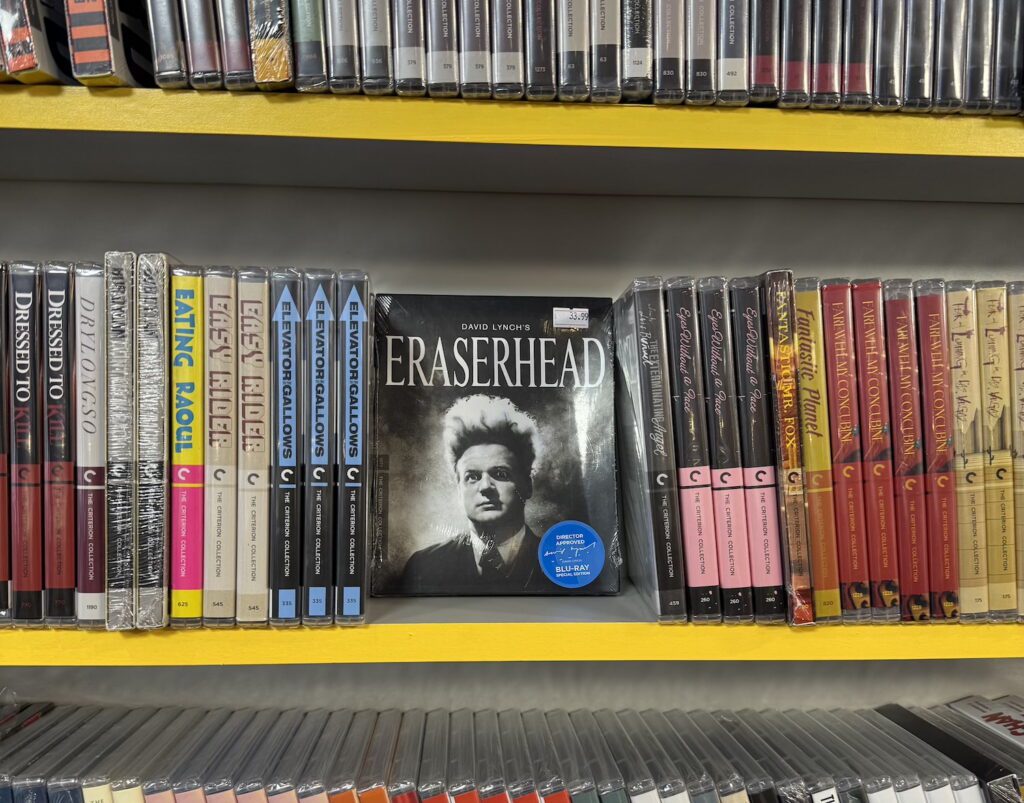
Photo by Abe Beame
If there is such a thing as a perfect resume for a video store owner, Aaron Hamel has it. He got his start in film working as an intern for the famed grindhouse studio Troma while still in university at Michigan State. Hamel parlayed this experience into a proper job, working as an Assistant Director and co-writer of Return to Nuke Em High Volume 1, an exploitation picture that sounds like The Toxic Avenger mixed with Dawson’s Creek and The Wachowskis’ Bound. From there, he went to the streaming platform FilmRise in 2013 as a creative director, still in the early days of streaming, which is when he met his business partner-to-be Jess Mills, but had launched a record label as a side hustle with two other Troma interns.
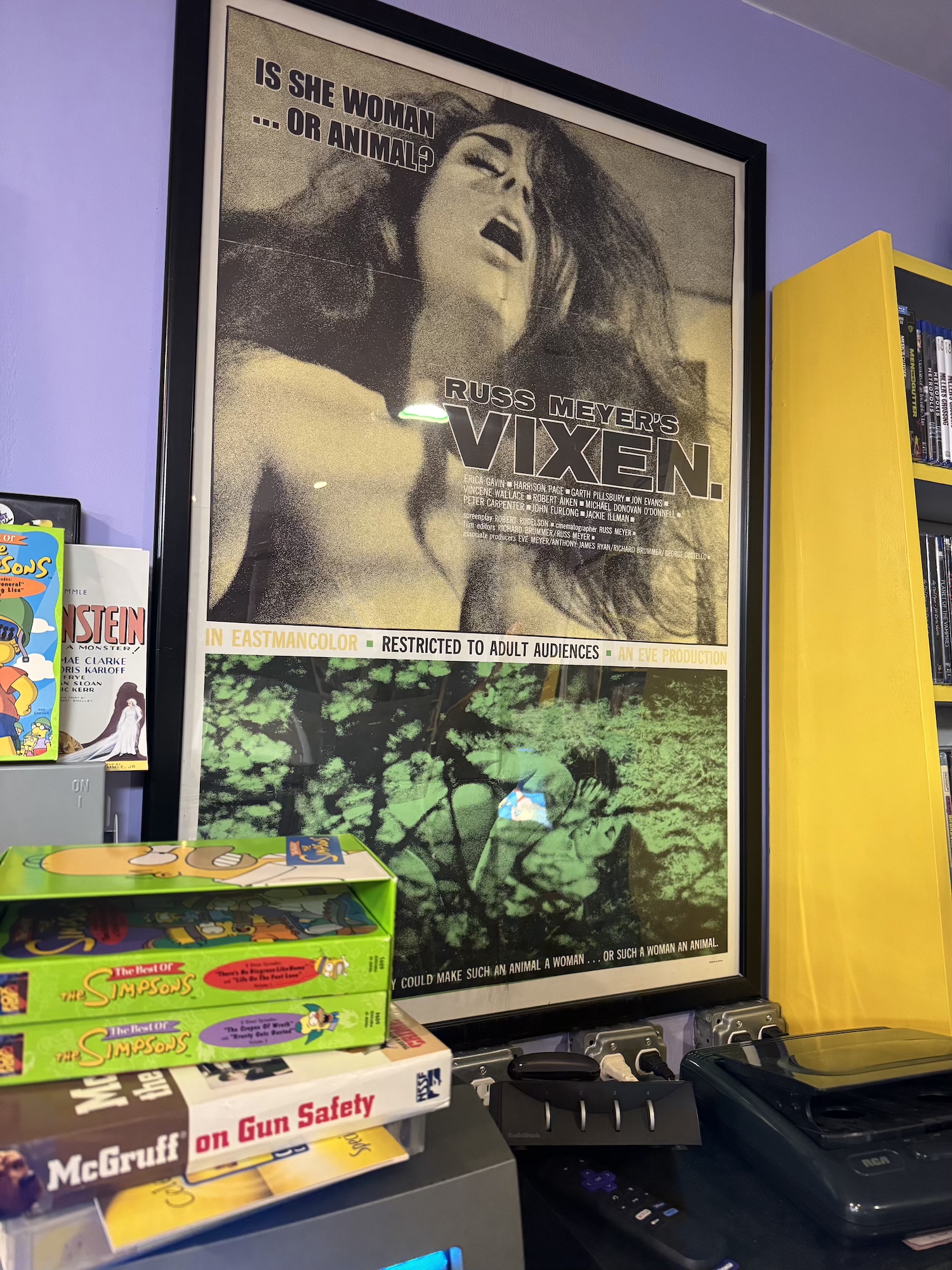
Photo by Abe Beame
Hamel’s record company, Ship to Shore PhoneCo, made its name with physical media. They released other types of records, but their niche was releasing video game soundtracks on vinyl. “That was my first introduction to what a big fucking scam streaming is,” Hamel says. “We would get the reports from our aggregator, and you would see you were getting less than $10 off a song that had been streamed thousands of times. We made a lot more money printing our own records, so I never understood that business model.”
After 10 years, Hamel sold the label, reconnected with his Troma co-worker Mills, and together they applied their hard-earned pragmatism to a shared love of film in the form of Night Owl, which has been a hit out the gate. “The goal for a lot of these companies is to devalue the art into nothing,” Hamel says. It’s a few days after the sale of Warner Brothers to Netflix is announced, and later that night, Hamel will be presenting Return to Oz, Disney’s infamous 1985 swing at a Wizard to Oz sequel, at the Williamsburg branch of the Nitehawk theater mini-chain.
The future of Warner’s library, in terms of both retail media releases and repertory offerings, is very much uncertain, as is seemingly the entire Hollywood studio system. An acid-tipped edge of jaded anger creeps into Hamel’s indictment of the culture that enabled Netflix’s rise, and makes a store like Night Owl so important. “The promise of streaming sounds great, but I think, in practice and in its impact on the consumer, it’s like you have everything, so nothing has any value to you personally,” Hamel says. “And I think that stems from cues we’re getting from these platforms. The goal is producing this content quickly and cheaply, and the quality of it doesn’t matter as much as the fact that you have it in front of you. There’s no such thing as discerning because they’re not discerning themselves. They don’t care about the integrity of any of this.”
Hamel and I are two guys old enough to remember a time before all of this sobering, apocalyptic shit, who either had or have film and record collections as well as the memory of what it was like going to a physical media store, and the pleasures that come with that experience. It’s value that extends beyond the discs you walk out with. You might expect a store with an “antiquated” concept like in-person retail selling “outdated” and less convenient technology to operate as a kind of echo chamber for us and people like us, a kind of retail museum/mausoleum in the Carousel of Progress catering to elder millennials. What Hamel finds both surprising and inspiring is that, a year into the business, his clientele isn’t confined to old cinephiles with disposable income to blow on 4K steelbooks, and, in fact, Night Owl would be in trouble if that were his entire base of support.
“Younger people, they’ve grown up with nothing but a digital life, and they see these physical things and they love them and they want something they can touch and feel and experience,” Hamel says, blaming the streaming era’s paradox of choice for inadvertently creating the need for his business. He makes the connection many have, as this return to physical media has ramped up, to the vinyl revolution that occurred several decades ago, after technology had allegedly moved “past” the format. He sees parallels in the room tone and hiss, the tactile qualities in vinyl that can’t be replicated by a digital experience, playing out in the way younger viewers appreciate VHS. “There’s a sort of murky quality of VHS that makes watching movies like The Blair Witch Project impossible to replicate on a pristine Blu-ray or through a streaming platform. There’s a certain aesthetic quality to VHS that I think that younger people have really latched onto.”
Since Night Owl opened, they have had to expand the split shelving space for VHS, which, by sales volume, makes up “30-40%” of their total business. The prime VHS demographic is made up of younger customers, drawn to the wallet-friendly price point of old, used video tapes, and perhaps, a retail and screening experience you can’t dial up through your phone.
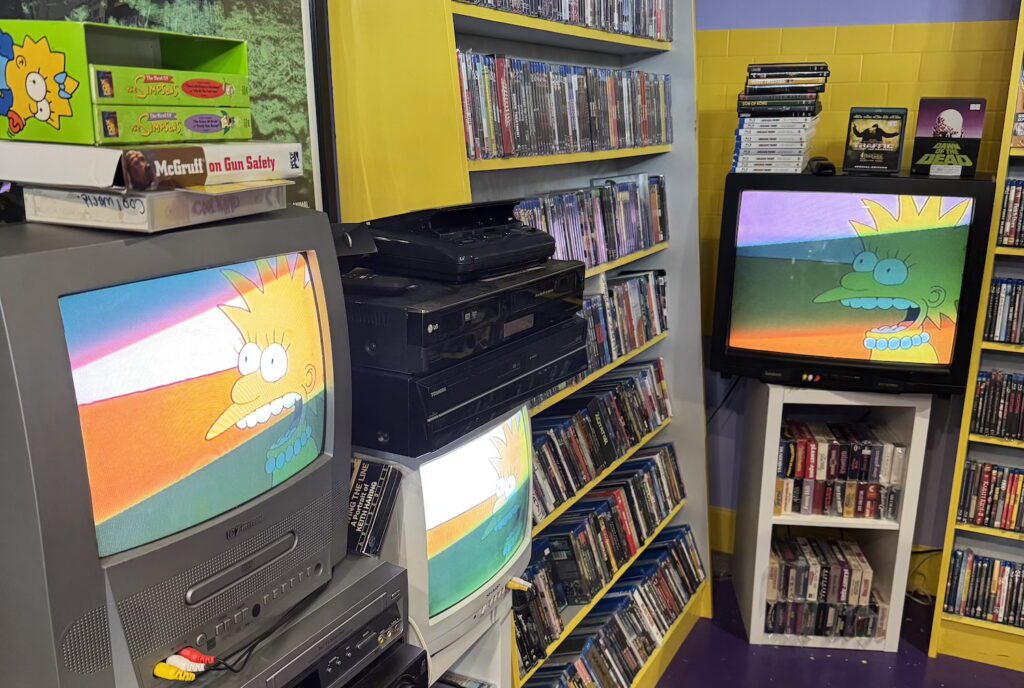
Photo by Abe Beame
When I walk into Night Owl, I am immediately struck by the genius branding, which identifies royal purple and gold as the platonic ideal color scheme and aesthetic for an imagined, eccentric early 90s indie video rental store in a small town, the specific sort of business and industry destroyed by streaming. The store is similarly artfully chaotic in the manner those stores once were. A stack of old boxy televisions balanced on top of one another plays Simpsons episodes on a compilation VHS, as they were in the mid 2000s in video stores, when whole seasons of the show were released in wildly popular multi-disc box sets. It’s a Criterion Closet that has been blown out and reorganized with omnivorous taste, a seamless blend of cultured film aesthete porn counterbalanced with absolute sicko shit.
So, an $85 Ti West Maxine Trilogy collector’s set is shoulder-to-shoulder with The Complete Neon Genesis Evangelion and a John Ford at Fox boxset and Lubitsch musicals and a Michael Haneke boxset, and, for whatever reason, Alex Winters’s Freaked 4K steelbook. There are stacks of Leonard Maltin’s movie guides, packs of The Rocketeer trading cards and Robocop 2 trading cards and Who Framed Roger Rabbit? trading cards. There are standees for Nightmare on Elm Street 5: The Dream Child, The Last Temptation of Christ laser discs, canvas totes featuring a portrait of Fancois Truffaut and renderings of scenes from his classic films, a hanging rack of movie shirts with Night Owl merch mixed in, and vintage $125 Japanese horror movie posters in giant plastic sleeves hanging from a rolling garment rack.
My visit coincided with a pop-up run by Vinegar Syndrome, the beloved film distribution and restoration company named after the deterioration effect that occurs organically to film over time. A table is set up at the front of the store, the archivist and curator Justin Laliberty, who serves as a producer for the company, is selling handsomely produced discs hand-to-hand. It is yet another example of the masterful job Aaron and Jess Mills have done identifying similarly passionate businesses and companies that are aligned with theirs ideologically and working together for in-store promotions and offsite events they don’t make any upfront money on, that short-sighted marketers and operators might turn down, because they can’t see the inherent long money, brand-building upside.
It is difficult to distinguish staff from customers. All 20-ish odd nerds awkwardly navigating around each other in the narrow aisles of the store at any given time during my visit have the same general style of dress and comportment, perhaps best articulated by those novelty, simultaneously academic and deeply unserious shirts they sell at IFC, with the names of great directors from the history of world cinema assuming the form of iconic heavy metal band emblems. They are all curious and meticulous shoppers, going through the dense stacks title by title, looking for steals and weighing splurges, searching for nothing in particular and considering everything.
I quickly found a disc I had been looking for as research and its accompanying Director Commentary-the type of feature that even in the best days of streaming, never made the leap to digital- but I was also researching a Jim Jarmusch piece at the time, so I wanted to buy some of the indie deity’s work. The store didn’t have what I was looking for (Patterson and/or Only Lovers Left Alive), but my fruitless pursuit was a reminder of the disappointment of the finite in-person experience (and the sentimental value it adds to eventually tracking down the item you’re looking for, that you can’t just click on), as well as the discreet joy of discovery in an aimless retail experience when you don’t have much in the way of a firm idea of what you want. It’s the ideal time to take a swing on a film you’ve never heard of before from a director you love or unearth a long-lost classic you didn’t know you desperately needed until you’re reminded it exists—two experiences I find I rarely encounter via algorithm. I ended up with the Criterion edition of Mystery Train (and a wonderful Dennis Lim essay on the film I ended up stealing a crucial concept from), and a Criterion Edition of Hollywood Shuffle I may or may not get to write about someday.
I spent more money than I had intended, but was happy to part with a decent chunk of what I’m getting paid to write this, excited by the old rush of a haul, a brown bag filled with discs to add to my regenerating library, and new movies to throw in my DVD player when I got home. It pains me to report they looked and sounded far superior to their digital counterparts.