Photo by Al Bello via Getty Images
It’s Dëmin Time for The Brooklyn Nets
The rookie guard, perhaps the most highly regarded prospect in Russian history, approaches his on-court growth with the doggedness of a Soviet chess prodigy
With about two minutes left in an ostensibly meaningless early January bout with the Orlando Magic, Brooklyn Net Egor Dëmin stepped over a screen and into a thirty-foot three-pointer to narrow the Magic’s lead to one possession. It was an amnesiac pull, the sort of shot that suggested the Russian teenager had awoken seconds prior, with no memory of the thus far cold shooting night in which he’d missed all four field goals he’d attempted.
For Nets fans, who have come to read Dëmin’s performances over the first half of the NBA season like tea leaves portending the franchise’s future, the basket was more evidence that the lanky rookie has a penchant for rising to big moments. The barrage of three-pointers that followed—shots that forced overtime, banked off the glass to take the lead, sailed from near the logo, and sent Barclays Center into its loudest non-Liberty-related frenzy in half a decade—became tarot cards for increasingly unhinged prophesizing. To watch the buzz-cut guard prance around the court flexing was to feel that the Brooklyn Nets may have—for the first time since moving to Downtown Brooklyn—drafted a prospective star. Days later, Dëmin memorialized the coming-out party with an Instagram slideshow set to Natasha Bedingfield’s duet with Sean Kingston, “Love Like This,” which was released when he was a year old.
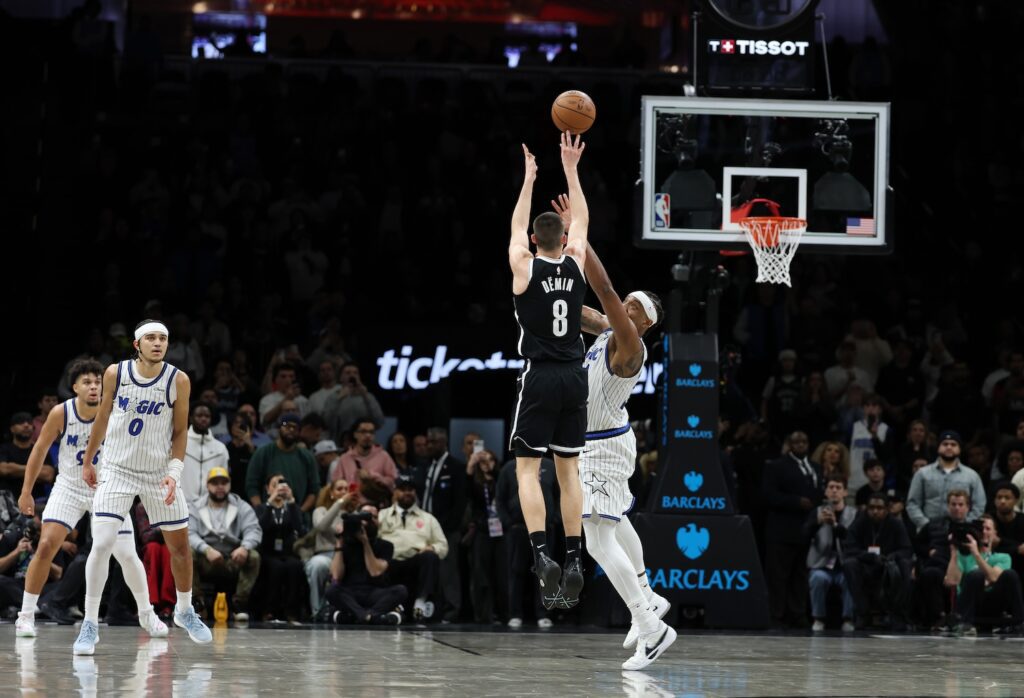
Egor Demin scores and puts the Brooklyn Nets ahead with seconds left in overtime against the Orlando Magic (Photo by Al Bello via Getty Images)
Since making their two-river move from the Meadowlands to Flatbush over a decade ago, the Nets have gone about their most important existential goal—building a rooted, invested, and organic fanbase in the shadow of Madison Square Garden—indelicately.
The story bears all the hallmarks of Greek tragedy, one in which rising hubristic ambitions repeatedly beget seemingly intractable falls. Since 2012, Nets fans have rooted for castoffs, developmental projects, past-their-prime legends, and in-their-prime Hall of Famers. To the extent that a common thread binds these disparate characters, it is that they are not in Brooklyn for long. Change, at Barclays, as in life, is inevitable. The longest-tenured Brooklyn Net in franchise history, the springy, 26-year-old Nicolas Claxton, is only in his seventh professional season (the great Brook Lopez played his first four seasons in Jersey). This cycle of player, coach, and directional churn has frustrated existing fans and stymied the meaningful acquisition of new ones. It’s hard enough for a tree to grow in Brooklyn without its soil being replaced every six months.
If the Nets’ organizational strategy over the past year—tearing down their roster, re-acquiring their loaned-out draft picks, hiring the young coaching mastermind Jordi Fernández, and selecting five players in the 2025 NBA draft—signals anything, it’s that Brooklyn has recognized the virtue of building slowly and sustainably, as it once did in the wreckage of their infamous Celtics deal. It’s within this context that Egor Vladimirovich Dëmin has come to serve as both avatar of and referendum upon the organization’s about-face. Watching Dëmin, whose selection with the eighth pick prompted near-universal derision across the NBA and its commentariat, feels, fairly or not, like grading the decision-making capacities of the entire franchise’s front office. To the surprise of many a jaded Brooklyn Nets fan, it has been—thus far—a complete delight.
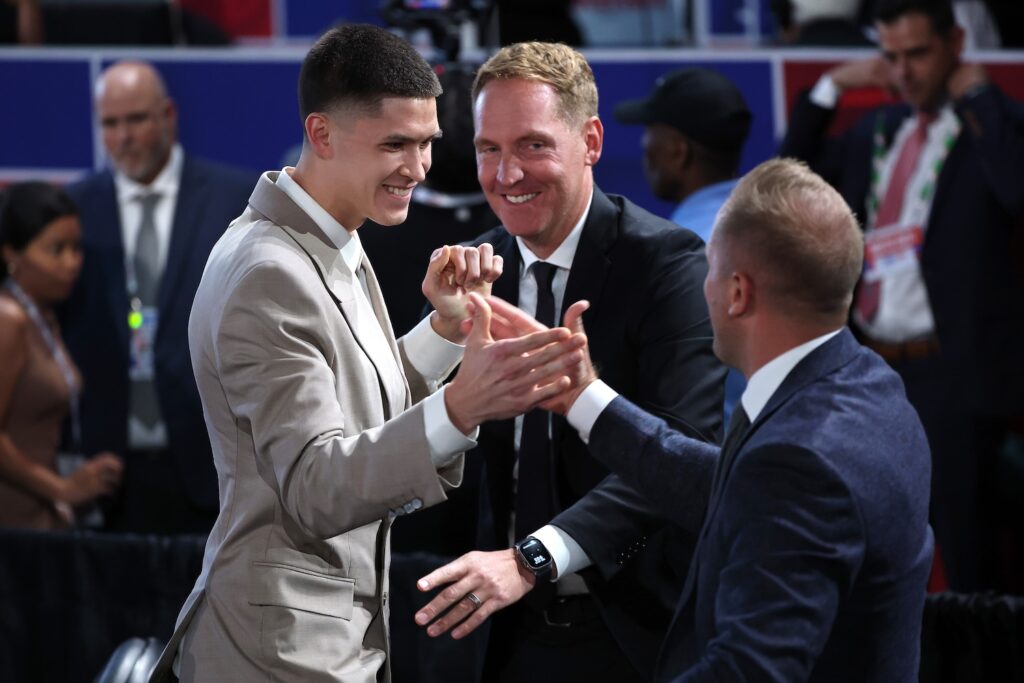
Photo by Sarah Stier via Getty Images
Though the Nets have not drafted shabbily since their move to Brooklyn, finding genuinely productive late-draft gems in the likes of Jarrett Allen, Caris Levert, and the aforementioned Claxton, Dëmin’s selection marked the first time that the black-and-white Nets picked in the top half of the NBA lottery (and their first lottery pick for the franchise since Derrick Favors was taken by New Jersey 16 years ago). In Dëmin, the team is finally tasked with nurturing a top rookie talent, challenging a player-development philosophy that has long resembled archeology. In other words, for Nets fans—relatively unfamiliar with watching prized young players grow in real-time—it was probably inevitable that the experience would feel foreign. But it is not just the novelty of investing hope in a teenager that has rendered The Dëmin Show so psychedelic.
The guard, who is perhaps the most highly regarded prospect in Russian history, approaches his on-court growth with the doggedness of a Soviet chess prodigy. Born to a pair of Russian hoopers at a pivotal juncture where Russian basketball was shifting stylistically from Andrei Kirilenko to Alexey Shved, Dëmin developed his game at the Moscow Basketball Academy before shipping off to Spain at sixteen to play for Real Madrid’s academy team. Rather than accept a contract with Real Madrid’s club team (which famously produced another supersized, young Slavic guard of a considerably wider frame in Luka Dončić), he opted to play a year of college ball at Brigham Young University instead. Dëmin overcame linguistic, religious, and cultural shocks and excelled early in his first season at BYU (he has spoken glowingly of Utah, comparing it to his home country), before a combination of injuries and legitimate competition slowed him down. At the end of his year in Provo, the scouting report billed him as a prodigious passer, whose struggle to create his own shots and make open ones considerably capped his ceiling.
But in his first season in the NBA, the wing-sized guard has been a lights-out shooter from beyond the arc (As if addressing this perception, his Instagram handle is “@3gorr”). If anything, the most salient critique of Egor-ball is that he takes too many three-pointers (his preference for the long-ball is such that it took him five full games to take a shot within the arc). His much-touted creation has shown itself in spurts, even as the ostensible point struggles immensely at, well, dribbling the basketball. And yet, Dëmin’s mere presence on the floor increases the team’s three-point rate tremendously. When he doesn’t launch his own long ball, he spreads it around to his teammates. Such is the Egor Dëmin developmental arc, which one cannot help but imagine is influenced by his father’s almost parodically Russian dispassion when analyzing his son’s shortcomings. Vladimir Dëmin once claimed to follow mock drafts “calmly…like an attraction, a game,” that provided objective indicia of his son’s areas of need, before adding “miracles don’t happen.”
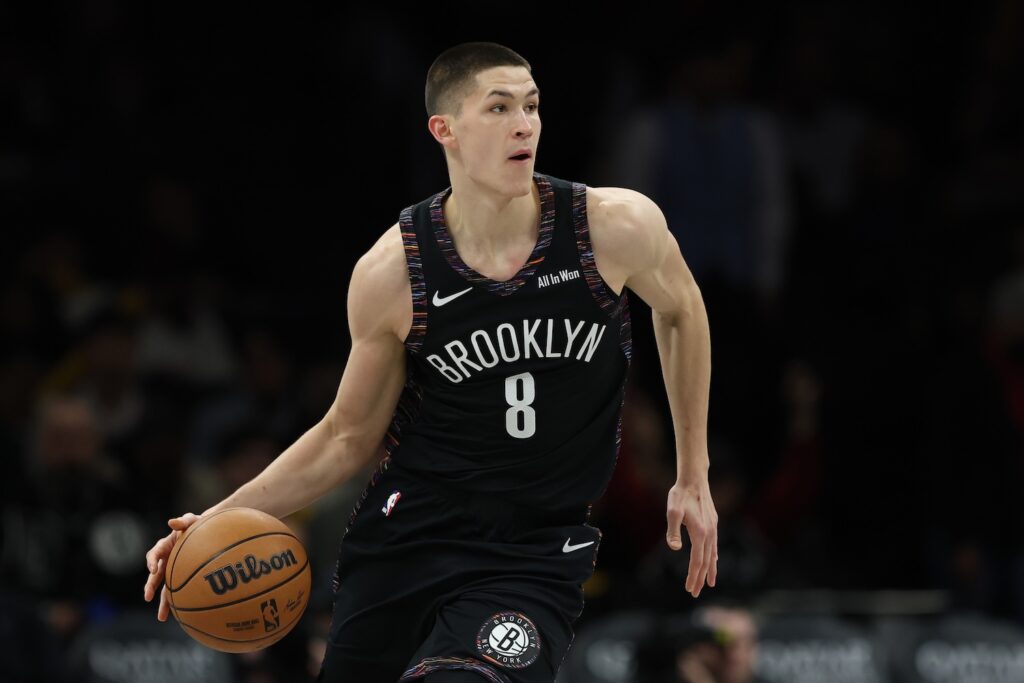
Photo by Sarah Stier via Getty Images
Following the string-beany, six-foot-eight Muscovite this season has become as joyous as it is nonsensical. That a guard prospect should count “dribbling” among his top areas of growth seems almost fundamentally disqualifying for his prospects at stardom. But there is something about the kid—maybe it’s his unique fashion sense, his self-evident work ethic, or a precise awareness of his weaknesses and developmental goals—that is equal parts endearing and addictive.
Up close, the proposition is even more confounding. Only in person can one come to fully appreciate how the gangly guard, who more often than not measures a head taller than the man covering him, bounds Bambi-on-ice-like around the perimeter in search of a roller or shooter. He plays with a mischievous smile, evoking Mark Eydelshteyn’s Igor in Anora, his progenitor and spiritual North Star, as it relates to lanky Russian teenagers inheriting Brooklyn as their playgrounds, lording over the court like a night at Tatiana in Brighton Beach with a limitless Black Card. It simply doesn’t compute how a player so raw, incomplete, and incongruous has the power to snap the Nets’ offense into coherence. He is simultaneously the smirking teen, who seems delighted to be living out his and his father’s dreams, and a heavily accented, deeply analytical pupil of the game, discussing and dissecting developmental milestones the way a piano virtuoso would while mastering the Goldberg Variations.
Perhaps the energy is best boiled down by the first great meme of the new-look Brooklyn Nets—an image of Dëmin’s face inside an infinite loop, cycling through “Being dope, having fun, chilling, and smiling.” These are not individual phases for the 19-year-old, but states he inhabits perpetually, and all at once.