Photos by Javier E. Piñero
How Alifax Mentor is Beating The Odds and Honoring Haiti at Lakay Bistro
The improbable journey of Lakay Bistro and its owner, who flipped a bleak diagnosis into a new beginning in Bed-Stuy
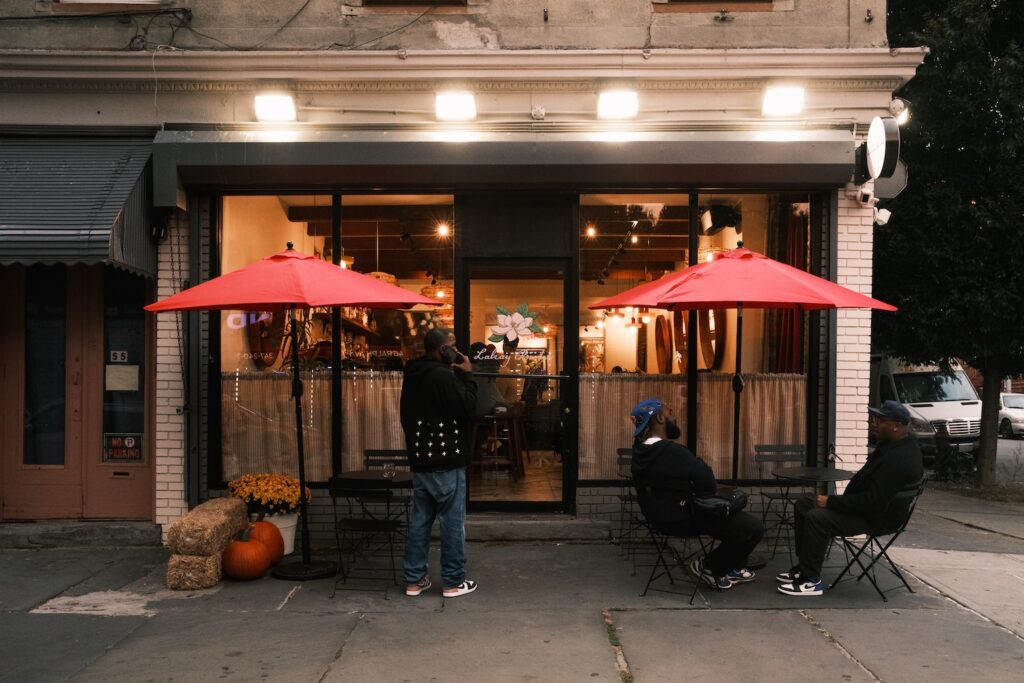
When the Brooklyn-by-way-of-Haiti raconteur-turned-restaurateur Alifax Mentor received his diagnosis of stage IV colon cancer, he did the only thing that made sense to him, and dedicated his life to the work of opening a restaurant in Bed Stuy. The restaurant, Lakay Bistro, at 55 Ralph Avenue, is a tribute to the food Alifax and his friend and business partner Steven Osiasin came of age eating in Haitian and East Flatbush kitchens. The business they have opened is also tribute to the country where they settled and had their families and lived their lives, a tribute to the familial sense of Haitian hospitality fostered in a foreign country where they had little else besides community to support them, and in Alifax’s miraculous two-year journey—to open Lakay in the face of odds his doctors might not have bet on in their private moments—his restaurant is a tribute to the human spirit.
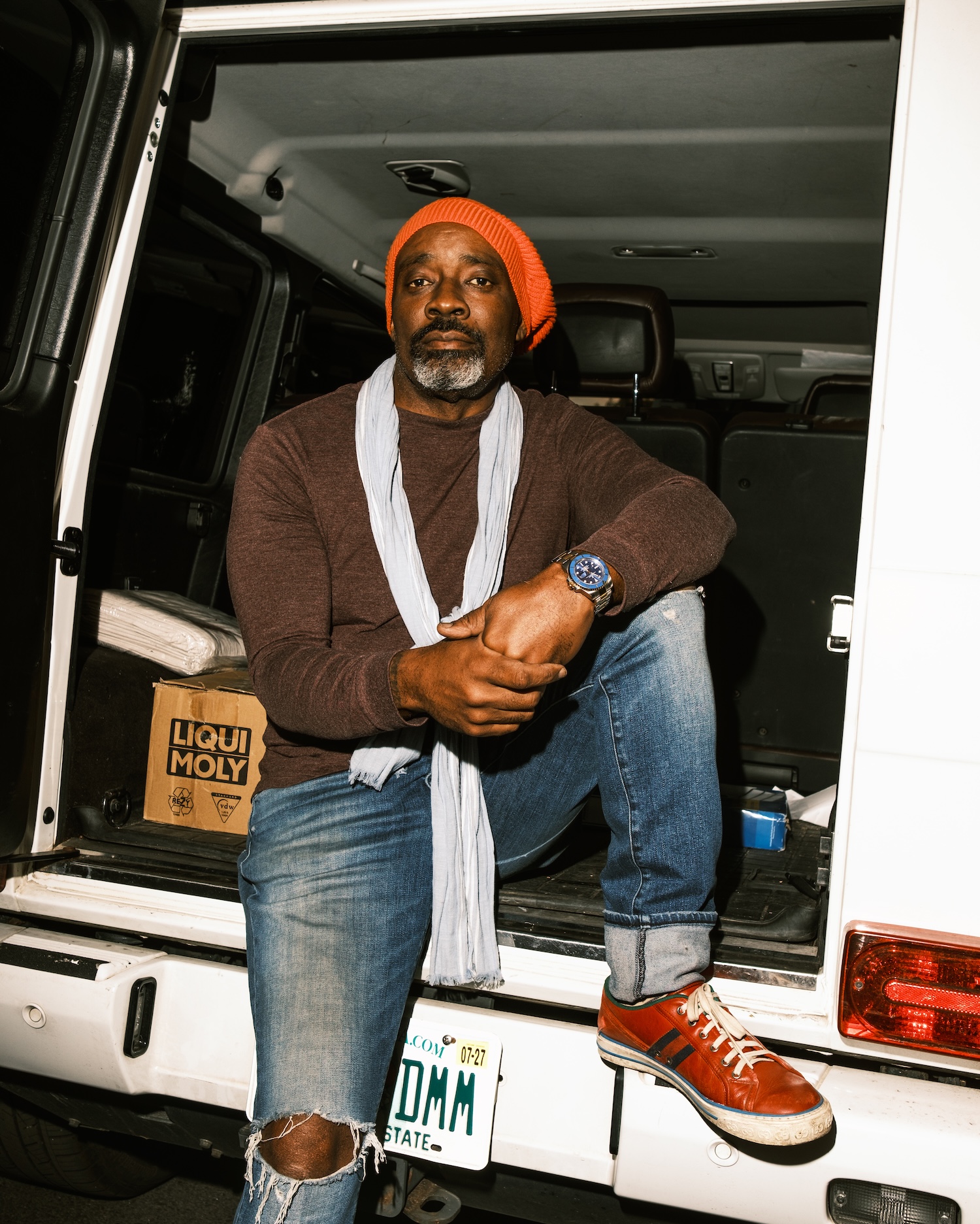
Alifax Mentor, co-owner of Lakay Bistro (Photo by Javier E. Piñero)
“This is my therapy,” Alifax told me over the phone from Lakay, on the precipice of soft opening several weeks ago. “90% of the time, after treatment, it gives me motivation to move forward. The more I see things moving forward, the more it blocks out what’s going on with me.”
Alifax was and is in great shape. Regular exercise and a healthy diet have kept him trim, and, like so many Haitian men, aside from a touch of snowcap on his goatee, his unlined face presents much younger than one belonging to a man in his 50s. Doctors had told him he was in peak health, but there was a colonoscopy on the books because his father had passed away from colon cancer. He put off the appointment for a trip to Barcelona, but, while overseas, began to feel an abdominal pain he could only compare to the time his appendix ruptured. Upon returning to America, he immediately checked himself into a hospital in Brooklyn, where doctors found five tumors on his liver. One was the size of a tangerine. At the time, he was developing a plan to open a cafe in St. Lucia, where he traveled often and owned property. When he realized treatment would require him to be based in America, those plans migrated back with him to the borough he landed in as a teen.
Alifax, or “Ali” to friends and intrusive Brooklyn Magazine reporters, was born in Anse-à-Veau, a countryside commune in Haiti on the southwestern tip of Hispaniola, and immigrated to New York at 15, attending high school at Erasmus Hall on Flatbush, where he learned, and quickly, why Haitians arguably had the most difficult slot in the hierarchical pecking order of ethnic identities in the Brooklyn public high school ecosystem of the 1980s.
He didn’t speak much English, and the cousins who gave him a place to stay didn’t speak much Kreyol. For the many born in Haiti who had arrived in the states as adolescents, like Ali, their accent was foreign even to other Caribbean kids who came from former British or Spanish colonies. Fair or not, their cuisine historically lacked the accessible wedge items—Caribbean foodstuffs like beef patties, doubles, and rice and beans—that endear and render these cultures legible to outsiders. Platters of fried pork and black rice and pikliz simply don’t travel as seamlessly as a baked clamshell of smoked and grilled chicken. “We was always different, even among Black students, even among Trinidadians and Jamaicans, because of the language barrier; there was a divide. It was difficult because even still, there’s a stigma with Haitians, like it was like the world was against Haitian young men. You’re always in survivor mode because everybody is trying to pick on you. You always got to find a way to get away from a fight, or you have to fight sometimes,” Ali said.
Perhaps this at least partially helps explain why, from the 80s through today, the Haitian restaurant scene has lagged just behind its Trini and Jamaican counterparts in Brooklyn’s Caribbean restaurant industry. Steven and Ali echoed much of my anecdotal research over the years, talking to Haitians in Flatbush who agreed that going out for Haitian food was rare. For decades in Brooklyn, it was a cuisine that lived primarily in the kitchens of houses and apartments in Caribbean enclaves, served out of tinfoil steam table pans that fed revelers at the weddings, birthday parties, and rent parties where Ali used to ply his trade, as an East Flatbush kompa DJ who called himself Fax International.
(Photo by Javier E. Piñero)
But Lakay Bistro is opening in a New York food scene greatly changed; a kind of Caribbean food revolution, led by hipster West Indian clubstaurants like Miss Lily’s proliferating in the toniest Manhattan neighborhoods. Haitian staples like black rice have entered the pan-Caribbean lexicon in fusion spots like Williamsburg’s trendy Kokomo, and annoying transplants in Flatbush can confidently distinguish salt fish from herring in tiny, delectable, croissant-like Haitian patties. An entire spectrum of Haitian restaurants can now be found between Manhattan and Brooklyn, across price points and styles of service. The all-day cafe Lakou on Utica in Crown Heights serves vegan-friendly, Haitian-influenced breakfast options alongside cremas cocktails at night. Over on Rogers Avenue, Joenise feels like walking into a friend’s apartment to grab a plate from their gifted aunt for lunch, while down the hill, DjonDjon sells steamed mussels, chiktay, and a $20 pork griot sandwich on a Nostrand block lined with drum smokers. “Haitian food is on the rise right now,” Ali says. “Well, we’re always on the rise, but now it’s a trend, so our challenge is how to make it better, how to make it ours,” Steven adds.
A year ago, Ali had called Steven while he was praying, and asked if he could pick Steven up and bring him to a former barbershop on Ralph Avenue Ali had just signed the lease on. The two had met back in Ali’s DJ days and had been friends for over 30 years. Steven was an assistant director at Kings County Hospital at the time, but knew he was about to retire, and was unsure what the next chapter might look like. Ali explained his plan to convert the barbershop into what Ali believed at the time would be a coffee shop with a food menu. Steven had no experience whatsoever in the restaurant industry and was aware of Ali’s diagnosis, accompanying him to several chemo appointments. But Steven clocked the coincidence as divine alignment, an opportunity to take on a business venture at the precise moment of anxious uncertainty. “Immediately, I said, ‘Dude, I’m with it 100%.’ Doubt never crossed my mind. Having seen the courage and the strength [Ali] has had dealing with this [cancer], I don’t know where he gets it from, but, you know, God bless him,” Steven says. “His attitude, that was never a question, never on my mind.”
(Photo by Javier E. Piñero)
The morning I was supposed to visit Lakay Bistro for the first time, Ali was at Sloan Kettering in treatment. He hadn’t felt well and rushed in to make sure there were no new or concerning developments. Ali’s cancer has been in fairly steady remission that has defied statistical reason, but treating cancer, even in a best-case scenario, isn’t linear. He’s currently back in chemo, and every time there is a CT scan, for the rest of his life, Ali will hold his breath, which is why the restaurant has been such a welcome, necessary distraction for the uniquely positive, goal-oriented, and gifted multi-tasker. The good and the bad of what can be an agonizing process of opening a restaurant in New York, worrying about dwindling budgets, about extortion masquerading as inspections, about staffing, about rent, is “all better than worrying about chemo,” Ali says. “When you’re frustrated, that means you’re alive.”
(Photo by Javier E. Piñero)
Ali’s 29-year-old son, Kristian Mentor, was born and raised in Canarsie. He is sharp and personable, and never learned Kreyol. “When I was growing up, there was a lot of guidance away from communal gathering and more of a focus on school. The message was clearly, ‘You should do everything you can to get out the hood,'” Kristian tells me on a Tuesday afternoon, several weeks into Lakay’s soft opening.
Kristian is part of a second generation of Caribbean kids who were raised by immigrants and, to varying degrees, encouraged to focus on assimilation rather than culture or tradition. The internalized trauma of classism and racism, and the many forms of oppression that came with it, were understandably received as warnings by many in the diaspora. Many taught their kids the values they believed best set them up for success in this crab barrel of a country. “There was a divesting away from certain elements of identity that happened for me and other kids like me, who grew up with different backgrounds,” Kristian reflects.
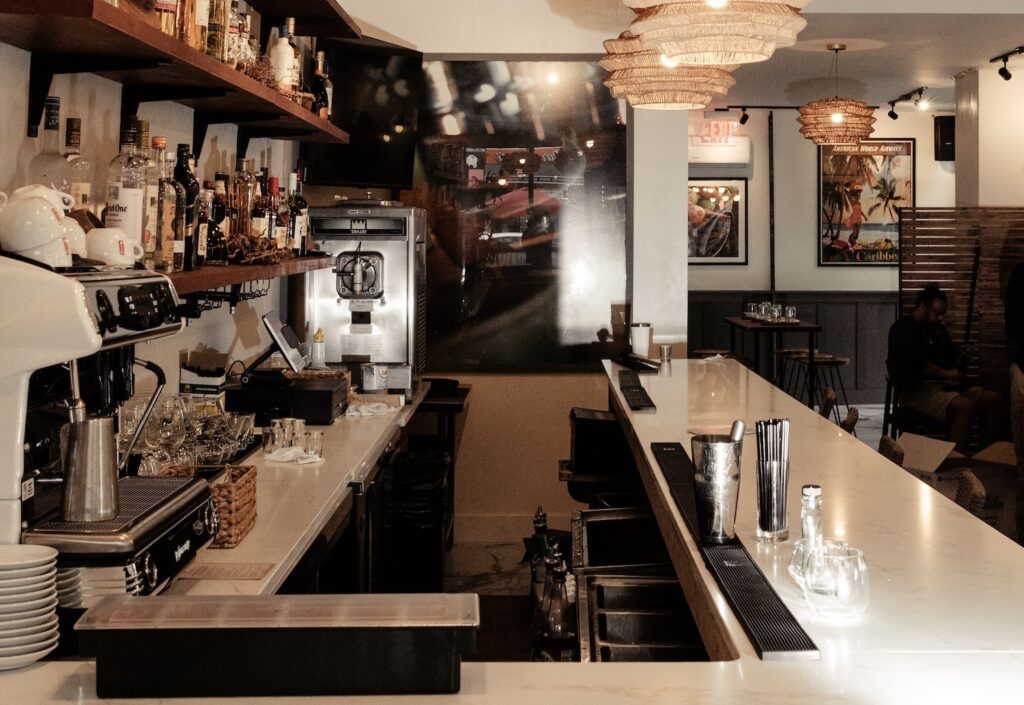
He’d discussed the restaurant with his father for a while, since before the diagnosis even, when it was originally intended to be based in St. Lucia as a journey they could embark on together. Kris was and is obviously concerned for his father, but has been amazed watching him continue his pursuit of the dream and has been incredibly proud of all he’s accomplished. On August 15th, he tweeted about the restaurant to his 3,000 followers, including a picture of Ali posed in the nearly finished space, and a framed illustration of Haiti on the restaurant wall. That Tweet has subsequently been liked nearly 40,000 times and made 1.6 million impressions, Ali told me, glowing with more than a little pride in his son.
(Photo by Javier E. Piñero)
I asked Kris why he thought his fairly innocuous Tweet had gone viral. “As a child of Haitian immigrants, I think there’s this sense of solidarity, especially among the Caribbean diaspora on the Internet, looking for something to rally behind, and I think in this case, this is a really cool thing to rally behind. Imagine being in your late-teens trying to find your own identity, and you’ve got every other person punching down on you in order to actualize themselves,” Kris says. He sees the overwhelmingly supportive response to Lakay as a kind of cultural reset, balancing scales that have been offset by American xenophobic bullshit for too long.
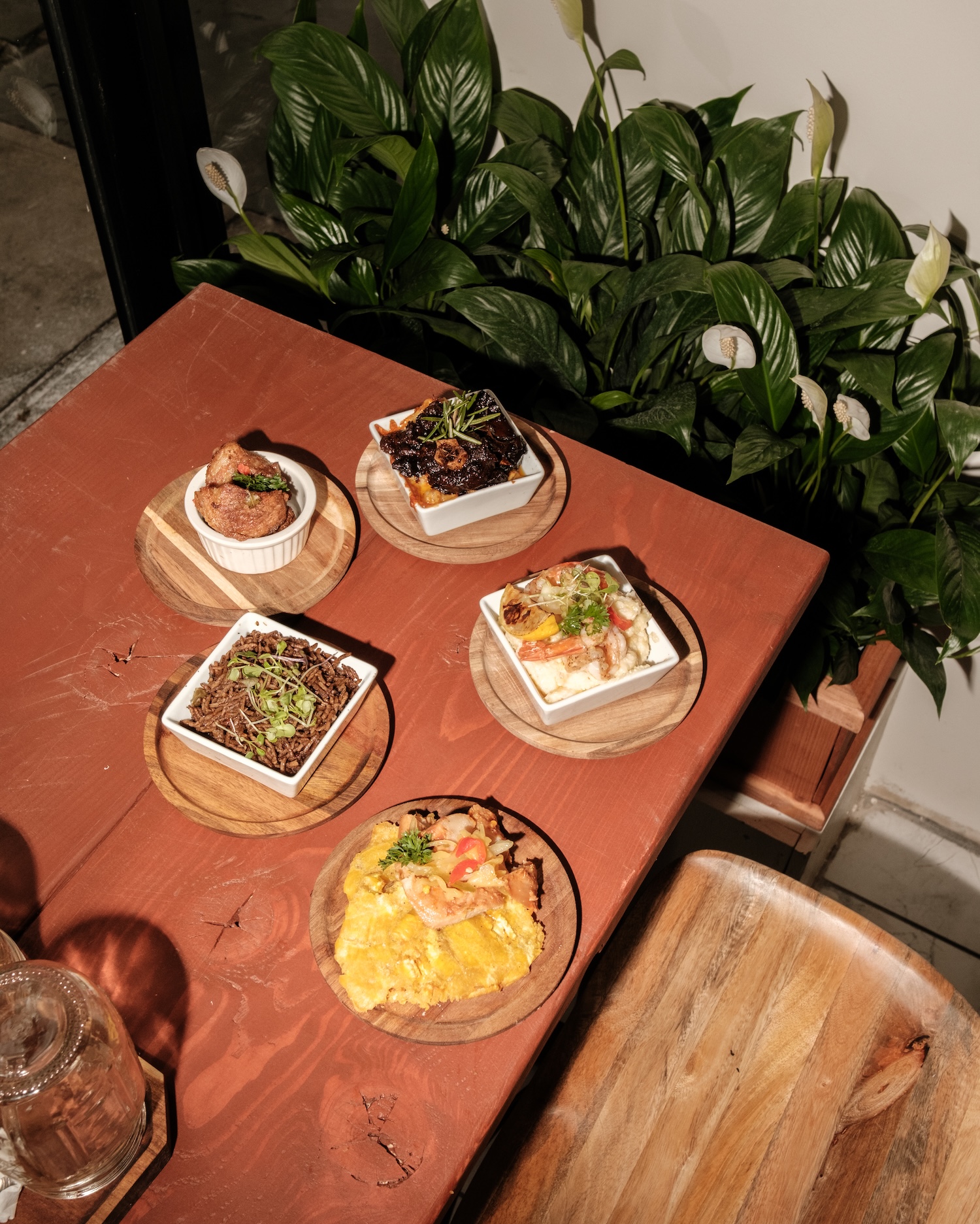
The spread during the soft opening (Photo by Javier E. Piñero)
During my conversation with Ali and Steven, the door was unlocked, and there were constant interruptions from would-be customers popping their heads into the under-construction space, hoping to grab a drink and/or bite. The Saturday night I stopped by just before close was the end of what had been a busy night, so it appears early on, the word-of-mouth campaign is working. It also can’t hurt that Ali and Steven have built a beautiful space that anyone would be compelled to check out if they noticed it for the first time in their neighborhood. “Lakay means home, my house, Steven says. “So it’s all about the ambience, you know? The atmosphere, where even if you’re not hungry, you’re going to stop in and have a drink, because I’m going to see Ali, I’m going to see Steve. A place for everyone in the neighborhood to stop in and say Sak Pase.” It’s a vision of Cheers with a Kreyol accent.
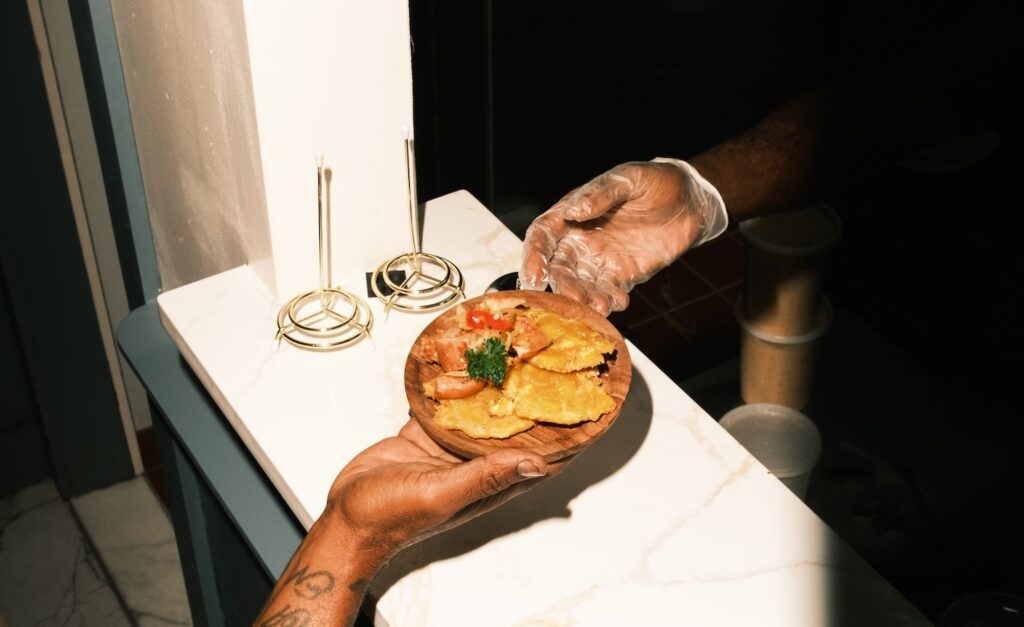
They are executing this by finding a cultural compromise in fusion, which Kris has been instrumental in helping them with, looking for seams in cuisine, the obvious shared African, Caribbean, and Southern American reference points Black American cuisine embodies. On my visit, very much in soft opening mode, kompa played as black rice went out alongside oxtail grits, fried chicken nuggets, and waffle shards, plantains, and bite-sized chunks of griot pork, all washed down with shareable sorrel-tinted cocktails, served in flask bottles and mojitos.
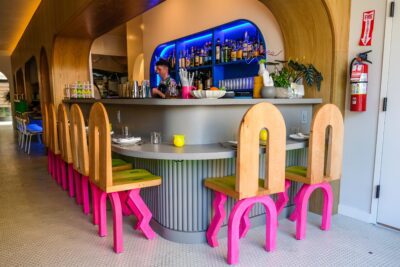
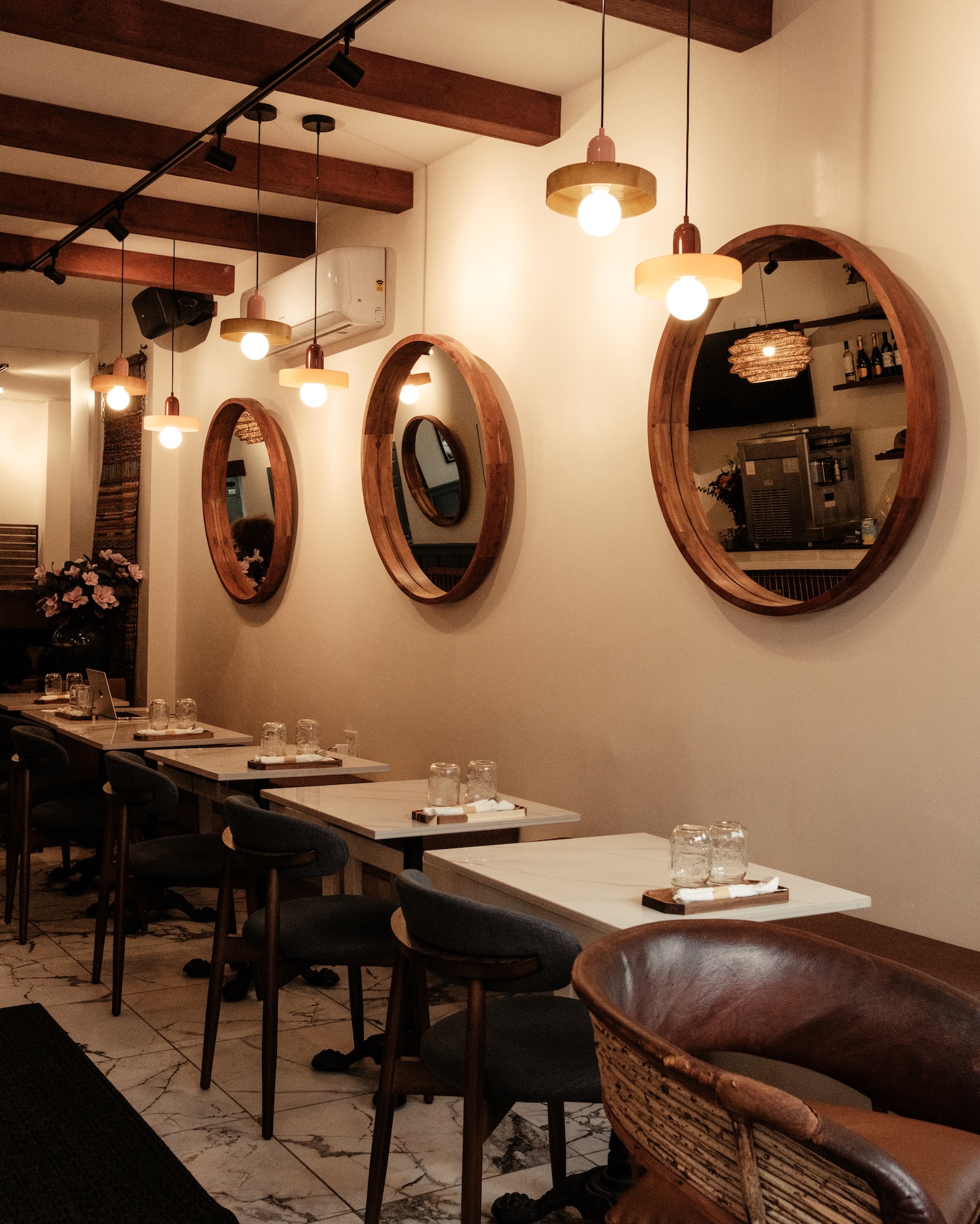
Midcentury and rattan pendant fixtures co-existed under a ceiling lined with exposed wooden beams. The frozen drink machine in one corner was spinning margaritas as the Celtics played above them on the flatscreen, and the water-fed La Spaziale espresso machine sat dormant in the other, waiting for the morning service to get up and running, when coffee will be served alongside patties from La Baguette, the legendary Haitian bakery institution on Church Avenue. We were assured by our server the soft opening ends and proper service begins “Next week, probably”, which, one would hope, would mean by the time you’re reading this.
There is no greater restaurant than the one that exists in the mind of the restauranteur in the early days, before their shop is fully up and running, when it’s all theoretical and the sky is the limit and the reality of night in, night out service hasn’t set in, but my experience was an exact execution of the vision the two old friends outlined to me over the phone. They have spent years and untold tens if not hundreds of thousands on this handshake across neighborhoods, continents, cuisines, and generations, but Kris, Steve, and Ali all seemed to be grounded by slight permutations of something Ali told me several times, explaining why he opened a restaurant, in spite of his diagnosis, in the first place. “There’s only one guarantee in life, which is death. I’d rather focus on the restaurant instead.”