Four Field Guides to BAM’s Massive “Indie 80s” Series
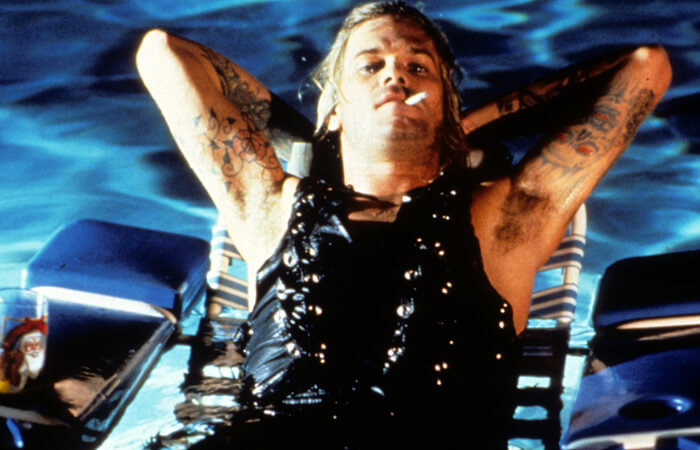
THE DECLINE OF WESTERN CIVILIZATION PART II: THE METAL YEARS courtesy BAM/Photofest
Indie 80s: Music
By Scout Tafoya
When Eszter Balint’s Eva arrives in New York at the start of Jim Jarmusch’s Stranger Than Paradise, she doesn’t pull out a map to look where she’s going. She produces a boom box and plays Screamin’ Jay Hawkins’s seminal soul hit “I Put A Spell On You.” This is her flashlight, her map, and her armor. By the time the film was released, music had exploded and imploded. There was now a band for everyone. Goth, no-wave, new wave, punk, post-punk, dinosaur rock, disco… the end of the 70s had brought them all out to fight and the resultant bloodbath had left everyone holding on to a little piece of music and staring into an uncertain future. Who knew what projectile would be launched now that an undead contract player had sauntered into the white house to finger the proverbial button? Music was what gave artists of every strata the spine to stand and deliver a message of profound ennui. In Blue Velvet (1986), the song of wraithlike chanteuse Isabelle Rosselini is the clue to a depraved mystery. In River’s Edge (1986), Crispin Glover’s metalhead tears around his hometown, trying to preserve his friend’s safetyand to maintain his vision of anti-suburban unity, Slayer and Fate’s Warning blasting tellingly from his car speakers. Music is both clue and talisman, keeping them awake and driven, keeping them strange.
“They can’t get real jobs ‘cause they don’t look right for real jobs,” says a club promoter in Penelope Spheeris’s The Decline of Western Civilization Part II: The Metal Years (1988). Metal is transformative, as witnessed in Spheeris’s documentary and its hilarious evil twin, Rob Reiner’s This Is Spinal Tap (1984). One can’t return to reality decked out in the costume of the hair metal fan. Regular people turn their back on the musician and her devoted worshippers so ad hoc societies must rise up around the beat. Subcultures of all kind can be found in documentaries, from the inextinguishable gospel choirs of Say Amen, Somebody (1982) to the punk rockers of My Degeneration (1989) to the West Coast headbangers in Decline, to the attendees of the Polka Masses of Les Blank’s In Heaven There Is No Beer? (1984) There’s a secrecy, a sense of much-needed retreat to these musical cliques; music has opened up another dimension where suburbia and normalcy can’t follow. Safety from safety. A ticket to hedonism bearing the engraving of the lyrics that give Blank’s documentary its title: In heaven there is no beer, that’s why we drink it here.
Many filmmakers used musicians the same way Eva uses that Screamin’ Jay Hawkins song: as a map to a world they don’t fit into. Jim Jarmusch us1985)es the inimitably cool artist/musician John Lurie as his surrogate in Stranger Than Paradise. Lydia Lunch of the no-wave bands Teenage Jesus and 8 Eyed Spy plays a private eye in the jagged and ragged Vortex (1982) Ditto outlaw country heartthrob Kris Kristofferson in the sublime Trouble In Mind (1985), whose romantic rival, greaser Keith Carradine, looks more and more like the mascot for The Cramps as he slides further into a life of crime. By cutting their own style to recall the well-worn clothes of noir heroes, counter-culture movie stars invite their subgenre’s audience into the more rarefied world of movie genre, and expand its boundaries with their own history as performers.
Hallmarks of DIY docufiction Wild Style (1983) and Blank Generation (1980) place their dreamers (playing thinly veiled versions of themselves) in the milieus from whence they came. Audiences everywhere could experience their lives as they were lived. These films normalized the endless search for a break in scenes filled with talented people, only a handful of whom could make it. Even success couldn’t always be trusted. The scars of fame are permanent and they mark the face of silky-voiced trumpeter Chet Baker in Bruce Weber’s near-perfect eulogy Let’s Get Lost (1988). Baker’s a ghost who walks upright, his legacy all but gone, music the only thing keeping the blood flowing through his veins. Weber’s black and white images interrogate every crag and wrinkle in his face for clues. At one point Weber asks Baker’s mother point blank: “Did he disappoint you as a son?” And the answer comes like water from a broken, gasping spit. “… yes. hmmhmm. Yes. But… let’s don’t go into that.” She didn’t ever know what it felt like, to have the armor of music protecting you from life or, for that matter, to feel it chip and splinter and reveal the human beneath. Let them drop the bomb. Nothing more can hurt now.